Vig Calculator: Juice, Hold and Overround of Any Bet
Free vig and hold calculator for sports betting. Enter every side of a market to see the sportsbook's overround, hold percentage and the break-even win rate.
A vig calculator measures how much margin a sportsbook has built into a market. Enter the American odds for every outcome (two to four) and it shows the overround (how far the implied probabilities exceed 100%), the hold (the share of the money wagered the book expects to keep on balanced action), and each outcome's implied probability. Lower vig means a cheaper market to bet into and a more reliable line to estimate fair odds from.
Vig and hold calculator
Add every outcome in a market to see its vig (overround) and hold.
This calculator needs JavaScript. Enable it to use the form below; the explanation above works without it.
Enter your numbers to see results.
The calculator is prefilled with an illustrative NFL point spread priced −115 / −105. Your inputs are saved in your browser only.
How to use the vig calculator
- Choose the number of outcomes: 2 for spreads, totals and most moneylines; 3 for a 60-minute hockey line or soccer; up to 4 for small futures markets such as an NFL division.
- Enter every outcome's American odds from one sportsbook. Leave nothing out: a missing outcome makes the market look cheaper than it is.
- Read the vig and hold. Compare across books and markets to see where your money goes furthest.
How vig and hold are calculated
Each price becomes an implied probability q = 1/decimal, using +A → 1 + A/100 and −A → 1 + 100/A.
Vig (overround) = Σq − 1
Hold = 1 − 1/Σq
Both measure the same margin from different angles. The vig is the excess of the implied probabilities over 100%. The hold is what the book keeps as a fraction of all money wagered when it has balanced action, meaning it pays out the same amount whichever outcome wins. Hold is always a little smaller than the vig. People use "vig", "juice" and "hold" loosely, so check which one a source means.
Worked example 1: the cost of −110
Both sides at −110 (decimal 1.9091):
- Implied: 52.38% + 52.38% = 104.76% → vig 4.76%
- Hold = 1 − 1/1.0476 = 4.55%
Check it with money. A book takes $1,100 on each side ($2,200 total). Whichever side wins, it pays $1,100 + $1,000 = $2,100 and keeps $100, which is 4.55% of the handle. That's the hold.
For you, it means a bettor with no edge (a true 50% chance) has EV = 0.5 × 1.9091 − 1 = −4.55% per bet, and you have to win 52.38% to break even.
Worked example 2: comparing markets
Illustrative prices:
| Market | Prices | Implied total | Vig | Hold |
|---|---|---|---|---|
| Sharp, low-margin line | −102 / −102 | 100.99% | 0.99% | 0.98% |
| Reduced juice | −105 / −105 | 102.44% | 2.44% | 2.38% |
| Standard spread | −110 / −110 | 104.76% | 4.76% | 4.55% |
| NFL spread | −115 / −105 | 104.71% | 4.71% | 4.50% |
| NHL 60-minute 3-way | +135 / +280 / +175 | 105.23% | 5.23% | 4.97% |
| NFL division futures (4 teams) | −200 / +250 / +600 / +2000 | 114.29% | 14.29% | 12.50% |
Volume makes the gap matter. A no-edge bettor placing 1,000 bets of $100 expects to lose about $4,545 at −110, $2,381 at −105 and $980 at −102. Same picks, very different bills. Notice too that the lopsided NFL spread has almost the same vig as −110 / −110: skewing the prices moves the margin between the sides, not necessarily its size.
Common vig-calculation mistakes
- Mixing books. The vig belongs to one book's market. Combining the best price on each side from different books tells you about line shopping (and possibly an arbitrage), not anyone's margin.
- Leaving out outcomes. A 3-way market without the draw, or a futures market with only the teams you like, understates the margin badly.
- Confusing vig with your edge. Low vig makes a market cheaper; it doesn't make a bet +EV. You still need a fair probability above the break-even rate.
- Assuming the vig is split evenly. On lopsided markets, books often load more margin onto the longshot. That's why the choice of devig method matters (see the no-vig calculator).
- Ignoring parlay compounding. Each leg's margin multiplies. Promotions such as odds boosts can offset that, but only sometimes.
How OddScouter uses vig
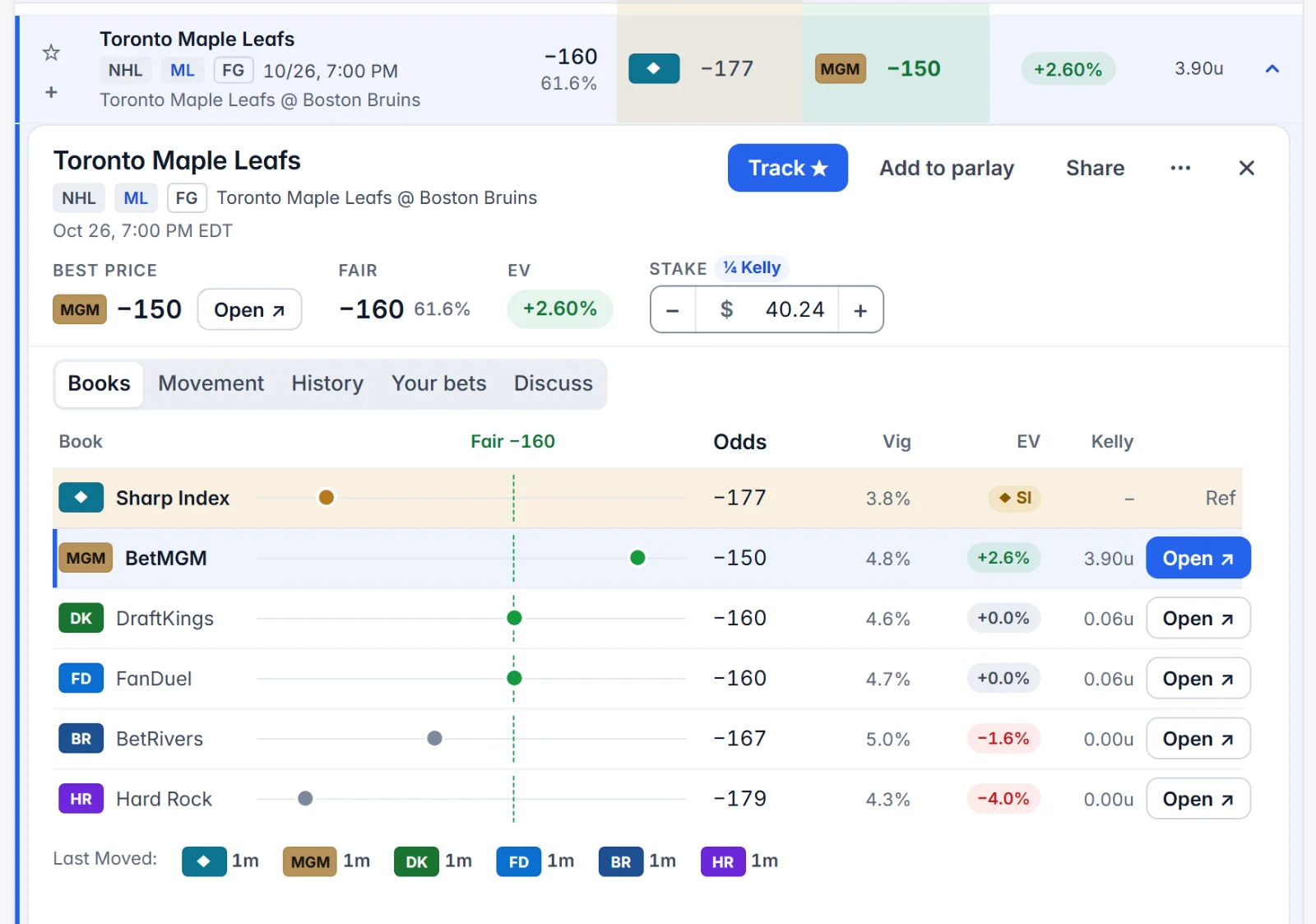
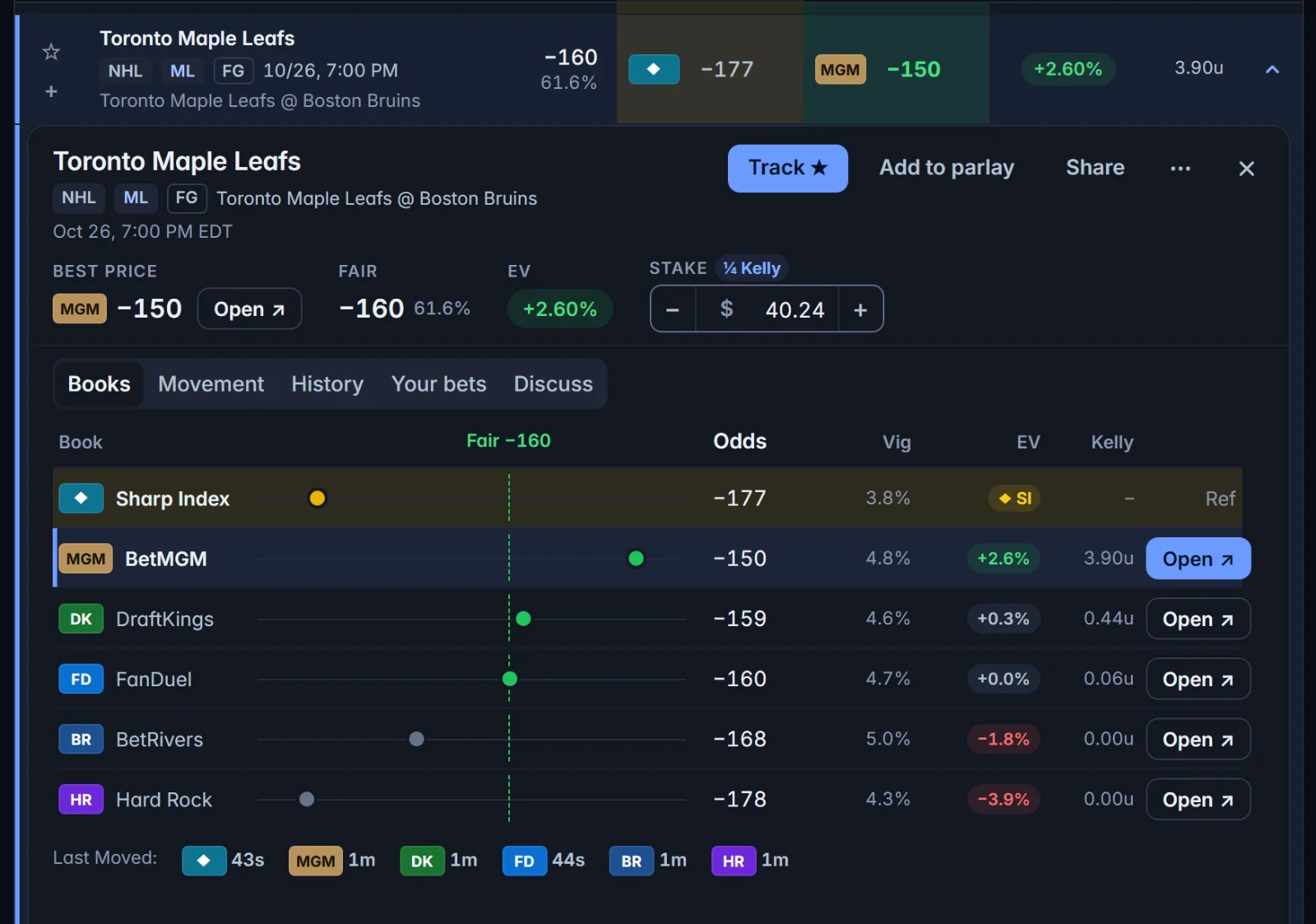
OddScouter measures the sharp market's vig on every bet on the +EV board and uses it to pick the reference: for player props the default "Lowest vig" setting devigs whichever of the Sharp Index and FanDuel prices that market with the tighter margin (game lines always use the Sharp Index), and it won't use a sharp market quoting more than 10% vig as a fair-price reference at all. Expand a bet and you'll see each book's price and vig side by side, so you can tell a genuinely good price from a high-margin market.
Learn the math behind this calculator
- How to devig odds: vig, overround and hold, and how to remove them.
- Implied probability in betting: why implied probabilities add up to more than 100%.
- Value betting: how to find positive EV bets: line shopping and the cost of a high-vig market.
- Parlay EV: how margin compounds across parlay legs.
Related free tools: no-vig fair odds calculator, betting EV calculator, odds converter.
Responsible gambling
Finding lower-vig markets reduces what betting costs you; it doesn't remove the risk of losing. No tool or method guarantees a profit. Only bet money you can afford to lose. You must be 21+ (or the legal age where you live). If gambling stops being fun, call or text 1-800-GAMBLER for free, confidential help.
Frequently asked questions
How do you calculate the vig on a bet?
Convert every side's odds to implied probability (1 ÷ decimal odds) and add them up. The amount over 100% is the vig, or overround. At −110 / −110, each side implies 52.38%, the total is 104.76%, so the vig is 4.76%.
What is the difference between vig and hold?
Vig (overround) is how far the implied probabilities exceed 100%. Hold is the share of the money wagered the sportsbook keeps if action is balanced so it pays the same whichever side wins: hold = 1 − 1 ÷ (sum of implied probabilities). At −110 / −110 the vig is 4.76% and the hold is 4.55%.
How much is the vig on −110?
A standard −110 / −110 line has 4.76% overround and 4.55% hold. A bettor with no edge loses about 4.55 cents per dollar staked on average, and needs to win 52.38% of bets to break even.
What is a good hold percentage for bettors?
Lower is better for the bettor. Sharp, low-margin books often deal major markets with 1% to 3% hold; standard US sides and totals at −110 hold about 4.5%; player props commonly hold 5% to 10%; and futures markets with many outcomes can hold 15% or more.
Why are futures and parlays so expensive?
Every outcome in a futures market carries some margin, so the total grows with the number of outcomes. Parlays multiply the margin of each leg, so a ticket's effective vig compounds as you add legs.
Related tools: Odds Converter and Implied Probability Calculator, No-Vig Calculator: Fair Odds by the Power Method.
OddScouter is an information tool, not a sportsbook, and nothing here is betting or financial advice. Positive expected value is not a promise of profit. You must be 21 or older. Gambling problem? Call 1-800-GAMBLER. Responsible gambling resources.