Arbitrage Betting: Stake Math, Examples and Real Risks
Arbitrage betting explained: how to spot a sports arb, calculate stakes for an equal payout, 2-way and 3-way examples, whether it's legal, and the real risks.
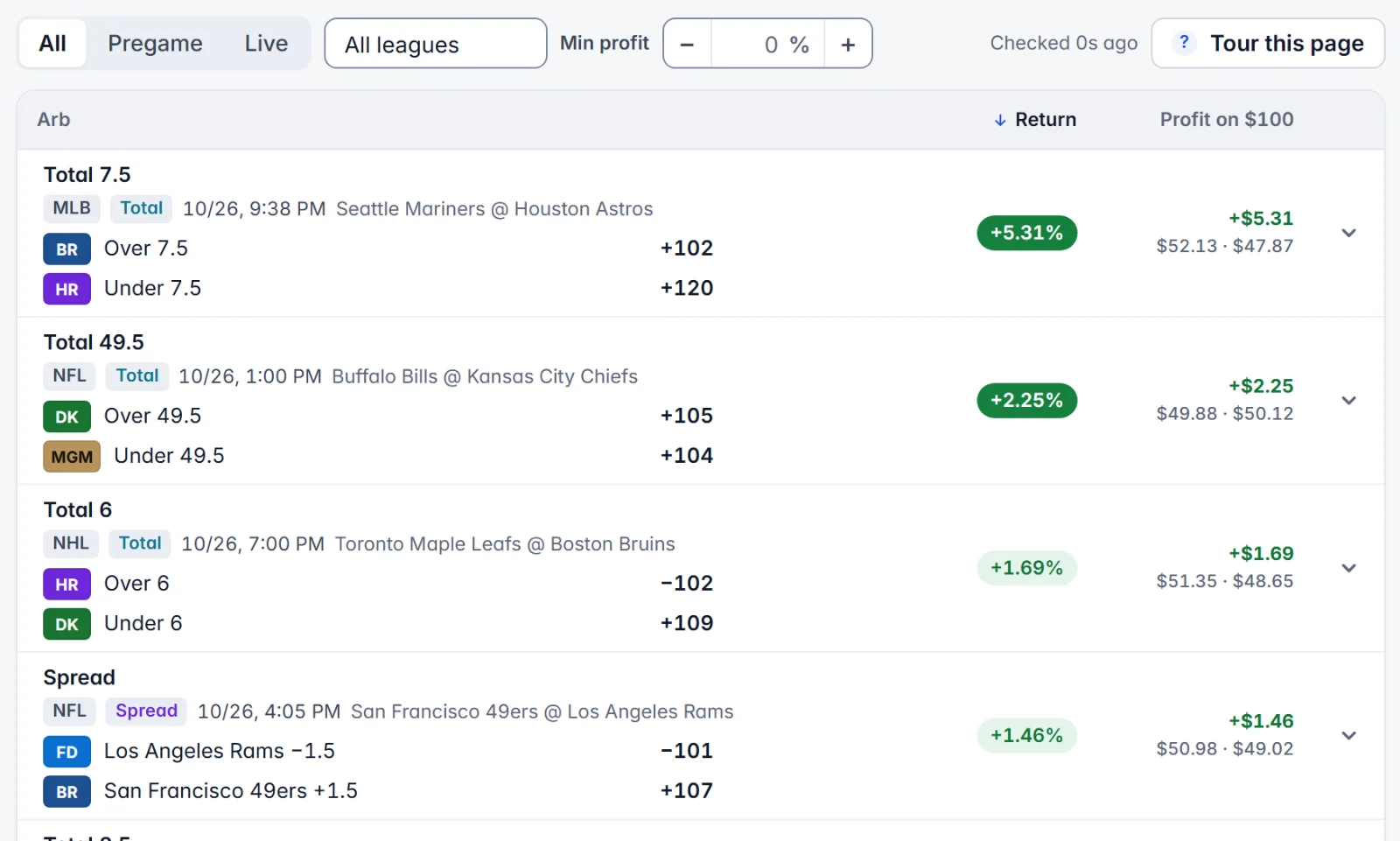
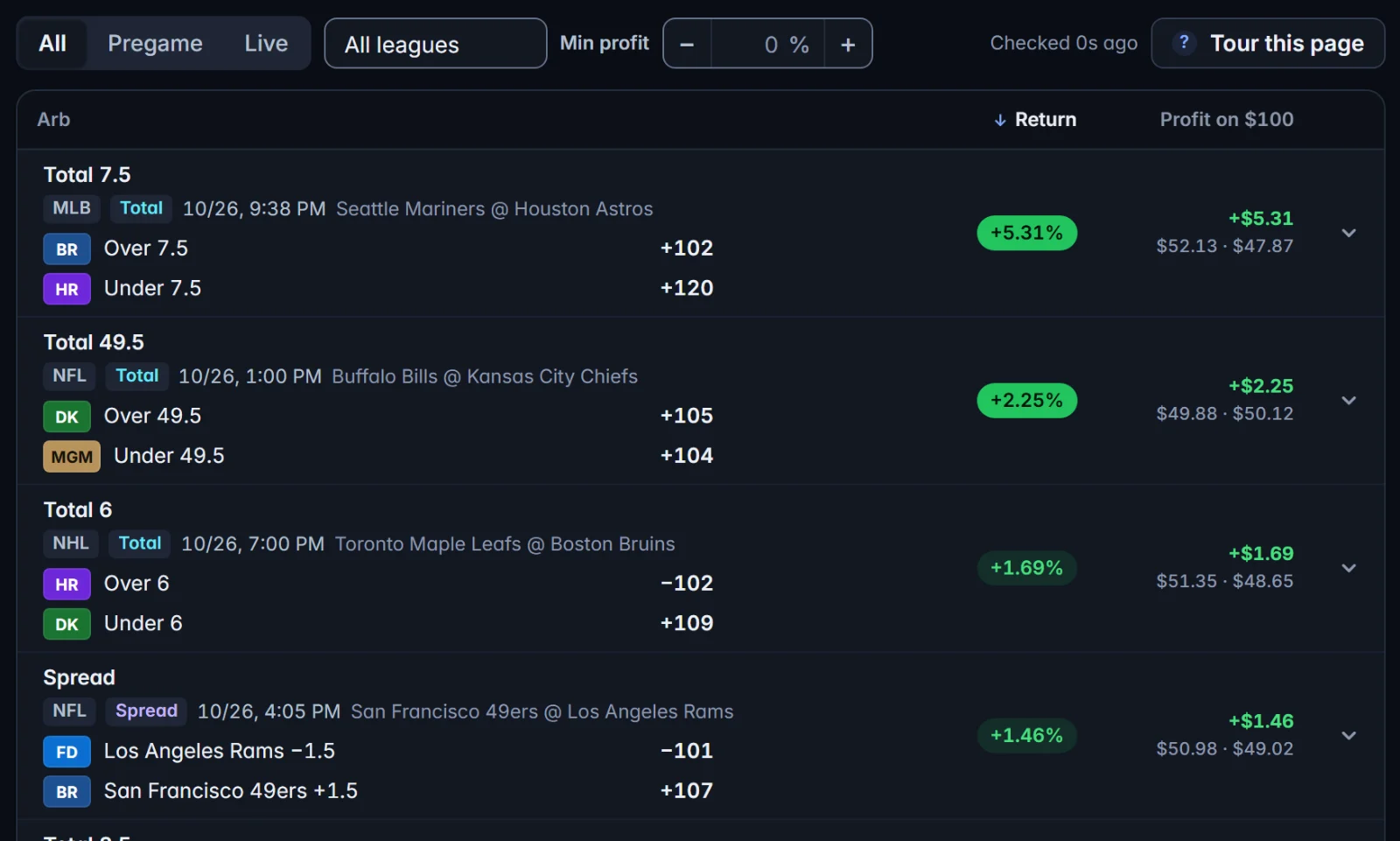
Arbitrage betting ("arbing") means backing every outcome of the same market at different sportsbooks, at prices good enough that you profit whichever side wins. It works when the best available prices' implied probabilities add up to less than 100%. Split your stake in proportion to each side's implied probability, and every outcome pays the same amount, which is more than you staked.
That's the theory. In practice arbs are small (usually around 0.5% to 3%), short-lived, and come with risks the formula doesn't show: voided bets, prices that move before your second bet lands, rule differences between books, and account limits. This guide covers the math first, then all of the ways it can go wrong.
How arbitrage betting works
Every price implies a probability. In decimal odds, it's 1 ÷ decimal (implied probability covers the conversions, and the free odds converter does them for you). A single sportsbook prices both sides of a market so the implied probabilities add up to more than 100%; the excess is its margin, the vig.
A standard −110 / −110 line:
- −110 = 1.909 decimal → 52.38% implied, on each side.
- Sum: 104.76%. Bet $50 on each side and you collect $95.45 whichever wins: −4.55%.
An arb flips that. If you take the best price for each outcome from different books, the sum can fall below 100%.
How to calculate an arbitrage bet
Call the sum of the best prices' implied probabilities S:
S = 1/d₁ + 1/d₂ + … + 1/dₙ
- S < 1 → arbitrage.
- Arb % = (1/S − 1) × 100, the return on your total stake if every leg is accepted and settled as placed.
- Stake on outcome i = Total × (1/dᵢ) ÷ S, which makes every outcome pay the same.
- Payout = Total ÷ S, whichever outcome wins.
The stake formula is the key. Each outcome receives a share of your money proportional to its implied probability, so the side at the shorter price receives more money and the payout comes out equal on every result.
Example: a two-way NFL arb
An illustrative Chiefs–Bills total of 48.5. Book A is slow to move its Over; Book B has its Under at a normal price:
| Outcome | Book | American | Decimal | Implied |
|---|---|---|---|---|
| Over 48.5 | Book A | +108 | 2.080 | 48.08% |
| Under 48.5 | Book B | −102 | 1.980 | 50.50% |
| Sum | 98.57% |
S = 0.9857, so this is an arb: 1/0.9857 − 1 = 1.45%.
On a $1,000 total stake:
- Over: $1,000 × 0.4808 ÷ 0.9857 = $487.73 at Book A.
- Under: $1,000 × 0.5050 ÷ 0.9857 = $512.27 at Book B.
- Either result pays $1,014.49: a profit of $14.49.
Books don't usually take $487.73 bets without attracting attention, so round: $488 and $512 still totals $1,000, and pays $1,015.04 if the Over hits or $1,013.96 if the Under does. Both outcomes still profit.
Starting from one leg's stake
If Book A will only take $250 on the Over, the total becomes stake × decimal × S = 250 × 2.08 × 0.9857 = $512.57, so you bet $262.57 on the Under, and either side pays $520.00 for a $7.43 profit.
Arbitrage calculator
Odds on every outcome at different books, and either your total stake or one leg's stake.
This calculator needs JavaScript. Enable it to use the form below; the explanation above works without it.
Enter your numbers to see results.
Example: a three-way NHL arb
Arbs aren't only two-way. Hockey's 60-minute (regulation-time) line has three outcomes: home win, away win, or a draw after 60 minutes. Three books, three best prices on an illustrative Rangers–Devils game:
| Outcome (60 min) | Book | American | Decimal | Implied |
|---|---|---|---|---|
| Rangers | Book A | +145 | 2.45 | 40.82% |
| Devils | Book B | +175 | 2.75 | 36.36% |
| Draw | Book C | +360 | 4.60 | 21.74% |
| Sum | 98.92% |
S = 0.9892, arb = 1.09%. On $1,000: $412.62 on the Rangers, $367.61 on the Devils and $219.77 on the draw, each paying $1,010.93. Rounded to whole dollars ($413 / $368 / $220, total $1,001), the worst case is still +$10.85.
Why arbitrage opportunities exist
If arbitrage is free money on paper, why do the prices line up that way? A few reasons, usually in combination:
- Stale lines. Sharp books move first on injury news, weather or sharp money. A recreational book that reprices every few minutes can sit on the old number in the meantime. Many arbs are one fresh price against one stale one.
- Genuine disagreement. Books set lines with different models and different customers. On props, alternate lines and lower-profile markets, they can sit a long way apart.
- Balancing exposure. A book that has taken a lot of money on one side may shade its price to attract the other side, briefly out of line with the market.
- Promotions and boosts. A boosted price can be good enough to arb against the regular price elsewhere (with the boost's own rules and stake caps; see profit boost strategy).
- Errors. Typos and feed glitches create the biggest "arbs" of all, and those are exactly the ones most likely to be voided.
Is arbitrage betting legal?
Placing bets at licensed sportsbooks is legal where sports betting is legal, and an arb is a combination of ordinary bets. What sportsbooks can do is limit how much you bet or close your account, and many look for the patterns arbing leaves: betting only stale lines, odd stake amounts, always taking the best price in the market. Legal is not the same as welcome.
Arbitrage betting risks: voids, line moves, rules and limits
The arb math only holds if every leg is accepted at the price you saw, settled under the same rules, and paid. Here is what breaks it.
1. The price moves before your second bet
Arbs close fast, often because one side was stale and is about to be corrected. Suppose you place the $487.73 Over at +108, and by the time you reach Book B the Under has moved from −102 to −112. The implied sum is now 100.91%: not an arb any more.
- To equalise the payouts you now need $535.96 on the Under: $1,023.69 staked for $1,014.49 back, a locked-in loss of −$9.20.
- Or bet the original $512.27 at −112 and accept an unequal result: +$14.49 if the Over wins, −$30.35 if the Under wins.
Bet the leg most likely to move first (the stale or the lower-limit one), and decide in advance what you'll do if the second price is gone.
2. Palpable errors and voided bets
Sportsbook terms let them void ("palp") bets placed at obviously wrong prices. If the voided leg was your arb's stale side, you're left holding the other leg as a plain straight bet: in the NFL example, $512.27 on an Under at −102, which wins $502.22 or loses $512.27. Close to a fair bet, but with full variance, and nothing like the locked-in $14.49 you planned. The bigger the arb, the more likely the price was a mistake.
3. Rule differences between books
Two books can settle the "same" bet differently:
- Ties on two-way moneylines. An NFL game that ends tied, or a part-game period (a first-half or first-period moneyline) that ends level, is usually graded as a push, but the rules differ by book and market.
- Player props. Most books void a prop if the player doesn't play, but the rules for a player who is active and leaves early, or for listed starters, vary.
- MLB listed pitchers. Some baseball bets are void if a listed starting pitcher is scratched; others have "action" regardless. An arb across two different pitcher rules isn't an arb if the starter changes.
- Weather-shortened games. MLB totals and run lines generally need a minimum number of innings to stand; the rule isn't identical everywhere.
- Overtime included or not, as in the hockey warning above, and similar distinctions in other sports.
4. Limits, account restrictions and timing
A limited account can't place the leg you need. Live arbs add speed: in-game prices are suspended and repriced between plays, so an arb can exist for seconds.
5. Money tied up, and taxes
Your total stake is locked until the event settles, across several sportsbook balances that all need funding. Returns of 1% per arb add up only with volume and capital. Keep records: sports betting winnings may be taxable, and tax treatment doesn't net your legs the way the arb math does.
Arbitrage vs value betting
An arb doesn't need a view on who wins. A value bet does: it backs one side at a price better than its fair probability and accepts that it will lose often, for a higher expected return per bet. In practice, the stale leg of most arbs is a value bet, and the other leg is insurance that costs you a little EV. Many sharp bettors prefer to bet only the +EV leg and manage the swings with Kelly staking. Arbs, by contrast, trade EV for certainty, but only as much certainty as the risks above allow.
How OddScouter's arbitrage tab finds and checks arbs
OddScouter scans the same odds it uses for the +EV board and looks for complete markets whose best prices across different books sum to less than 1. The rules are deliberately strict:
- Complementary sets only. A set is formed only from the full, mutually exclusive outcomes of one market at the same line: Over and Under at the same total, home and away at mirrored spreads, home and away on a two-way moneyline, home/away/draw on a three-way line (never mixed with a two-way one), or yes/no. One-sided markets, outrights and combinations are never paired.
- At least two books. Each outcome takes its best eligible price; if those best prices would all be at one book, the best combination that uses two or more books is taken instead, so a single-book "arb" is never shown.
- The Sharp Index is never a leg. It's the sharp reference for fair prices, not a place to bet.
- Freshness. Every leg's price must have been confirmed recently: by default within 120 seconds pregame and 20 seconds live. Locked, suspended or closed prices are excluded, and pregame arbs disappear once the game starts.
- Notes on the arb. A sharp line that has moved, two-way part-game lines where tie rules matter, and rounded stakes that turn one outcome negative show as notes when you open the arb.
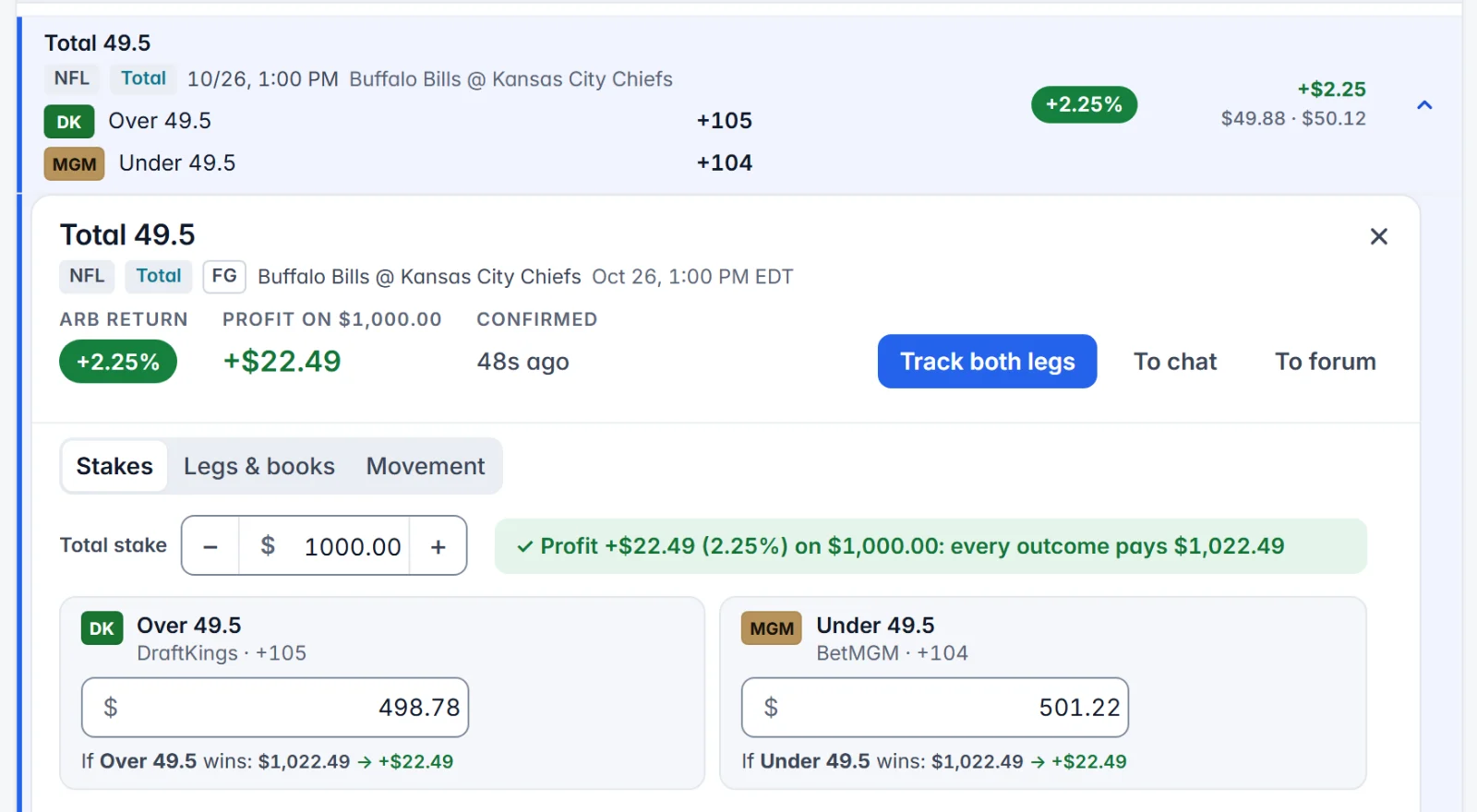
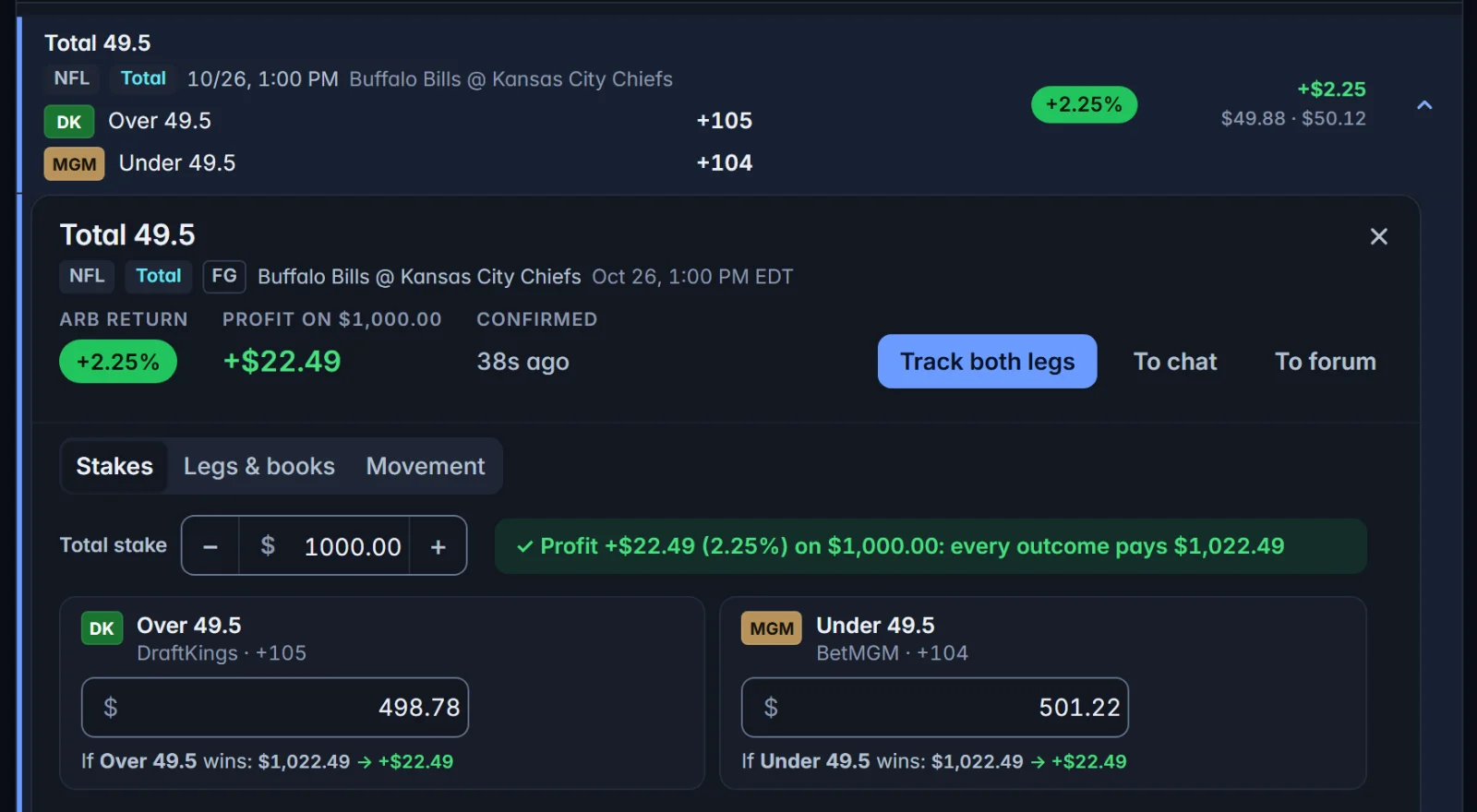
Opening an arb shows its linked stake calculator. Type a total and each leg's stake fills in so every outcome pays the same; type any one leg's stake (your limit at that book) and the rest fill in around it. A check line confirms the profit and what every outcome pays, and turns into a warning if the stakes leave one outcome losing money. The Legs & books tab shows each leg's price, its edge against fair, when it last moved and was confirmed, the other books' prices, and a link to the bet at the book; Movement charts each leg's line history. You can filter by pregame or live, league and minimum profit, and track every leg of an arb into your P&L at once.
Key takeaways
- An arb exists when Σ(1/decimal) across the best prices is below 1. Arb % = 1/S − 1; stake each outcome in proportion to 1/decimal.
- Real pregame arbs are usually small (around 0.5% to 3%). Big ones are often stale lines or errors.
- The margin is only locked in if every leg stands at the price you saw: watch for voids, line moves, rule differences and limits.
- Bet the most fragile leg first and have a plan if the second price moves.
- Arbs and value bets are related: the stale leg is usually the +EV one.
Related guides and calculators
- Implied probability in betting: the conversion every arb calculation starts from.
- How to devig odds: vig, overround and hold, the margin an arb beats.
- Value betting: how to find +EV bets: the alternative to locking in a small return.
- Profit boost strategy: boosts can create arbs, with their own rules.
- Free tools: odds converter, vig and hold calculator.
Responsible gambling
Arbitrage carries real risk: voids, line moves, rule differences and limits can all turn a planned profit into a loss. Only bet what you can afford to lose and set limits before you start. You must be 21+ (or the legal age where you live) to bet. If gambling stops being fun, call or text 1-800-GAMBLER for free, confidential help.
Examples are illustrative, not live prices or betting advice. Every number here can be reproduced with scripts/article_arbitrage.py.
Frequently asked questions
What is arbitrage betting?
Betting every outcome of one market at different sportsbooks, at prices whose implied probabilities add up to less than 100%, with stakes split so every outcome pays the same amount. If every bet stands as placed, you profit whichever side wins.
How do you calculate an arbitrage bet?
Convert each outcome's best price to decimal odds and add up 1 ÷ decimal for every outcome. If the sum S is below 1, it's an arb, the return if every leg stands is 1/S − 1, and each outcome's stake is total stake × (1/decimal) ÷ S.
Is arbitrage betting legal?
Placing bets at legal sportsbooks is legal where sports betting is legal, and arbitrage is a combination of ordinary bets. But sportsbooks are allowed to limit or close accounts, and many restrict bettors they identify as arbers.
Can an arbitrage bet lose money?
Yes. The math locks in a profit only if every leg is accepted and settled as placed. Voided 'palpable error' bets, prices moving before your second bet, different rules on ties, overtime or player scratches, and account limits all create real risk.
How much profit does an arbitrage bet make?
Most genuine pregame arbs are small, typically around 0.5% to 3% of the total staked. An arb much bigger than that is more likely a stale price or an error that may be voided than a windfall.
Why do arbitrage opportunities exist?
Sportsbooks set and move prices independently. One book is slow to react to news or a sharp line move, books disagree on a price, or a promotion pushes one price out of line, and for a short time the best prices across books add up to less than 100%.
Free calculators for this topic: Odds Converter and Implied Probability Calculator, No-Vig Calculator: Fair Odds by the Power Method, Vig Calculator: Juice, Hold and Overround of Any Bet.
OddScouter is an information tool, not a sportsbook, and nothing here is betting or financial advice. Positive expected value is not a promise of profit. You must be 21 or older. Gambling problem? Call 1-800-GAMBLER. Responsible gambling resources.