Profit Boost Strategy: Which Bets to Boost and Why
Profit boost strategy: how to value odds boosts and profit boosts with fair odds, why +150 to +400 bets usually gain the most, and how max-win caps change it.
A profit boost is worth the most on a bet around +150 to +400 that's already priced close to fair. A profit boost multiplies your winnings, and winnings are bigger relative to the stake at longer odds, so the same token adds more expected value there. Heavy favourites waste most of it, and very long shots tend to hit max-win caps and carry bigger margins. Any boost, odds boost or profit boost, is only worth what the boosted price pays above the bet's fair probability.
This guide shows how to value any boost with a fair price from a sharp book, the math behind the "modest longshot" rule, where it stops working, and how to use OddScouter to pick the leg.
Types of odds boosts
Sportsbooks offer three main kinds, and they're valued differently.
- Odds boosts (boosted prices). The book posts a specific bet at a better price: "Rangers to win,
+105+130." You can't choose the bet; you can only judge whether the new price beats fair. - Profit boosts. A token, usually a percentage (25%, 50%, 100%), that increases the winnings on a bet you choose, often with minimum odds, a maximum stake and sometimes a cap on the extra winnings.
- Parlay boosts. A profit boost restricted to parlays, often with a minimum number of legs or minimum odds per leg.
All three come down to the same question: does the boosted payout beat the true probability? That needs a fair probability, which is where devigging comes in.
How to calculate the value of an odds boost
For any bet, with fair probability p and decimal odds d, the expected value of a $1 stake is:
EV = p × d − 1
A boost changes d and nothing else. So:
- Value of an odds boost = p × (d_boosted − d_original) per $1 staked.
- Profit boost of x%: the boosted decimal is
d' = 1 + (d − 1)(1 + x). If there's a cap on the extra winnings, the extra is limited to that cap.
The fair probability p should come from a sharp, de-vigged line, not the boosting book's own price, which includes its margin. (How to devig odds explains how, the free no-vig fair odds calculator does it, and implied probability covers the conversions.)
Worked example: an NHL odds boost
A book boosts the Rangers moneyline from +105 to +130. A sharp book has the Rangers at +102 and the Bruins at −112.
- Sharp implied probabilities: +102 → 49.50%, −112 → 52.83%. Sum 102.34% (2.34% overround).
- Power devig: the Rangers' fair probability is 48.32%, fair odds +107.
- EV at the original +105: 0.48319 × 2.05 − 1 = −0.95%. A small −EV bet, as you'd expect from a normal price.
- EV at the boosted +130: 0.48319 × 2.30 − 1 = +11.13%.
- On a $25 maximum stake, the boost is worth 0.4832 × 25 × (2.30 − 2.05) = $3.02 of expected value, turning a −$0.24 bet into a +$2.78 one.
EV calculator
Expected value of a bet, given the true (fair) chance it wins.
This calculator needs JavaScript. Enable it to use the form below; the explanation above works without it.
Enter your numbers to see results.
The same check works on any bet with the free betting EV calculator.
What is the best bet to use a profit boost on?
The key result: for a profit boost of x% (no cap), the value added per $1 staked is:
x × p × (d − 1)
Since p × d = 1 + EV₀, where EV₀ is the bet's EV before the boost, that becomes:
Boost value per $1 = x × (1 + EV₀ − p)
Read it term by term:
- x: the boost percentage. Fixed by the token.
- 1 + EV₀: how close the price already is to fair. A better base price means more value.
- − p: the bet's win probability. The less likely the bet, the more of the boost you keep.
Why does p reduce the value? A profit boost adds to winnings, and the winnings of a 70% favourite are small relative to the stake: at −240 you win $41.67 per $100, so a 50% boost adds $20.83. At +300 you win $300 per $100, so the same boost adds $150. Even after accounting for the favourite winning more often, the longer price gains far more expected value from the boost.
The numbers: a 50% boost on $50, at every price
Assume every price is 4.5% worse than fair (about what a recreational book charges on a main line), so before the boost every bet is −4.5% EV, a $2.25 expected loss on $50.
| Original odds | Boosted to | Win probability | EV after boost | EV % | Share of the max possible boost value |
|---|---|---|---|---|---|
| −250 | −167 | 68.2% | $4.57 | +9.1% | 29% |
| −110 | +136 | 50.0% | $9.12 | +18.2% | 48% |
| +150 | +225 | 38.2% | $12.08 | +24.2% | 60% |
| +250 | +375 | 27.3% | $14.80 | +29.6% | 71% |
| +400 | +600 | 19.1% | $16.85 | +33.7% | 80% |
| +1000 | +1500 | 8.7% | $19.45 | +38.9% | 91% |
| +2000 | +3000 | 4.5% | $20.49 | +41.0% | 95% |
The same token is worth $4.57 on a −250 favourite and $16.85 on a +400 bet: nearly four times as much. The last column shows how much of the theoretical maximum ($23.88, the value as p approaches zero) you capture. By +400 you have 80% of it.
Where very long shots stop being better
Without a cap and with a constant margin, the formula keeps rising forever. Real promotions and real markets don't work like that, for three reasons.
1. Max-win caps. Suppose the same $50, 50% token has a $100 cap on the extra winnings. At +400 the extra winnings are 50 × 4 × 0.5 = $100, exactly the cap. Past that, the extra stays at $100 while the chance of collecting it keeps falling:
| Original odds | EV after boost, no cap | EV after boost, $100 cap |
|---|---|---|
| +300 | $15.66 | $15.66 |
| +400 | $16.85 | $16.85 (cap reached) |
| +600 | $18.21 | $11.39 |
| +1000 | $19.45 | $6.43 |
| +2000 | $20.49 | $2.30 |
The best price with a cap is the one where the extra winnings exactly reach the cap. For a boost of x on stake S with an extra-winnings cap C, that's where S × (d − 1) × x = C, so d − 1 = C ÷ (S × x). Here: 100 ÷ (50 × 0.5) = 4, which is +400. A cap on total winnings works the same way: find the odds where the boosted winnings exactly hit it.
2. Longshot markets carry more margin. Alternate lines, player milestones and other longshot markets often carry far more margin than a main line. If the margin rises from 4.5% at +150 to, say, 9% at +600 and 18% at +2000 (an illustrative assumption, but the direction is typical), the boosted EV peaks around +400 at about +30% and falls to +21% at +2000. A bad base price eats the boost.
3. Variance. A $50 boosted bet at +400 has a standard deviation of about $138; at +2000, about $323, and it wins less than 5% of the time. The EV is real, but if you receive one token a week, a longshot boost will usually pay nothing for months.
Put together, the sweet spot for most profit boosts is a modest longshot, roughly +150 to +400, priced close to fair, below any max-win cap.
Odds boost calculator
What a boosted price is worth against the fair chance of winning.
This calculator needs JavaScript. Enable it to use the form below; the explanation above works without it.
Enter your numbers to see results.
Parlay boosts
A parlay's winnings are large relative to its stake, so a profit boost on a parlay adds a lot of EV, for the same reason a longer single does. Take a three-leg parlay of ordinary −110 coin flips. It pays +596 against fair odds of +700: −13.03% EV.
| Parlay profit boost | Boosted price | EV |
|---|---|---|
| None | +596 | −13.03% |
| 20% | +715 | +1.87% |
| 30% | +775 | +9.32% |
| 50% | +894 | +24.21% |
The break-even boost for that parlay is about 17.5%. Build it from legs that are already +EV, like the three-leg parlay in parlay EV: are parlays worth it? (+779, +10.11% EV), and a 30% boost takes it to +1012 at +39.38% EV. The caveats from that article still apply: correlated same-game legs can't be priced by multiplying probabilities, and parlay variance is high. Parlay boosts also tend to have the strictest caps, so check them before choosing the legs.
How to choose the leg: a worked example
Say you have a 50% profit boost, $25 maximum stake, no other cap, at one book. You pull fair probabilities from a sharp line for a few bets that book offers (illustrative):
| Bet at the boosting book | Price | Fair probability | EV before | Boosted | EV after |
|---|---|---|---|---|---|
| MLB: Dodgers ML | −240 | 70.0% | −0.8% | −160 | +13.8% ($3.44) |
| NFL: Lions −6.5 | −110 | 51.0% | −2.6% | +136 | +20.6% ($5.14) |
| NFL: Bears ML | +175 | 35.5% | −2.4% | +262 | +28.7% ($7.17) |
| NHL: Kraken ML | +210 | 31.5% | −2.4% | +315 | +30.7% ($7.68) |
| NFL: Mahomes 2+ passing TDs | +320 | 22.5% | −5.5% | +480 | +30.5% ($7.62) |
| NFL: alt total Over 55.5 | +900 | 8.0% | −20.0% | +1350 | +16.0% ($4.00) |
The Dodgers are the closest to fair price before the boost, and the worst place to use it. The Kraken and the Mahomes milestone, both in the +150 to +400 range with modest margins, are best. The +900 alternate total has the biggest multiplier but carries so much margin that the boost mostly pays it back.
Using OddScouter to find the best leg to boost
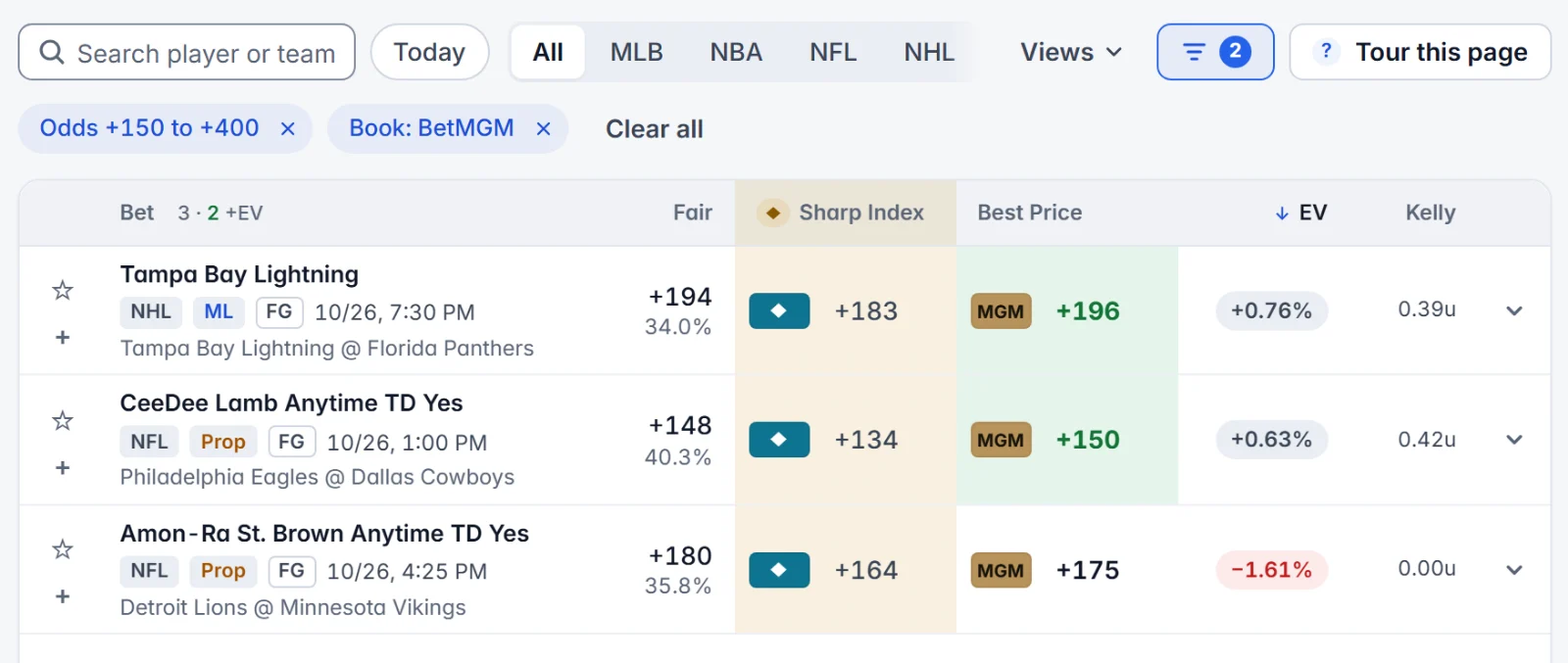
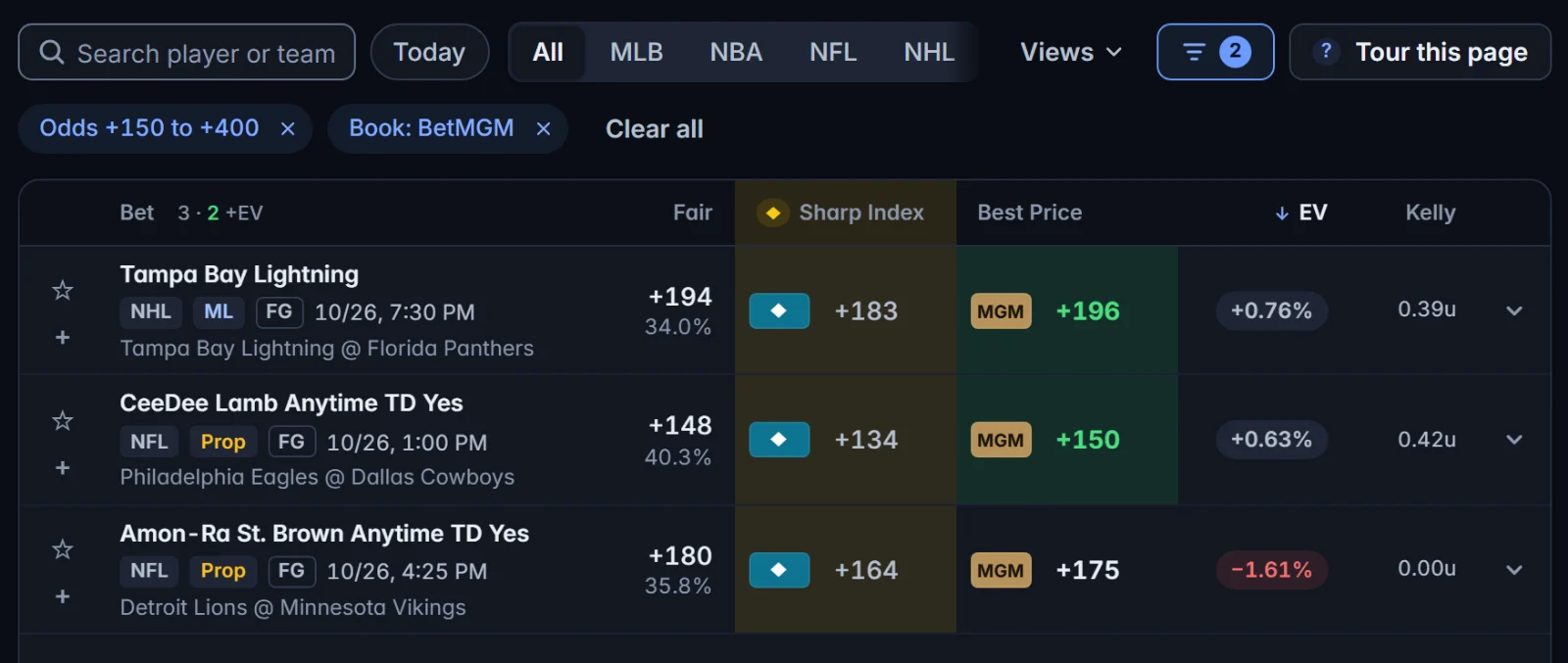
OddScouter doesn't track sportsbook promotions; it shows the two numbers you need to value one: a fair price for nearly every main-market and prop bet, and every book's price next to it.
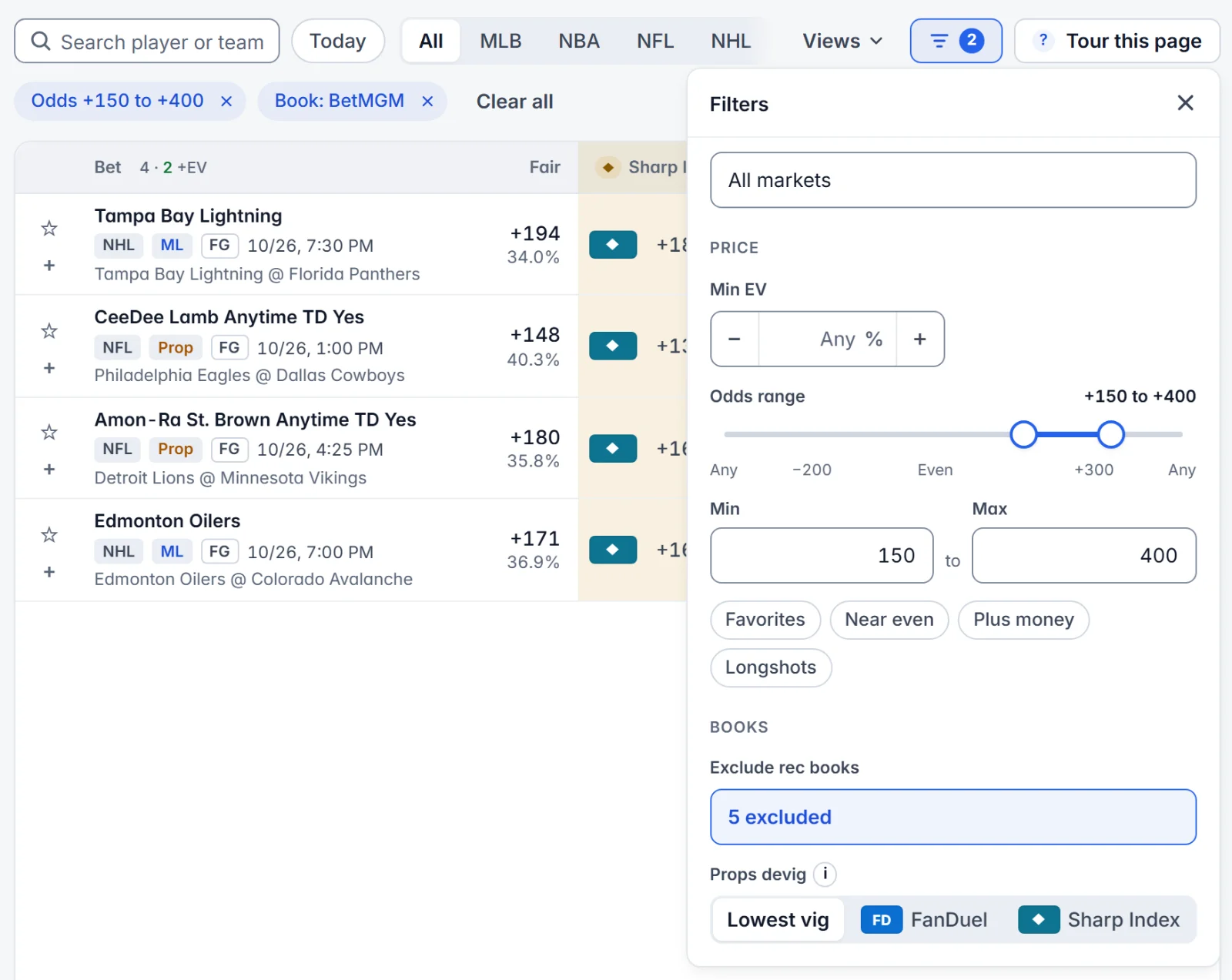
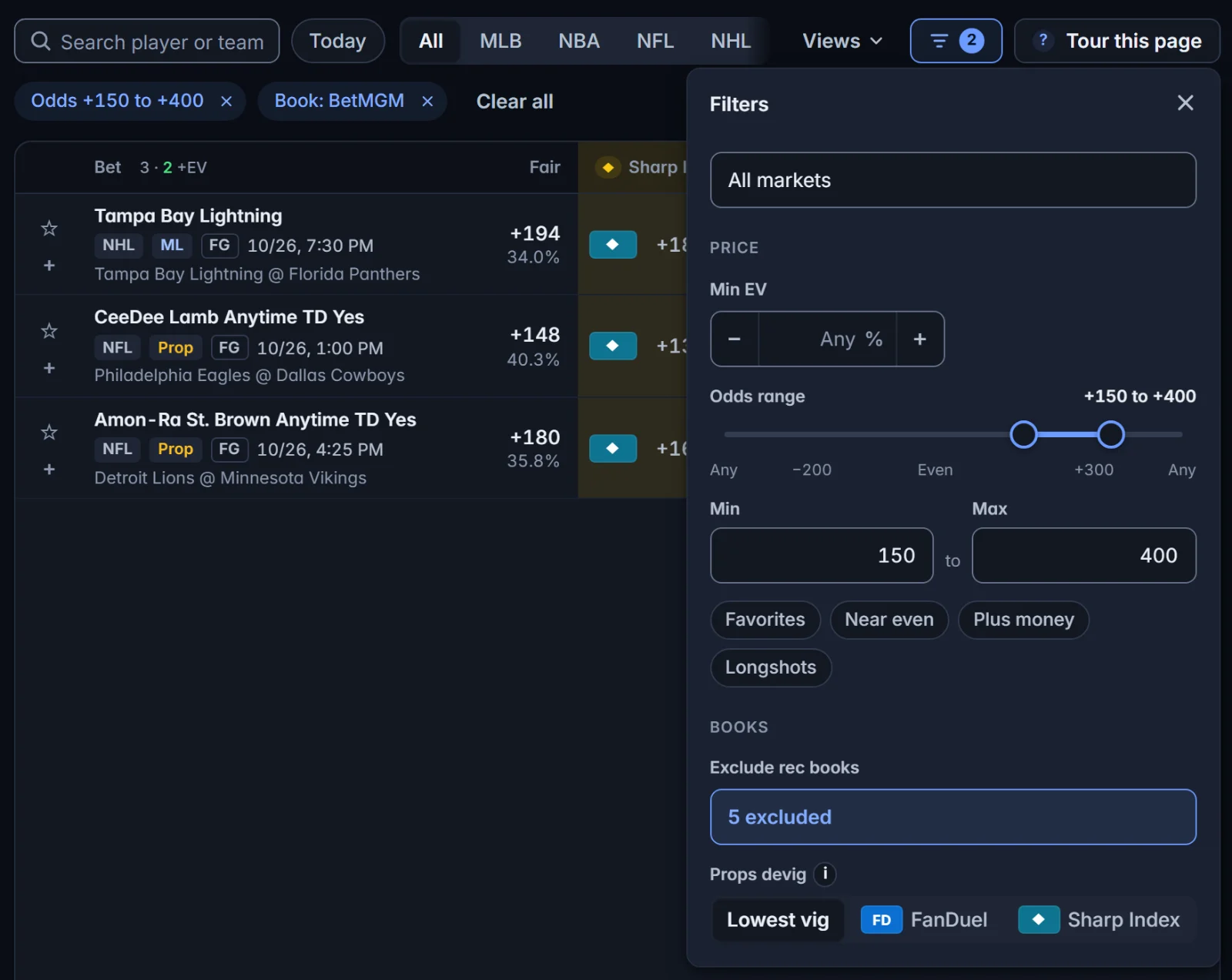
- Filter the +EV board to the boosting book. Pick it in the Book quick filter, or leave only that book in Exclude rec books in the Filters panel, so the best price and EV shown are that book's.
- Set the odds range. Under Odds range in the Filters panel, drag the slider or type a Min and Max (for example 150 and 400, or up to your cap's sweet spot).
- Sort by EV. Leave Min EV at Any, since before the boost the best candidates are often slightly negative. The bet with the highest EV in that range is the one closest to fair, and the boost adds the most on top of it.
- Check the fair odds in the row and the Sharp Index's vig in the expanded bet. A fair price from a low-vig sharp market is more trustworthy; one-sided markets have no fair price at all.
- Run the numbers in the boost calculator above with that bet's fair probability, and track the bet in your P&L at the boosted price you actually took.
Odds boost mistakes to avoid
- Boosting a heavy favourite because it "feels safe". It is the lowest-value use of a profit boost.
- Ignoring the cap. Past the cap, longer odds lose value fast.
- Trusting the book's own "was" price. Compare with a sharp fair price, not the boosting book's pre-boost odds.
- Boosting a bet with a huge margin. In the example above, the 50% boost made the −20% alternate total only +16%, but the −2.4% Kraken price +30.7%.
- Forgetting the rules. Minimum odds, eligible markets, stake limits, and what happens on a push or void (often the token is lost) differ by book.
Key takeaways
- A boost is worth p × (boosted decimal − original decimal) per $1. Without a fair p, you can't value it.
- A profit boost of x adds x × (1 + EV₀ − p) per $1: lower win probability and a price closer to fair both increase it.
- Best spot for most profit boosts: about +150 to +400, near fair, below any max-win cap.
- With an extra-winnings cap C, the best odds are where S × (d − 1) × x = C.
- Parlay boosts can turn ordinary parlays +EV, but variance is high and legs still need fair prices.
Related guides and calculators
- Value betting: how to find +EV bets: the same fair-line comparison, without a promotion.
- How to devig odds: the fair probability every boost is valued against.
- Parlay EV: are parlays worth it?: the math behind parlay boosts.
- Arbitrage betting: when a boosted price beats every other book.
- Free tools: betting EV calculator, no-vig fair odds calculator, odds converter.
Responsible gambling
Promotions have terms that vary by sportsbook; read them. A boosted bet can still lose, most longshot boosts pay nothing most of the time, and no strategy guarantees a profit. Only bet what you can afford to lose. You must be 21+ (or the legal age where you live) to bet. If gambling stops being fun, call or text 1-800-GAMBLER for free, confidential help.
Examples are illustrative, not live prices, promotions or betting advice. Every number here can be reproduced with scripts/article_boosts.py.
Frequently asked questions
What is the best bet to use a profit boost on?
Usually a bet between about +150 and +400 whose price is already close to fair. A profit boost multiplies your winnings, and winnings are larger relative to the stake at longer odds, so the boost adds more expected value. Heavy favourites waste most of it; very long shots often run into max-win caps and higher margins.
How do you calculate the value of an odds boost?
Find the bet's fair probability p, ideally from a de-vigged sharp line. EV per $1 = p × boosted decimal odds − 1. The boost's value is the difference between that and the EV at the original price: p × (boosted decimal − original decimal) per $1 staked.
How does a profit boost work?
A profit boost of x% increases the winnings portion of your payout by x%, not your stake. At +200 (3.00 decimal), a 50% profit boost pays +300 (4.00 decimal): $20 profit on $10 becomes $30. Many profit boosts cap the stake or the extra winnings.
Are odds boosts worth it?
Many are, and many aren't. A boost is only worth what it pays above the fair price. A boosted price that's still below fair odds is still a −EV bet, however big the boost looks, so compare every boost with a fair line before betting it.
Should I use a profit boost on a parlay?
A parlay's winnings are large relative to its stake, so a profit boost adds a lot of EV there too. A 30% boost turns a three-leg parlay of −110 coin flips from about −13% EV to about +9%. But the parlay's legs still need fair prices, and the result is high variance.
Should I use a profit boost on a favourite?
Rarely. A profit boost only multiplies winnings, and a heavy favourite's winnings are small. In our example a 50% boost on a $50 bet is worth $4.57 at −250 but $16.85 at +400, so the same token is worth almost four times as much on the modest longshot.
Free calculators for this topic: Betting EV Calculator: Expected Value of Any Bet, No-Vig Calculator: Fair Odds by the Power Method, Vig Calculator: Juice, Hold and Overround of Any Bet.
OddScouter is an information tool, not a sportsbook, and nothing here is betting or financial advice. Positive expected value is not a promise of profit. You must be 21 or older. Gambling problem? Call 1-800-GAMBLER. Responsible gambling resources.