No-Vig Calculator: Fair Odds by the Power Method
Free no-vig calculator: remove the vig from any 2-way or 3-way line and see fair probabilities and odds by the Power method, with other methods for comparison.
A no-vig fair odds calculator removes the sportsbook's margin (the vig) from a line so you can see the fair probability of each outcome and the fair odds that match it. Enter every side of one market from one sportsbook, two-way (moneyline, spread, total) or three-way (such as an NHL 60-minute line), and it shows the vig and the fair probabilities and odds by the Power method. Multiplicative, additive and Shin are listed underneath for comparison only. The Power numbers are what you compare against other books' prices to find +EV bets.
Devig calculator
Enter every outcome's price from one sportsbook to remove the vig four ways.
This calculator needs JavaScript. Enable it to use the form below; the explanation above works without it.
Enter your numbers to see results.
The calculator is prefilled with an illustrative MLB moneyline: Yankees −150, Red Sox +130. Your inputs and preferred method are saved in your browser only.
How to use the no-vig calculator
- Choose 2-way or 3-way, matching the market.
- Enter every outcome's American odds from the same sportsbook, ideally a sharp, low-vig one. Don't mix books: the margin you're removing belongs to one book's market.
- Read the vig: how much the implied probabilities exceed 100%.
- Read the fair odds. The headline result is the Power method's fair probability and odds for every outcome. The table below it shows what multiplicative, additive and Shin would say, so you can see how much the method matters on your market.
- Take a fair price to the EV calculator. Any book offering more than the fair odds on that outcome is +EV against that fair line. The expected value calculator does that step.
How devigging works
Each price becomes an implied probability q = 1/decimal. They add up to more than 1; the excess is the vig (overround): vig = Σq − 1. Every method turns the q values into fair probabilities p that sum to exactly 1:
| Method | Formula | What it assumes |
|---|---|---|
| Multiplicative (comparison) | p_i = q_i / Σq | Margin is spread in proportion to each side's probability |
| Additive (comparison) | p_i = q_i − (Σq − 1)/n | Every side carries the same number of points of margin |
| Power (the calculator's result) | p_i = q_i^k, with k chosen so Σ q_i^k = 1 | Longshots carry proportionally more margin than favourites |
| Shin (comparison) | p_i = (√(z² + 4(1 − z)·q_i²/Σq) − z) / (2(1 − z)), with z chosen so Σp_i = 1 | Margin partly protects the book against bettors with inside information |
The Power method in four steps. (1) Turn each price into its implied probability q. (2) Search for the exponent k that makes q₁^k + q₂^k (+ q₃^k) add up to exactly 1: the calculator does this by bisection on (0, 50], halving the interval 200 times, so k is accurate to far more digits than you will ever see. (3) The fair probability of each outcome is q_i^k. (4) Fair odds are 1 / p_i, converted back to American. Because k is above 1 when there is vig, small probabilities shrink by a larger share than big ones. The comparison methods use bisection for Shin's z on [0, 1). Two facts worth knowing: on a two-way market Shin gives the same answer as additive, and when both sides are priced the same (−110 / −110) every method gives 50% / 50%.
Worked example 1: an MLB moneyline
Yankees −150 / Red Sox +130 at a sharp book:
- Implied: 1/1.6667 = 60.00% and 1/2.30 = 43.48%; total 103.48%, so 3.48% vig
- Power: solving 0.6000^k + 0.4348^k = 1 gives k = 1.0530, so the fair probabilities are 0.6000^1.0530 = 58.40% (fair −140) and 0.4348^1.0530 = 41.60% (fair +140). The calculator's headline result is exactly this.
- Check on a balanced market: −110 / −110 gives k = 1.0719 and 50.00% / 50.00% (fair +100 each).
| Method | Yankees fair | Red Sox fair |
|---|---|---|
| Multiplicative | 57.98% (−138) | 42.02% (+138) |
| Additive | 58.26% (−140) | 41.74% (+140) |
| Power | 58.40% (−140) | 41.60% (+140) |
| Shin | 58.26% (−140) | 41.74% (+140) |
Now a recreational book offers Red Sox +145 (decimal 2.45). EV = p × 2.45 − 1, which is +1.92% against the Power fair line (the calculator's result) and +2.94% against multiplicative. At +140 the bet is +0.84% by multiplicative but −0.16% by power. The method decides whether a thin edge exists at all.
Worked example 2: a lopsided prop
An NFL touchdown-scorer style prop priced Yes +400 / No −600 (5.71% vig). The Power method solves for k = 1.1361, giving Yes 0.2000^1.1361 = 16.07% (fair +522) and No 83.93% (fair −522):
| Method | "Yes" fair probability | Fair odds | EV of +450 elsewhere |
|---|---|---|---|
| Multiplicative | 18.92% | +429 | +4.05% |
| Additive / Shin | 17.14% | +483 | −5.71% |
| Power | 16.07% | +522 | −11.64% |
Same market, a swing of almost 16 points of EV. Multiplicative assigns the longshot a large share of the fair probability; power and Shin assign it less, reflecting the well-documented favourite-longshot bias, where longshots tend to be overpriced. That's why this calculator, like OddScouter itself, uses the Power method for its headline result, especially for props and longshots. It's a judgement backed by evidence, not a law: the vig and devig guide compares the methods in depth.
Common devig mistakes
- Mixing books. Taking the over from one book and the under from another doesn't give you either book's margin. (If the two prices sum to less than 100%, that's an arbitrage, not a market to devig.)
- Devigging a one-sided market. A prop with only a "Yes" price has no vig to measure; you can't devig it reliably.
- Leaving out an outcome. A three-way market (home / draw / away) must include all three prices.
- Using a high-vig market as the reference. The more margin there is to remove, the more the method choice changes the answer. A 10% hold market is a weak fair-line source whatever method you use.
- Comparing different lines. The fair probability of Over 8.5 runs says nothing directly about Over 9.
How OddScouter devigs automatically
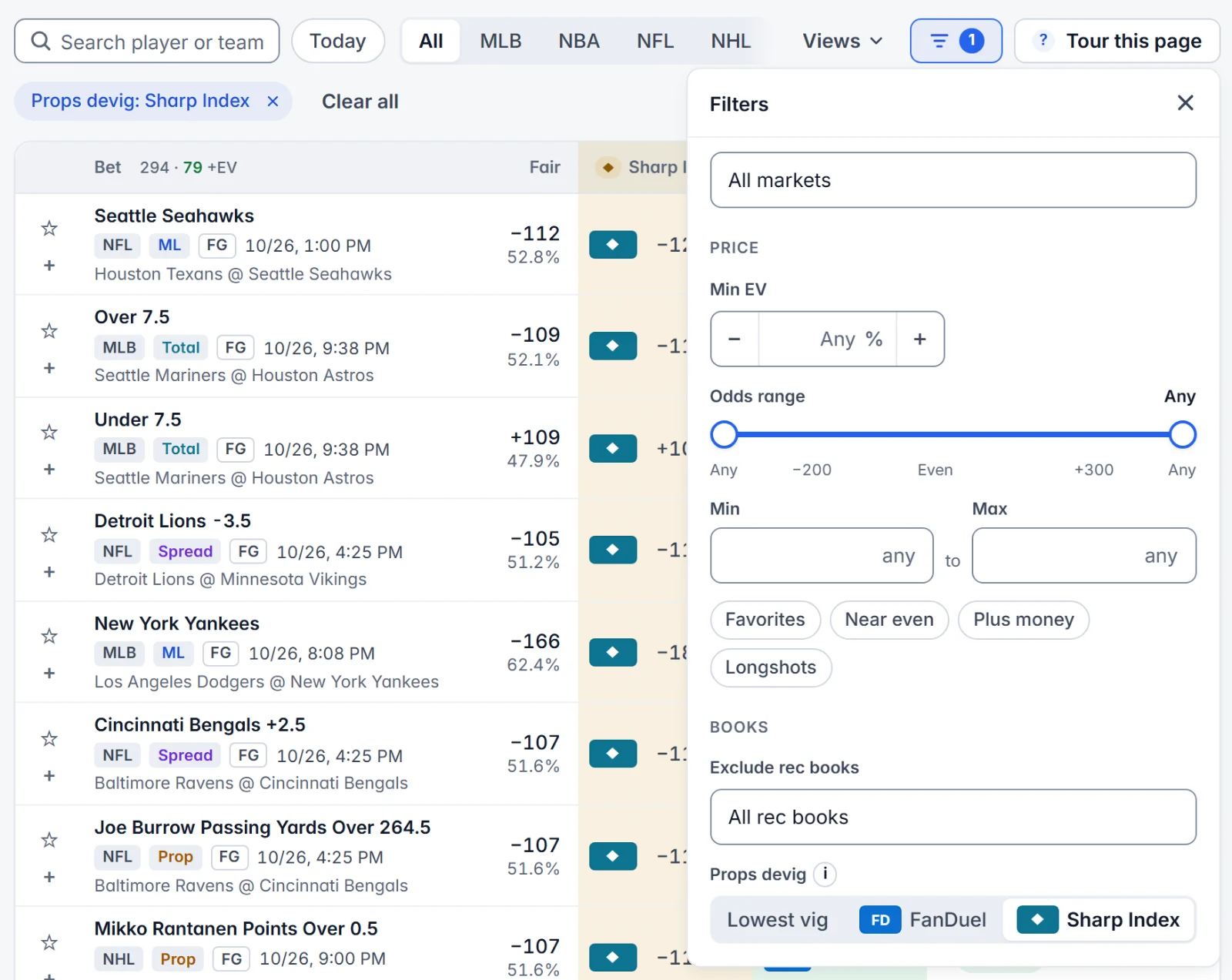
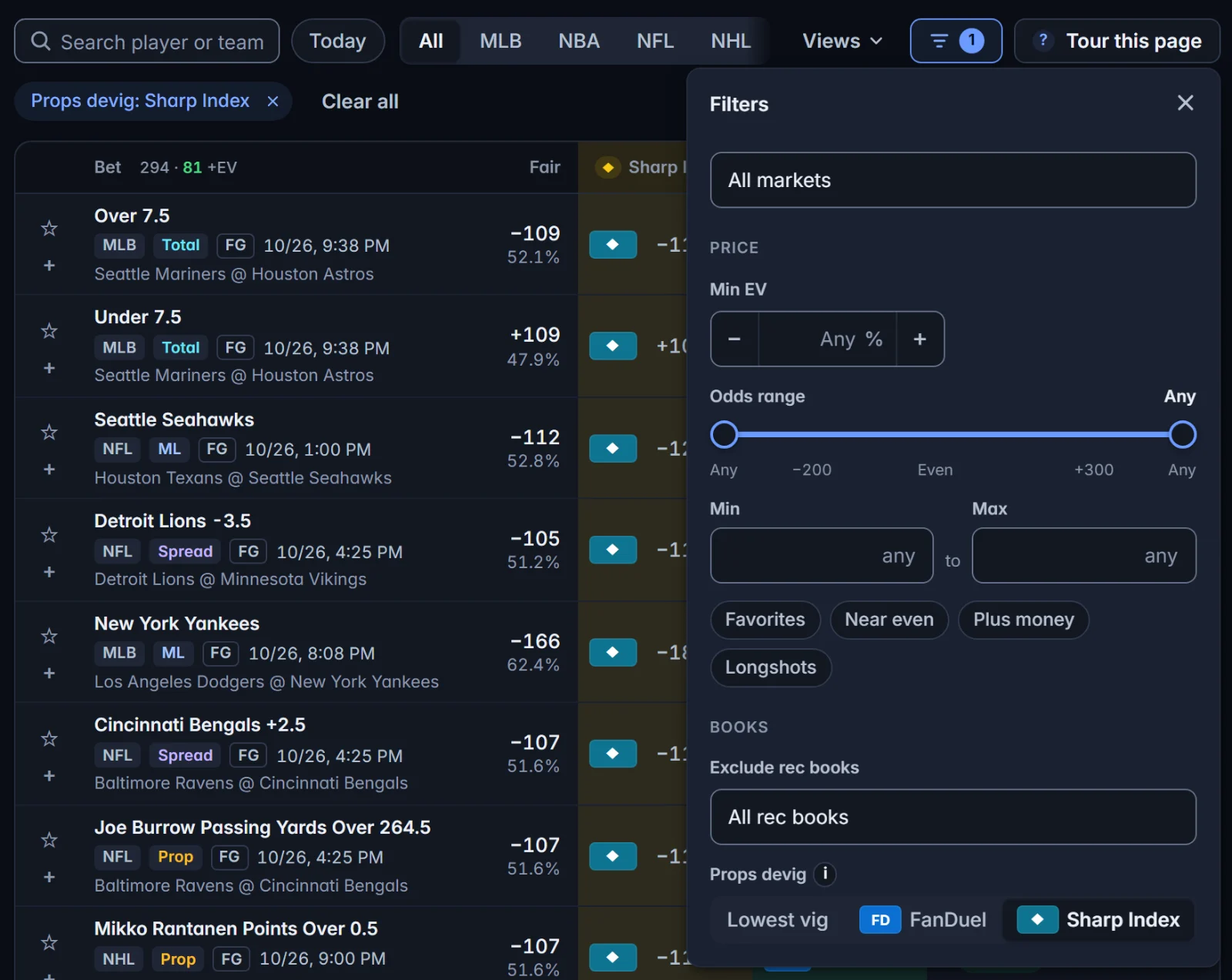
OddScouter uses the power method for every fair price it shows. It devigs the full two-sided sharp market (the Sharp Index, the no-vig fair price from the world's sharpest market makers (Pinnacle, SBOBet and the Betdaq, Matchbook and Smarkets exchanges), combined into one line: the best price any of them offers on each side, with the margin removed, for game lines; the Sharp Index or FanDuel for player props, your choice, or whichever has the lower vig on that market), skips one-sided markets rather than guessing, and won't trust a sharp market quoting more than 10% vig as a reference. Every rec-book price on the board is graded against that fair line.
Learn the math behind this calculator
- How to devig odds: the four devig methods compared, and the evidence for the Power method.
- Value betting: how to find positive EV bets: what to do with a fair line once you have it.
- Implied probability in betting: the conversions every devig starts from.
- Arbitrage betting: when prices across books add up to less than 100%.
Related free tools: vig calculator, betting EV calculator, odds converter.
Responsible gambling
A fair line is an estimate, not a certainty, and the right devig method can still be wrong for a given market. No calculation guarantees a profit, and books may limit winning accounts. Only bet what you can afford to lose. You must be 21+ (or the legal age where you live). If gambling stops being fun, call or text 1-800-GAMBLER for free, confidential help.
Frequently asked questions
How do you calculate no-vig fair odds?
Convert each side's odds to implied probability (1 ÷ decimal odds), then remove the vig so they add up to 100%. This calculator uses the Power method: it finds the exponent k so that q₁^k + q₂^k = 1. At −150 / +130 the implied 60.00% and 43.48% sum to 103.48%, k comes out at 1.0530, and the fair probabilities are 58.40% (−140) and 41.60% (+140).
How do I use no-vig odds to find +EV bets?
Devig a sharp book's market, then compare its fair odds with other books' prices on the same line. Any price longer than the fair odds is +EV by that method. If the power method makes the Red Sox a fair +140, a +145 price elsewhere is about +1.9% EV.
Why does the calculator use the Power method?
The Power method assigns longshots a smaller share of the fair probability than a simple proportional rescale does, which matches the favourite-longshot bias seen in real betting markets. On an even market such as −110 / −110 every method agrees at 50% / 50%; on a lopsided one the choice matters, and Power is the more cautious (less generous to the longshot).
What is the difference between multiplicative and additive devig?
Multiplicative scales every side's implied probability by the same factor, so each side gives up vig in proportion to its size. Additive subtracts the same number of percentage points from every side. On a lopsided market, additive leaves the favourite with a higher fair probability than multiplicative does.
Why are the Shin and additive results the same on my two-way market?
For markets with exactly two outcomes, Shin's method gives the same fair probabilities as the additive method. The two only differ on markets with three or more outcomes, such as a 60-minute hockey 3-way or a futures market.
Should I devig the sportsbook I'm betting at?
Devig a sharp, low-margin book to estimate the true probability, then compare that with the price at the book you want to bet. Devigging a recreational book only tells you that book's own opinion with its margin removed, which is not an independent fair line.
Related tools: Betting EV Calculator: Expected Value of Any Bet, Vig Calculator: Juice, Hold and Overround of Any Bet.
OddScouter is an information tool, not a sportsbook, and nothing here is betting or financial advice. Positive expected value is not a promise of profit. You must be 21 or older. Gambling problem? Call 1-800-GAMBLER. Responsible gambling resources.