Betting EV Calculator: Expected Value of Any Bet
Free betting expected value calculator: enter your odds and a fair probability, fair odds or both sides of a sharp line for EV % and expected profit per bet.
A betting expected value (EV) calculator tells you how much a bet is worth on average: the profit you'd expect per dollar staked if you could place the same bet thousands of times. Enter the odds on offer and the bet's true win probability (as a percentage, as fair odds, or as both sides of a sharp market to devig) and it returns EV as a percentage and in dollars for your stake. Positive EV (+EV) means the price pays more than the risk is worth; negative EV means it pays less.
EV calculator
Expected value of a bet, given the true (fair) chance it wins.
This calculator needs JavaScript. Enable it to use the form below; the explanation above works without it.
Enter your numbers to see results.
The calculator is prefilled with an illustrative NFL example: a recreational book offers the Bills at +120, while a sharp book deals +105 / −125 on the same game. Your inputs are saved in your browser only.
How to use the EV calculator
- Enter your odds: the American price you can actually bet, for example
+120. - Choose where your fair probability comes from:
- A fair probability I have: type it in percent (e.g.
47). - Fair odds: type a no-vig price (e.g.
+115). - Both sides of a sharp market: type the sharp book's price for your side and the other side, and pick a devig method. Power is the default.
- A fair probability I have: type it in percent (e.g.
- Enter your stake to see the expected profit in dollars.
- Read the result. Above zero is +EV. Compare it with the minimum edge you're willing to bet (many bettors start at +2% on main markets).
How the EV formula works
The calculator converts your odds to decimal (+A → 1 + A/100, −A → 1 + 100/A) and applies:
EV per $1 = p × (decimal − 1) − (1 − p)
EV % = EV per $1 × 100
where p is the fair win probability. The first term is what you win times how often you win; the second is what you lose times how often you lose. It simplifies to EV = p × decimal − 1.
The break-even probability is 1/decimal. If your fair probability is above it, the bet is +EV.
When you enter both sides of a sharp market, the calculator first removes the vig: it converts each price to an implied probability, then rescales them to sum to 100% with the method you choose (multiplicative, additive, power or Shin; see the no-vig calculator for how each works).
Worked example 1: a fair probability you already have
Celtics +120, fair probability 47%, $50 stake:
- Decimal = 1 + 120/100 = 2.20; break-even = 1/2.20 = 45.45%
- EV = 0.47 × 1.20 − 0.53 = +0.034 per $1, or +3.40%
- On $50: win +$60.00 (47% of the time), lose −$50.00 (53%), so expected profit = $1.70
Worked example 2: devigging a sharp market first
Same +120 at the rec book. The sharp book deals Celtics +105 and the opponent −125:
- Implied probabilities: 1/2.05 = 48.78% and 1/1.80 = 55.56%, a total of 104.34% (4.34% vig)
- Power devig: Celtics fair probability 46.54% (fair odds about +115) → EV at +120 = +2.39%
- Multiplicative devig: 46.75% (about +114) → EV = +2.86%
The method matters at the margin: here it changes the edge by about half a point. Using the raw 48.78% without devigging would show +7.32%, roughly three times too high, which is the most common EV mistake there is.
Common EV mistakes
- Not removing the vig. A sharp book's raw implied probability includes its margin. Always devig before comparing.
- Using a soft book as the fair line. A recreational book's price with the vig removed is still a recreational book's opinion.
- Comparing different markets. Over 4.5 shots isn't Over 3.5, a first-half line isn't a full-game line, and books settle some props differently (overtime, player not starting). Confirm your price and the sharp price describe the same bet.
- Trusting huge edges. A +15% edge on a main market usually means a stale line, a misread market or an error the book may void as a palpable mistake.
- Judging EV by results. A +EV bet that loses was still a good bet. Track closing line value (CLV) and judge your process over hundreds of bets, not a weekend.
- Forgetting stake size. A +EV bet sized too large can still hurt you. The Kelly calculator turns EV into a stake.
How OddScouter calculates EV for you
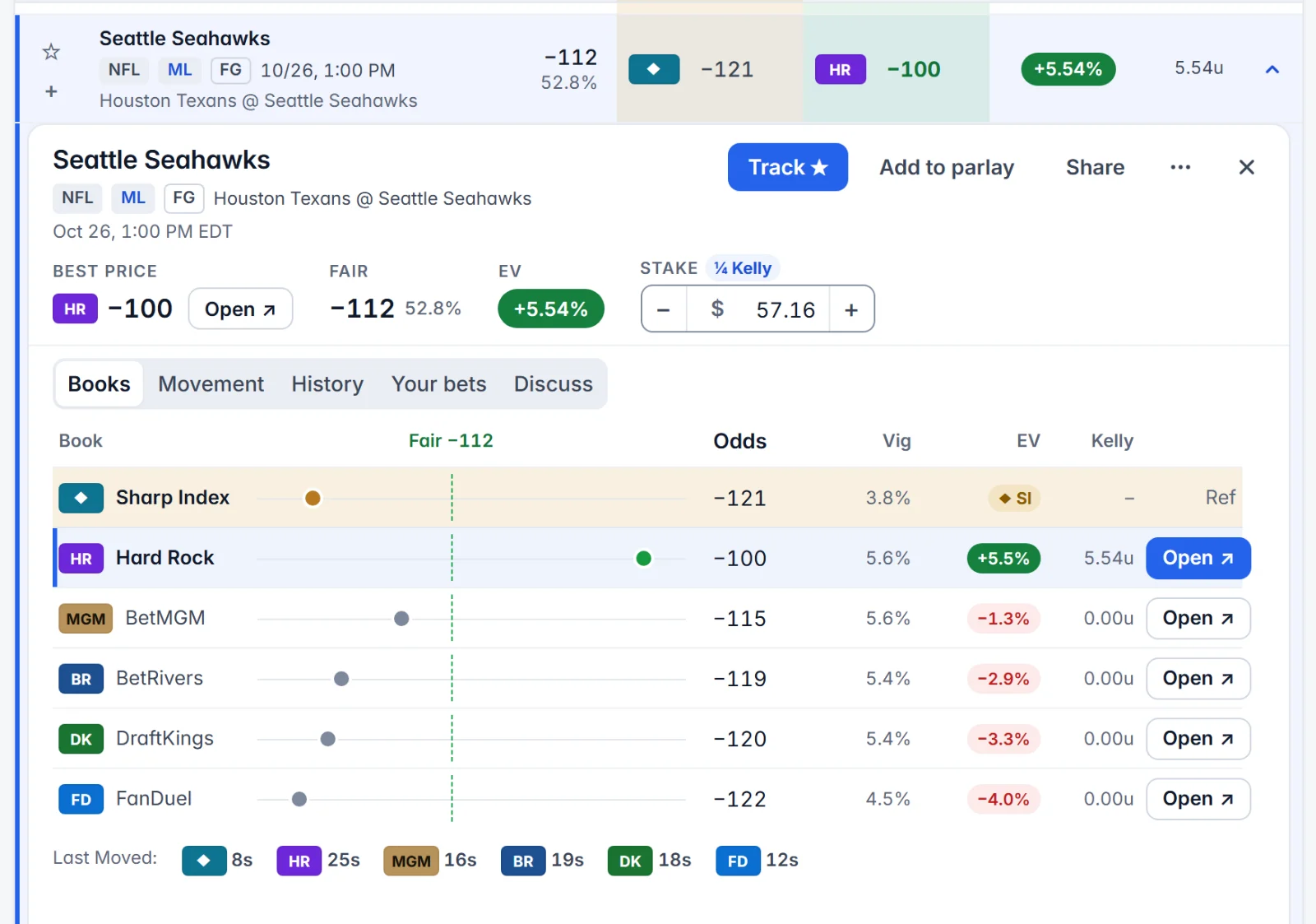
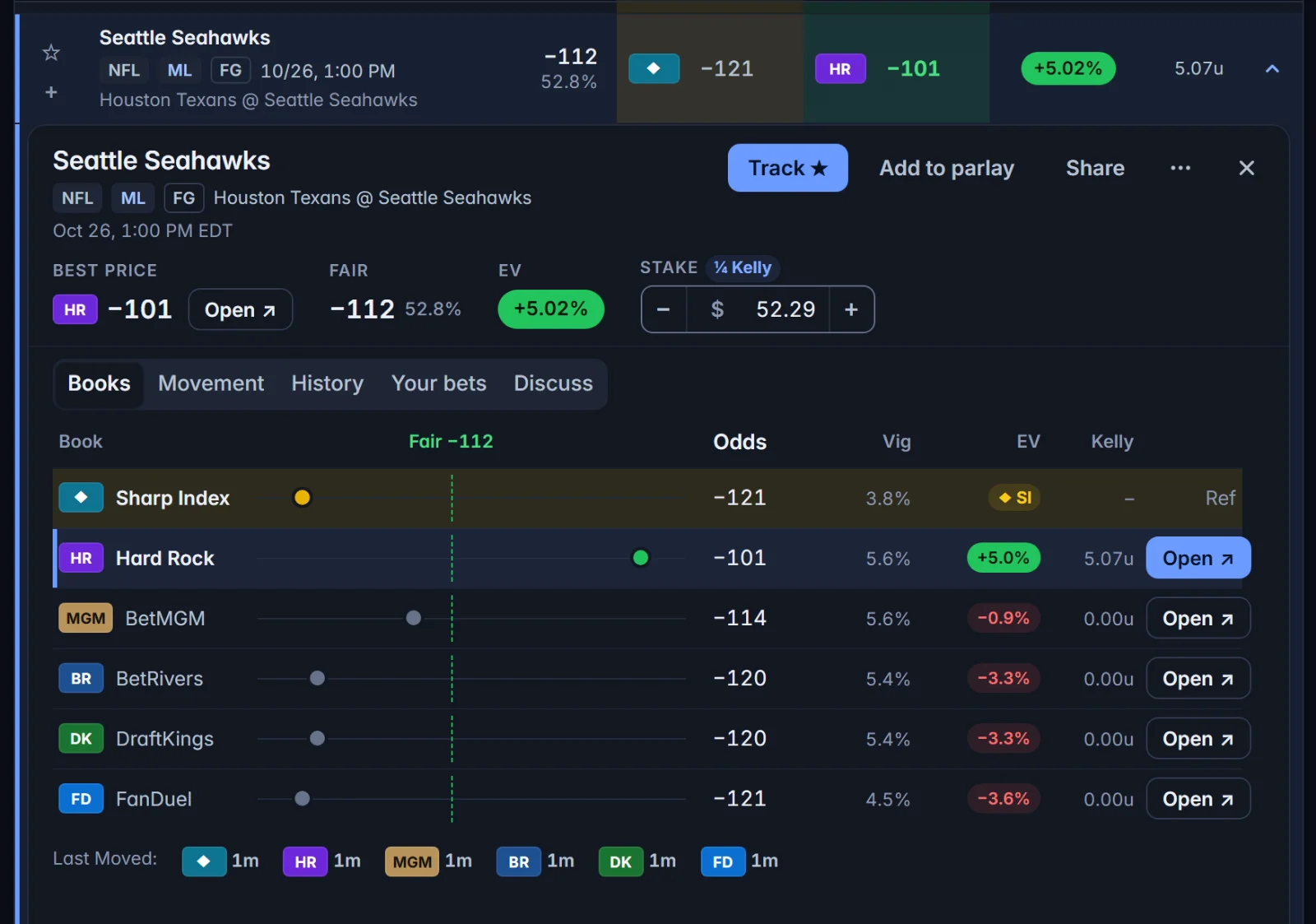
Running this calculator for every price at every book isn't practical by hand. OddScouter does it continuously: it devigs the sharp market with the power method, grades every sportsbook's price for the same line against that fair probability, and lists bets by EV, with the best price, fair odds and Kelly stake on one row. The value betting guide walks through the full workflow.
Learn the math behind this calculator
- Value betting: how to find positive EV bets: the full +EV workflow this calculator is one step of.
- How to devig odds: where the fair probability comes from, and why the method matters.
- Implied probability in betting: break-even win rates and why results are noisy.
- Profit boost strategy: using EV to pick the best bet for a boost.
Related free tools: no-vig fair odds calculator, Kelly criterion calculator, odds converter, vig calculator.
Responsible gambling
Expected value describes the long-run average, not the next result. +EV bets lose often, fair-probability estimates can be wrong, and sportsbooks may limit accounts that win consistently. Nothing here guarantees a profit. Only bet money you can afford to lose. You must be 21+ (or the legal age where you live). If gambling stops being fun, call or text 1-800-GAMBLER for free, confidential help.
Frequently asked questions
How do you calculate expected value in sports betting?
EV per $1 = p × (decimal odds − 1) − (1 − p), where p is the true win probability. At +120 (decimal 2.20) with a 47% fair probability, EV = 0.47 × 1.20 − 0.53 = +0.034, so +3.4%, or $3.40 of expected profit per $100 staked.
What is a good EV percentage in sports betting?
On main markets such as NFL spreads or MLB totals, +1% to +3% is a realistic, sustainable edge. Player props often show +3% to +8%, but with more uncertainty in the fair line. Edges above about 10% are rare and often signal a stale line, a rule difference or a pricing error that may be voided.
Does a +EV bet mean I will win?
No. EV is the average result over many identical bets. A +3.4% bet at +120 still loses about 53% of the time. Profit from +EV betting shows up only over hundreds of bets, and losing stretches along the way are normal.
Where does the fair probability come from?
Usually from a sharp sportsbook's line with the vig removed. Sharp books take large wagers from professional bettors and adjust quickly, so their devigged price is a strong, though not perfect, estimate of the true probability.
What is the difference between EV and ROI?
EV is what a bet is expected to earn before it settles; ROI is what your bets actually earned afterwards, as profit divided by total staked. Over a large sample, ROI should drift towards your average EV, but over short runs the two can differ a lot because of variance.
Related tools: Kelly Criterion Calculator: Optimal Bet Size for Sports, No-Vig Calculator: Fair Odds by the Power Method.
OddScouter is an information tool, not a sportsbook, and nothing here is betting or financial advice. Positive expected value is not a promise of profit. You must be 21 or older. Gambling problem? Call 1-800-GAMBLER. Responsible gambling resources.