Kelly Criterion in Sports Betting: Formula and Examples
The Kelly criterion sizes bets for maximum long-run bankroll growth. The formula with NFL, NHL and MLB examples, its history, and why bettors use ½ or ¼ Kelly.
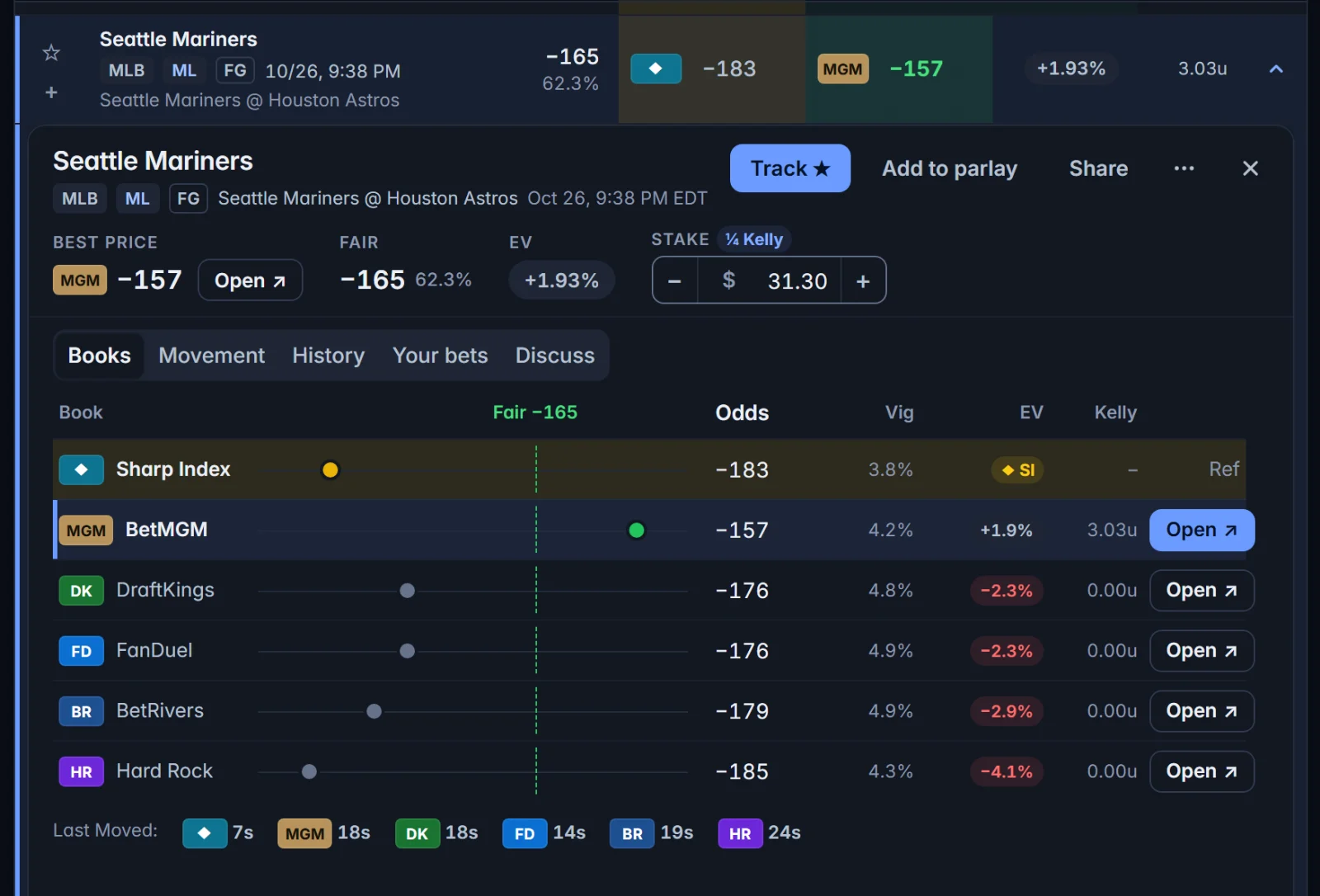
The Kelly criterion is a formula for sizing bets that maximizes how fast your bankroll grows over the long run. It says to stake a fraction of your bankroll equal to your edge divided by the net odds: f* = (b·p − (1 − p)) ÷ b, where b is decimal odds minus 1 and p is the true win probability. Most sports bettors stake a half or a quarter of that amount, because full Kelly is only optimal when your probabilities are exactly right.
This guide covers the formula with NFL, NHL and MLB examples, how to use it with fair odds from a devigged sharp line, why full Kelly is too aggressive, and where the formula came from (Bell Labs, 1956). To size a bet right now, use the free Kelly criterion calculator.
The Kelly criterion formula
For a bet that pays net odds b (decimal odds − 1) with true win probability p:
f* = (b·p − (1 − p)) ÷ b
where f* is the fraction of your current bankroll to stake. This article and the calculators quote stakes in units on a 100-unit bankroll: 1u = 1% of your bankroll, so f* = 0.0314 is written 3.14u. Two useful facts:
- The numerator, b·p − (1 − p), is exactly the bet's expected value per $1. So full Kelly equals EV ÷ b.
- If EV is zero or negative, f* is zero or negative: no edge, no bet.
Example: an even-money edge
A coin that lands heads 55% of the time, paying even money (b = 1):
f* = (1 × 0.55 − 0.45) ÷ 1 = 10u per flip (10% of the bankroll).
Example: an NHL underdog
The Oilers are +140 at a rec book. Devigging the sharp market gives them a fair probability of 43.5%.
- Decimal 2.40, so b = 1.40
- EV = 0.435 × 2.40 − 1 = +4.40%
- Full Kelly = 0.044 ÷ 1.40 = 3.14u
On a $5,000 bankroll, 1u is $50: 3.14u = $157 at full Kelly, 1.57u = $79 at half Kelly, 0.79u = $39 at quarter Kelly.
Example: an MLB favourite
A starter-driven MLB favourite at −150 with a fair probability of 62%:
- Decimal 1.667 (exactly 5/3), so b = 2/3
- EV = 0.62 × 5/3 − 1 = +3.33%
- Full Kelly = 0.0333 ÷ (2/3) = 5.00u
Notice the favourite receives a bigger stake despite a smaller EV. Kelly sizes by edge relative to the odds, because a favourite's result is less volatile. The same +3.5% edge at different prices:
| Price | Fair probability | Full Kelly |
|---|---|---|
| −200 | 69.00% | 7.00u |
| −110 | 54.21% | 3.85u |
| +150 | 41.40% | 2.33u |
| +300 | 25.87% | 1.17u |
Kelly calculator
The stake that maximises long-run growth, in units (1u = 1% of your bankroll).
This calculator needs JavaScript. Enable it to use the form below; the explanation above works without it.
Enter your numbers to see results.
How to use the Kelly criterion in sports betting
- Find a fair probability. Kelly needs a true probability, not the book's. Plugging in the price's own implied probability gives EV = 0 and a stake of zero by definition. Take p from a devigged sharp line: the price at a sharp, high-limit book with the margin removed (how to devig odds explains the methods; the no-vig fair odds calculator does it for you).
- Work out the EV of the price you can bet: p × decimal − 1. If it isn't positive, stop. (Value betting covers the whole +EV workflow.)
- Divide by b (decimal − 1): the result is full Kelly.
- Multiply by your Kelly fraction: ½ or ¼ for most bettors.
- Convert to money: units × your unit size (1u = 1% of your current bankroll).
Why Kelly works: maximizing log growth
Why that fraction? Because bankrolls compound. A win multiplies your bankroll by (1 + f·b) and a loss by (1 − f). Over many bets, what matters is the product of those multipliers, so the right thing to maximize is the average of their logarithms, the expected log growth:
G(f) = p · ln(1 + f·b) + (1 − p) · ln(1 − f)
Kelly's fraction is the f that makes G(f) as large as possible. Back to the 55% coin:
| Stake per flip | Growth per flip | Median bankroll after 1,000 flips |
|---|---|---|
| 2.5u | 0.0022 | 8.9× |
| 5u | 0.0038 | 42.6× |
| 10u (Kelly) | 0.0050 | 149.7× |
| 15u | 0.0037 | 41.9× |
| 20u | −0.0001 | 0.87× |
| 25u | −0.0067 | 0.001× |
(A 10% edge on every flip is wildly unrealistic for sports; the shape is the point.) Three lessons:
- Betting less than Kelly costs some growth, but gently. Half Kelly still grows fast.
- Betting more than Kelly costs growth and adds risk. It's strictly worse than betting less.
- At twice Kelly, growth is roughly zero. Beyond that, a bettor with a genuine edge goes broke in the long run from overbetting alone.
Why full Kelly is too aggressive
Full Kelly is the fastest growth strategy, not a comfortable one. A classic result (in the continuous approximation) is that a full-Kelly bettor has a 50% chance of halving their bankroll at some point and a 25% chance of losing three quarters of it, even with perfectly known edges. In our own simulation of 10,000 bettors making 1,000 bets each at +2–4% EV, full-Kelly bettors finished below their starting bankroll 32% of the time, and 74% of them suffered a 50% drop from a peak along the way.
That's with perfect knowledge of every probability. Real bettors don't have that.
Estimation error: the real risk
Kelly assumes you know p. You never do. Your fair probability comes from a devigged market or a model, and both have error. The cost of that error is lopsided: overestimating your edge makes you overbet, and overbetting is the expensive direction.
Take the Oilers bet again. You think the edge is +4.4%; suppose the truth is only half that (+2.2%, a 42.58% win chance). The chart shows expected log growth at different stake sizes, measured in multiples of the Kelly stake you calculated:
- If your estimate is right, full Kelly gives the most growth (about 69% log growth per 1,000 such bets, a median bankroll of roughly 2×).
- If the true edge is half your estimate, your "full Kelly" stake produces essentially zero growth, and 2× Kelly loses heavily. Half Kelly turns out to be the optimal size.
- A quarter-Kelly stake grows in both worlds.
Because you can't tell which world you're in, betting a fraction of Kelly is the sensible way to account for your own uncertainty.
Fractional Kelly: half Kelly and quarter Kelly
Fractional Kelly means staking c × f* for some c below 1. In the continuous approximation the trade-off is clean:
| Fraction of Kelly | Growth rate vs full Kelly | Chance of ever halving the bankroll |
|---|---|---|
| Full (1.0) | 100% | 50% |
| Half (0.5) | 75% | 12.5% |
| Quarter (0.25) | 43.75% | 0.8% |
Half Kelly gives up a quarter of the growth to cut the chance of a halving from one in two to one in eight. Quarter Kelly gives up more than half the growth but makes a halving very unlikely, and it holds up much better when edges are overestimated. These are long-run theoretical figures; the bankroll simulations show what they look like over a realistic 1,000-bet stretch.
Most professional sports bettors land somewhere between ¼ and ½ Kelly, lower on thin markets (player props, niche leagues) where fair prices are less certain.
Practical adjustments
- Simultaneous bets. Kelly assumes one bet at a time. On a busy NFL Sunday you may have 15 positions open, so sum your stakes and scale down if the total is a large share of your bankroll.
- Correlated bets. A side and a player prop on the same game aren't independent. Don't size each as if it were.
- Re-measure your bankroll. Kelly stakes are a fraction of your current bankroll. Many bettors re-base weekly rather than after every bet.
- Caps. Book limits often cap your stake below Kelly anyway, and a hard maximum (e.g., 2–3u on any bet) guards against fat-finger fair prices.
- Know what your bankroll is. It's the money you've set aside for betting and can afford to lose, not your savings.
A short history: from Bell Labs to the blackjack table
John L. Kelly Jr. and information theory
John Larry Kelly Jr. (1923–1965) was a Texan who flew for the US Navy in World War II, earned a PhD in physics at the University of Texas, and joined Bell Telephone Laboratories, one of the most productive research labs of the century. Bell Labs was home to Claude Shannon, whose 1948 paper founded information theory: the mathematics of how much information a noisy channel can carry.
In 1956 Kelly published "A New Interpretation of Information Rate" in the Bell System Technical Journal. His thought experiment was a gambler with a private wire that tells him results before the odds adjust, but over a noisy line that is sometimes wrong. How much of his money should he bet on each tip? Kelly showed that the bet size that maximizes the long-run growth rate of the gambler's capital is a specific fraction of it, and that in the simplest case the maximum growth rate equals the information rate of the channel in Shannon's sense. Betting and information theory turned out to be the same mathematics.
Kelly's career was short. Among other work, he programmed an IBM 704 to sing "Daisy Bell" with Carol Lochbaum in 1961, one of the first demonstrations of computer speech synthesis, which is said to have inspired the HAL 9000 scene in 2001: A Space Odyssey. He died in 1965, aged 41.
Ed Thorp takes it to the casino, then Wall Street
The formula stayed mostly in academic circles until Edward O. Thorp, a young mathematician at MIT, worked out that blackjack could be beaten by counting cards. Shannon pointed him to Kelly's paper as the answer to his next question: how much to bet when the count is in your favour. Thorp used Kelly sizing at the tables, raising bets when the deck was rich and betting the minimum otherwise, and published Beat the Dealer in 1962. With Shannon he also built one of the first wearable computers to predict roulette.
Thorp then took the same thinking to markets. He co-wrote Beat the Market (1967) on warrant hedging and ran the hedge fund Princeton Newport Partners for roughly two decades, sizing positions with Kelly principles. His later paper, "The Kelly Criterion in Blackjack, Sports Betting, and the Stock Market," remains one of the clearest treatments of the subject.
Meanwhile mathematicians proved why the formula is special. Leo Breiman showed in 1961 that a Kelly bettor's wealth eventually outgrows that of any essentially different strategy. And the critics had their say: economist Paul Samuelson argued that maximizing growth is not the same as maximizing everyone's satisfaction, famously writing a 1979 rebuttal using only one-syllable words. Both points matter for bettors. William Poundstone's book Fortune's Formula (2005) tells the whole story.
Kelly stakes in OddScouter
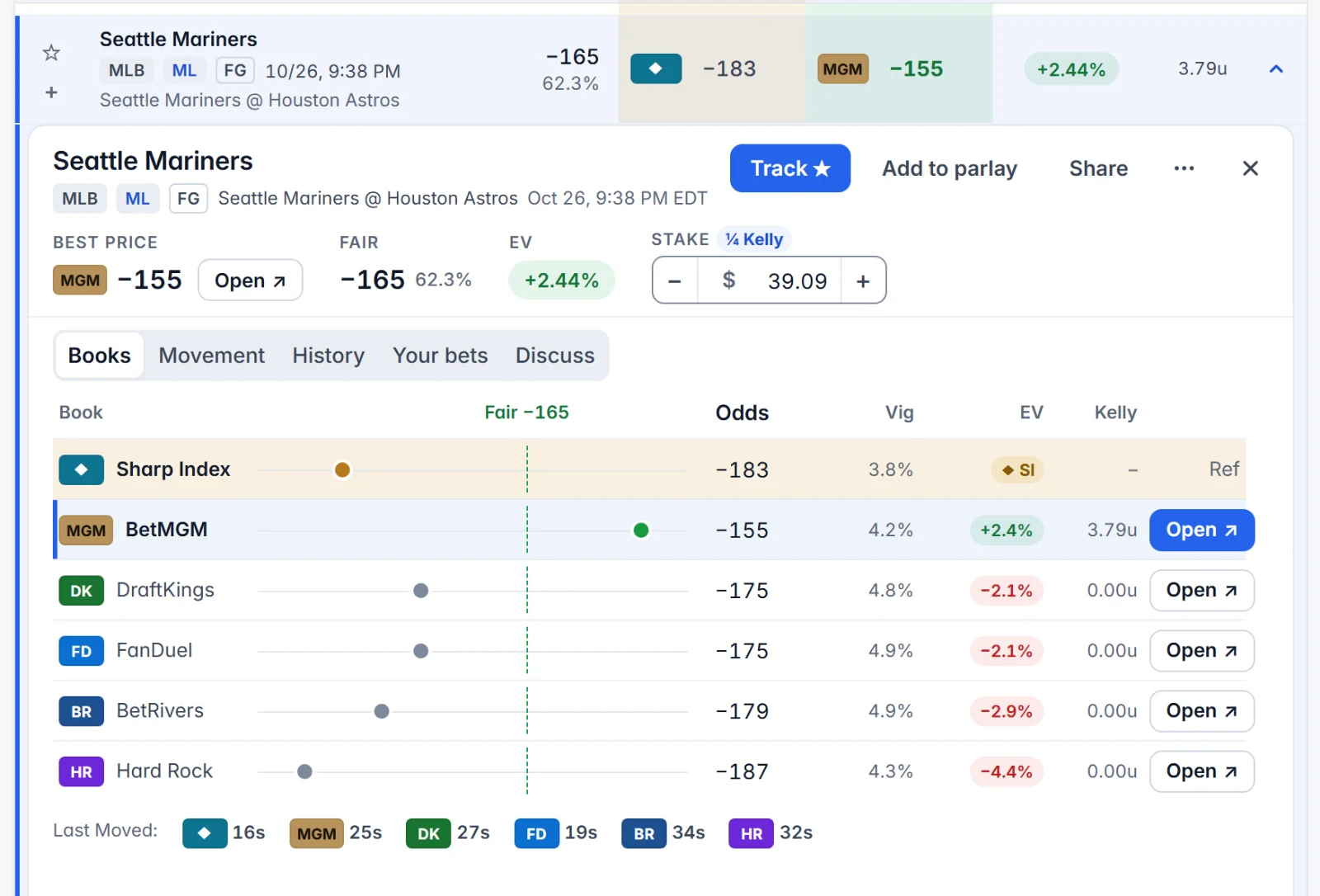
OddScouter calculates Kelly for every price it grades, using the devigged sharp fair probability:
- The board's Kelly column shows the full-Kelly stake in units of a 100-unit bankroll, so "3.14u" is the same unit used throughout this article (1u = 1% of bankroll).
- Expand a bet and its summary (Best price, Fair, EV, Stake) shows a suggested stake in dollars from your bankroll setting, at ¼ Kelly by default. Clicking the ¼ Kelly label cycles it to ½ Kelly and full Kelly.
- When you log a bet, the stake field offers Kelly, ½K and ¼K chips. The book-by-book table inside the expansion shows each book's own Kelly at its own price.
- The price calculator in the Parlay builder tab returns full and quarter Kelly for any price and fair chance, and the parlay builder shows a Kelly figure for the combined ticket.
- The Variance tab simulates your own settled bets at quarter, half or full Kelly, so you can see the drawdowns before you live through them.
Common Kelly mistakes
- Using a soft line as "fair". Garbage in, oversized bets out.
- Full Kelly on uncertain edges. If you'd be unsurprised to learn your edge is half what you think, full Kelly is overbetting.
- Treating parlays like singles. A parlay's fair probability is the product of the legs', and errors multiply too. See parlay EV.
- Chasing losses with bigger stakes. Kelly scales down after losses, because the bankroll is smaller.
- Forgetting other risks. Voids, rule differences between books, limits and taxes don't appear in the formula. Arbitrage and profit boosts carry their own sizing considerations.
Related guides and calculators
- Sports betting bankroll management: flat units vs full, half and quarter Kelly, simulated.
- Value betting: how to find +EV bets: where the edge Kelly sizes comes from.
- How to devig odds: finding the fair probability Kelly needs.
- Parlay EV: why Kelly stakes on parlays are so small.
- Free tools: Kelly criterion calculator, betting EV calculator, no-vig fair odds calculator.
Responsible gambling
The Kelly criterion is a sizing tool, not a promise of profit. Even perfectly sized +EV bets lose, often many in a row, and edges can be smaller than you think. Never bet money you need, set limits before you start, and treat a bankroll as money you can afford to lose. You must be 21+ (or the legal age where you live) to bet. If gambling stops being fun, call or text 1-800-GAMBLER for free, confidential help.
Examples are illustrative, not live prices or betting advice. The numbers can be reproduced with scripts/article_math.py.
Frequently asked questions
What is the Kelly criterion?
The Kelly criterion is a bet-sizing formula that says what fraction of your bankroll to stake to maximize long-run growth. For a bet at net odds b with true win probability p, full Kelly is (b × p − (1 − p)) ÷ b, which equals the bet's EV divided by b.
How much should I bet using the Kelly criterion?
Work out your edge from a fair probability, then divide by the net odds. Example: +140 with a 43.5% fair chance has EV +4.4% and full Kelly 3.14u (1u = 1% of bankroll). On $5,000, where 1u is $50, that's $157 full, $79 half or $39 quarter Kelly.
What is half Kelly?
Half Kelly means staking 50% of the full Kelly amount. In the standard long-run approximation it keeps 75% of full Kelly's growth rate while cutting the chance of ever halving your bankroll from 50% to 12.5%, and it is far more forgiving if your edge estimates are too high.
Why do bettors use half or quarter Kelly?
Full Kelly is only optimal if your probabilities are exactly right, and even then it produces deep drawdowns, with a 50% chance of halving your bankroll at some point in the long run. Half Kelly keeps about 75% of the growth with far smaller swings; quarter Kelly keeps about 44%.
What happens if you bet more than Kelly?
Growth falls. At twice the Kelly stake expected growth drops to about zero, and beyond that your bankroll is expected to shrink even though every bet is +EV. Overestimating your edge has the same effect, which is why most sharps bet a fraction of Kelly.
Who invented the Kelly criterion?
John L. Kelly Jr., a physicist at Bell Labs, published it in 1956 in the Bell System Technical Journal as "A New Interpretation of Information Rate." Mathematician Edward O. Thorp later applied it to blackjack and then to investing, which made it famous.
Free calculators for this topic: Kelly Criterion Calculator: Optimal Bet Size for Sports, Betting EV Calculator: Expected Value of Any Bet.
OddScouter is an information tool, not a sportsbook, and nothing here is betting or financial advice. Positive expected value is not a promise of profit. You must be 21 or older. Gambling problem? Call 1-800-GAMBLER. Responsible gambling resources.