How to Devig Odds: Vig, Hold and the 4 Devig Methods
What vig, overround and hold mean, how to devig odds into fair no-vig probabilities, and how the multiplicative, additive, power and Shin methods compare.
Vig (also called juice, overround or margin) is the extra probability a sportsbook builds into its prices so the implied probabilities of every outcome add up to more than 100%. To devig odds, convert each side's price to an implied probability and rescale them so they sum to exactly 100%: what's left is each outcome's fair probability and fair (no-vig) odds. On close-to-even markets every devig method gives the same answer. On lopsided ones they disagree, and the power method, which takes more of the margin off the longshot, is usually the better default, for reasons and with limits explained below.
Fair probabilities are the foundation of everything else: value betting compares a price with the fair line, the Kelly criterion sizes a stake from it, and a profit boost is only worth what it pays above it. If the fair line is wrong, every number downstream is wrong too.
Want the answer without the theory? The free no-vig fair odds calculator devigs any two- or three-way market.
What is vig in sports betting? Vig, overround and hold
Start with a standard −110 / −110 line on an NFL total. In decimal, −110 is 1.909, an implied probability of 1 ÷ 1.909 = 52.38% on each side.
- Sum of implied probabilities: 52.38% + 52.38% = 104.76%.
- Overround = sum − 1 = 4.76%. This is what most people (and most odds screens, including OddScouter's Vig column) call the vig.
- Hold = 1 − 1 ÷ sum = 4.55%. If the book took equal liability on both sides, this is the share of all money staked it would keep. Bet $50 each way and you collect $95.45.
Overround and hold describe the same margin in two ways, and they're close for normal markets. A three-way market works the same way. An illustrative NHL 60-minute line at one book, home +140 / away +160 / draw +310, has implied probabilities of 41.67% + 38.46% + 24.39% = 104.52%: a 4.52% overround and a 4.32% hold.
Vig and hold calculator
Add every outcome in a market to see its vig (overround) and hold.
This calculator needs JavaScript. Enable it to use the form below; the explanation above works without it.
Enter your numbers to see results.
The free vig calculator measures overround and hold for any market of up to four outcomes.
Vig differs a lot by book and market. Sharp books post main lines with overrounds around 2% or less; recreational books are often 4.5% to 5% on main lines and far higher on props, alternates and futures.
Why devig? Fair odds from a sharp line
If 104.76% of probability is on offer, 4.76% of it isn't real. Remove it and what's left, with the outcomes summing to exactly 100%, is the market's estimate of the true chances. From a sharp book (one that takes big bets from winning players and moves its line to them) that estimate is about as accurate as public information allows. That's why the de-vigged sharp line is the standard benchmark for "fair": you're not saying who will win; you're saying what a price would be with no margin, according to the most efficient market available.
The catch: the vig isn't labelled. The book doesn't tell you how much of the 4.76% sits on each side. Every devig method is an assumption about how it was spread.
How to devig odds: the four methods
Below, qᵢ is each outcome's implied probability (1 ÷ decimal), Σq is their sum, n is the number of outcomes, and pᵢ is the fair probability.
Multiplicative devig (proportional, "normalisation")
pᵢ = qᵢ ÷ Σq
Scale everything down by the same factor. Assumption: the margin is proportional to probability, so a 79% favourite carries more than three times the margin of a 25% underdog. Simple and widely used, and on an even market, fine.
Additive devig
pᵢ = qᵢ − (Σq − 1) ÷ n
Subtract the same number of percentage points from every outcome. Assumption: the margin is spread equally in absolute terms. It takes proportionally more from the longshot. On very small probabilities it can even produce a negative number, which is a sign the assumption has broken.
Power devig
Find k such that Σ qᵢᵏ = 1, then pᵢ = qᵢᵏ.
Because every qᵢ is below 1, raising it to a power slightly above 1 shrinks it, and shrinks small numbers proportionally more than large ones. Assumption: the margin falls hardest, in relative terms, on the least likely outcomes. It always gives a valid set of probabilities, and the one parameter k is easy to solve for.
Shin devig
pᵢ = (√(z² + 4(1 − z) · qᵢ² ÷ Σq) − z) ÷ (2(1 − z)), solving for z so the pᵢ sum to 1.
Shin's model comes from a theory of why books carry margin: protection against a share z of bettors with inside information. It also shades the longshot. One useful fact: for a two-outcome market, Shin's answer is identical to the additive method's. The two only differ with three or more outcomes.
Worst-case check
Not a model but a precaution: work out the fair probability with several methods and use the least favourable one for the side you're betting. If a bet is +EV under every method, the method doesn't matter. If it's only +EV under one, be careful.
Worked example: one lopsided market, four methods
An illustrative NFL moneyline at a recreational book: favourite −380, underdog +300.
- −380 = 1.263 decimal → 79.17% implied. +300 = 4.000 → 25.00%.
- Sum 104.17%: overround 4.17%, hold 4.00%.
| Method | Favourite fair | Underdog fair | Margin taken off the underdog |
|---|---|---|---|
| Multiplicative | 76.00% (−317) | 24.00% (+317) | 1.00 pt (4.0% of its implied) |
| Additive | 77.08% (−336) | 22.92% (+336) | 2.08 pt (8.3%) |
| Shin | 77.08% (−336) | 22.92% (+336) | 2.08 pt (8.3%) |
| Power (k = 1.082) | 77.67% (−348) | 22.33% (+348) | 2.67 pt (10.7%) |
Same prices, same 4.17% of margin, and the underdog's fair probability ranges from 22.3% to 24.0%. That gap matters as soon as you compare with another book. Suppose a second book has the underdog at +330:
| Method | EV of the underdog at +330 | EV of the favourite at −340 |
|---|---|---|
| Multiplicative | +3.20% | −1.65% |
| Additive / Shin | −1.46% | −0.25% |
| Power | −3.99% | +0.52% |
Under the multiplicative method, the +330 underdog looks like a good bet. Under power, it's clearly −EV and the favourite at −340 is the marginal edge instead. The method does more than nudge the number; it can decide which side is the value.
Try the same market, or your own, in the calculator. Its headline result is the Power method (k = 1.0816 for this market, fair probabilities 77.67% and 22.33%); the other methods are listed underneath for comparison.
Devig calculator
Enter every outcome's price from one sportsbook to remove the vig four ways.
This calculator needs JavaScript. Enable it to use the form below; the explanation above works without it.
Enter your numbers to see results.
The same Power-method calculator, with the comparison table, has its own page as the no-vig fair odds calculator. To turn a fair probability into an edge, use the betting EV calculator.
On a close market the methods converge. An MLB line at −130 / +110 (4.14% overround) gives the underdog 45.73% (multiplicative), 45.55% (additive and Shin) or 45.46% (power): a spread of about a quarter of a point. And at −110 / −110, every method says 50%.
The favourite–longshot bias
Why would a book put more margin on the longshot? The favourite–longshot bias is the long-documented tendency for longshots to win less often than their odds imply, and favourites slightly more often. It's strongest in horse racing (Griffith, 1949; Snowberg and Wolfers, 2010), and it shows up in many sports betting markets, plausibly because recreational bettors like big payouts and books price accordingly.
If longshots are systematically overpriced in implied terms, then a devig method that removes more margin from them should land closer to the truth, and that's exactly what additive, Shin and power do. On two-way markets, power does it the most.
The chart holds the overround at 4.5% and makes a two-way market steadily more lopsided. On a coin flip the methods agree. With a −400 favourite, power gives the +308 underdog about 1.8 points less than multiplicative; with a −1000 favourite, about 2.7 points less.
Which devig method is best?
The evidence, honestly stated, favours the power method as a default:
- Published comparisons favour longshot-shading methods. Štrumbelj (2014) found that Shin's method produced more accurate probabilities from bookmaker odds than simple proportional normalisation, and Clarke, Kovalchik and Ingram (2017) found the power method performed comparably to or better than Shin's in their tests while being much simpler.
- It behaves well everywhere. Power always returns valid probabilities between 0 and 1, handles any number of outcomes, and reduces to the obvious answer on an even market.
- It matches the shape of the bias. If longshots are the outcomes most overpriced in implied terms, a method that removes proportionally more from small probabilities is modelling the right thing. Power does that smoothly, with one parameter.
And the limits:
- Most of that research comes from other sports and other books (tennis, soccer and racing feature heavily). Older studies of MLB and NHL moneylines (for example, Woodland and Woodland's work in the 1990s and 2000s) found a small reverse bias, with favourites overbet in some samples. The bias isn't the same in every market or era.
- No single exponent fits every market. Props, alternates and three-way lines can carry margin differently. On the NHL three-way line above, Shin actually removes slightly less margin from the draw than additive does, and power sits between them.
- The method matters less on a sharp line. A sharp book's version of the NFL line at −345 / +310 has a 1.9% overround; there, multiplicative and power disagree on the underdog by about 0.75 points instead of 1.67. Use the lowest-vig sharp line you can, and the method question shrinks.
So: power is a sound, well-supported default, especially on favourites and longshots. It isn't proof. When a bet's EV depends on the method, the worst-case check is the honest answer.
How OddScouter devigs
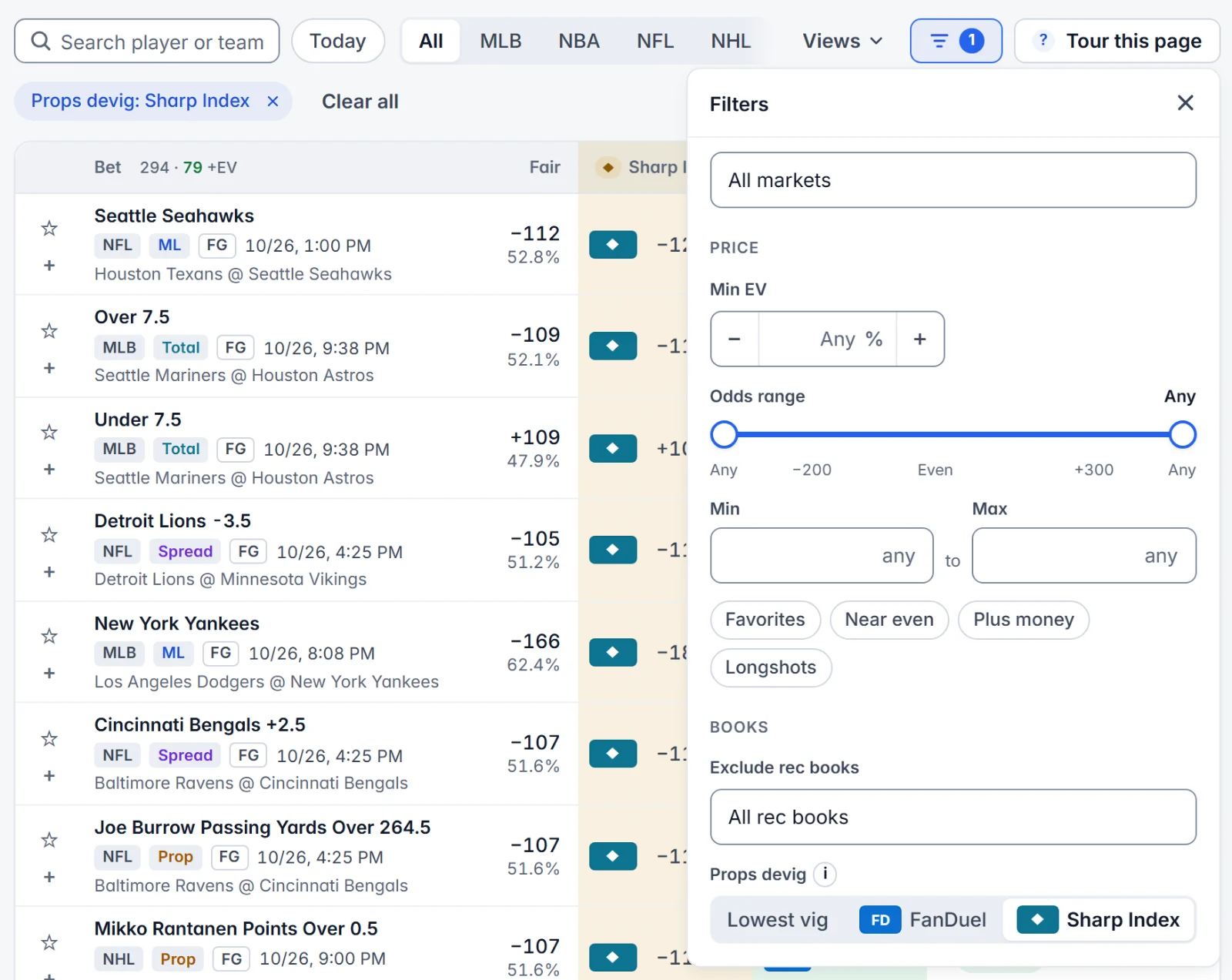
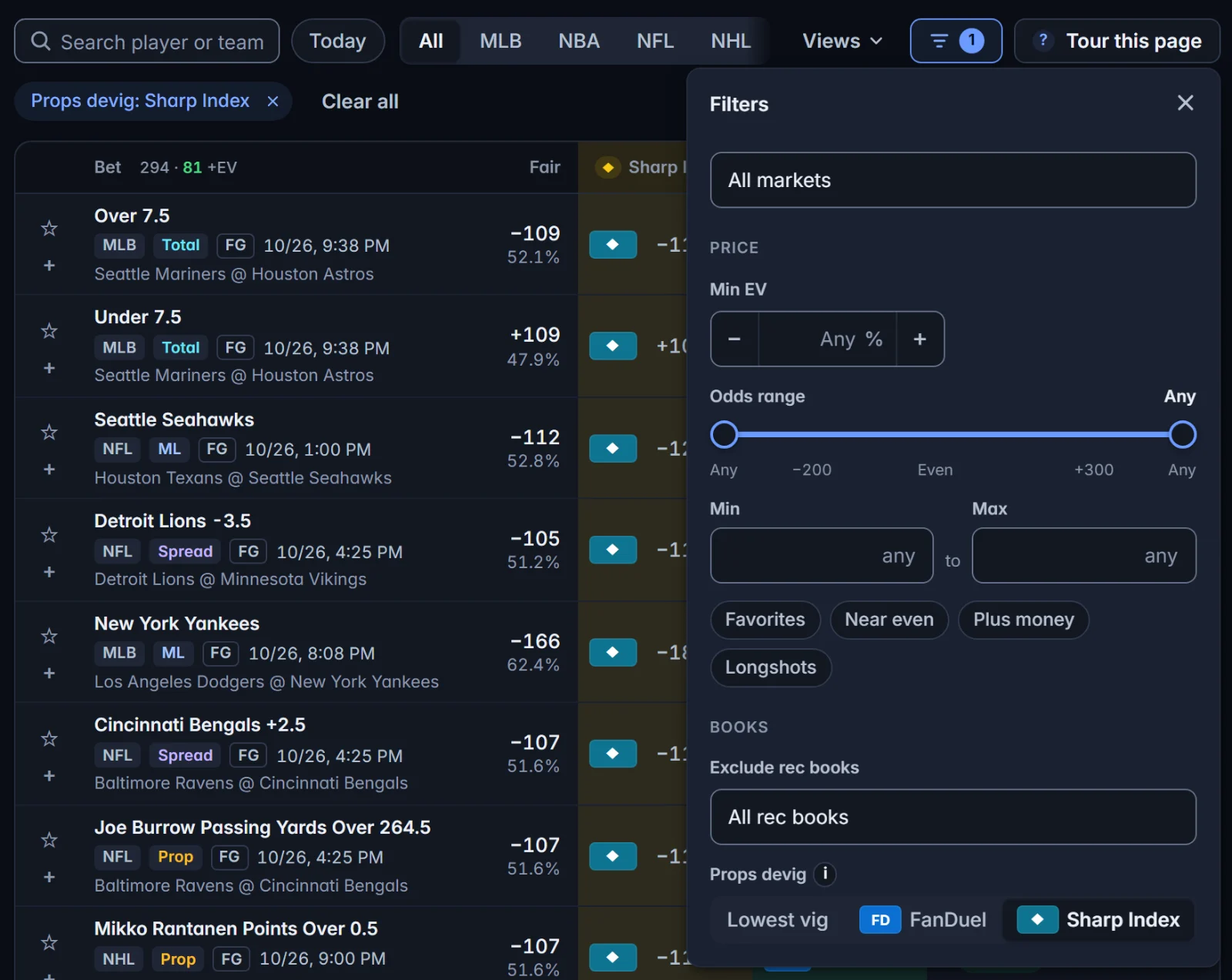
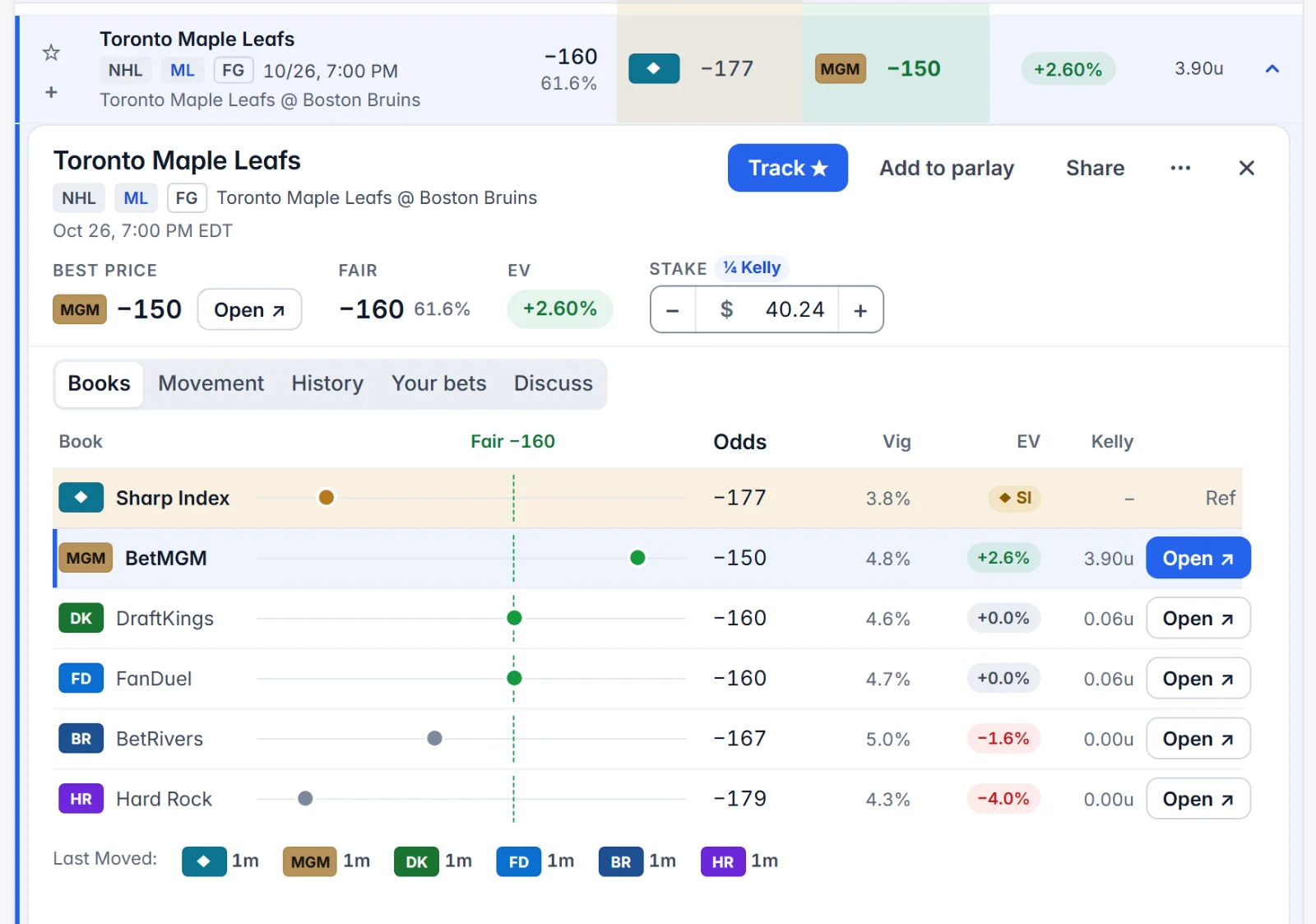
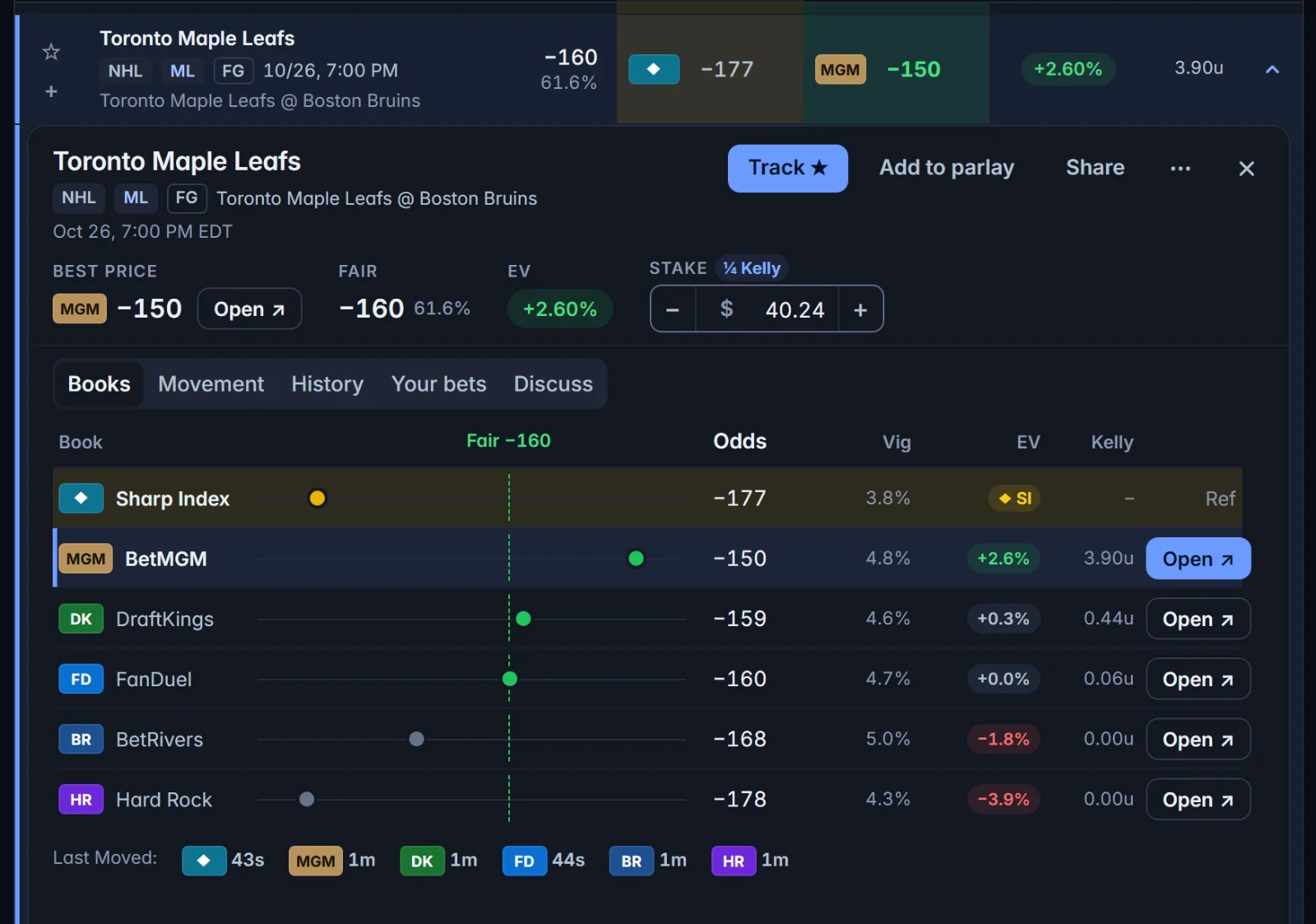
OddScouter uses the power method for every fair price it shows. For each bet, it devigs the full two-sided sharp market: the Sharp Index (the no-vig fair price from the world's sharpest market makers (Pinnacle, SBOBet and the Betdaq, Matchbook and Smarkets exchanges), combined into one line: the best price any of them offers on each side, with the margin removed) for game lines, and the Sharp Index or FanDuel for player props. Game lines always use the Sharp Index; for props you choose in the Props devig filter, and the default, Lowest vig, picks whichever of the Sharp Index and FanDuel prices that particular market with the tighter margin. A one-sided market (a prop with no "No" side, for example) has no vig to remove, so it has no fair price rather than a guess, and a sharp quoting more than 10% vig on a market isn't trusted as a fair-price reference at all.
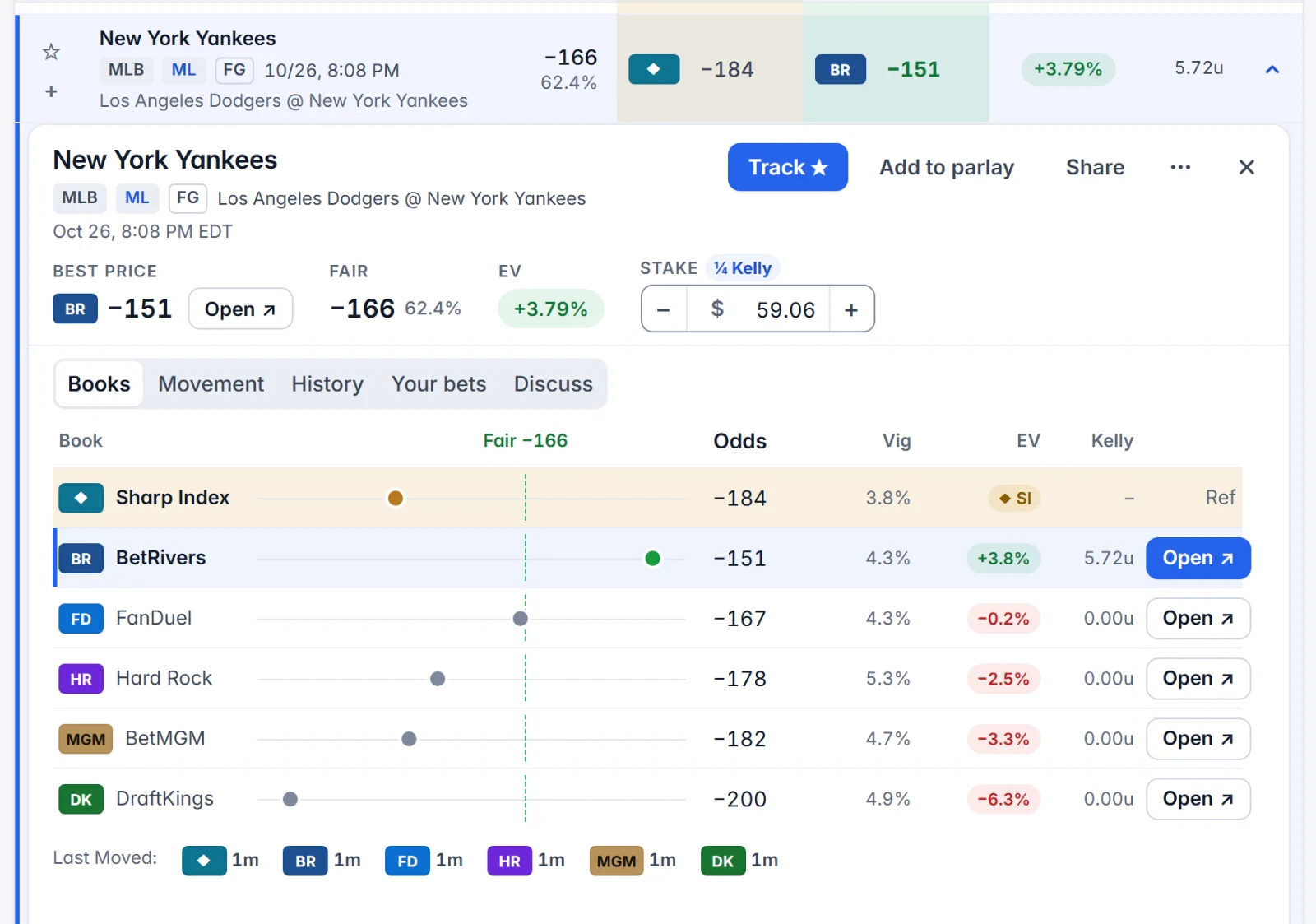
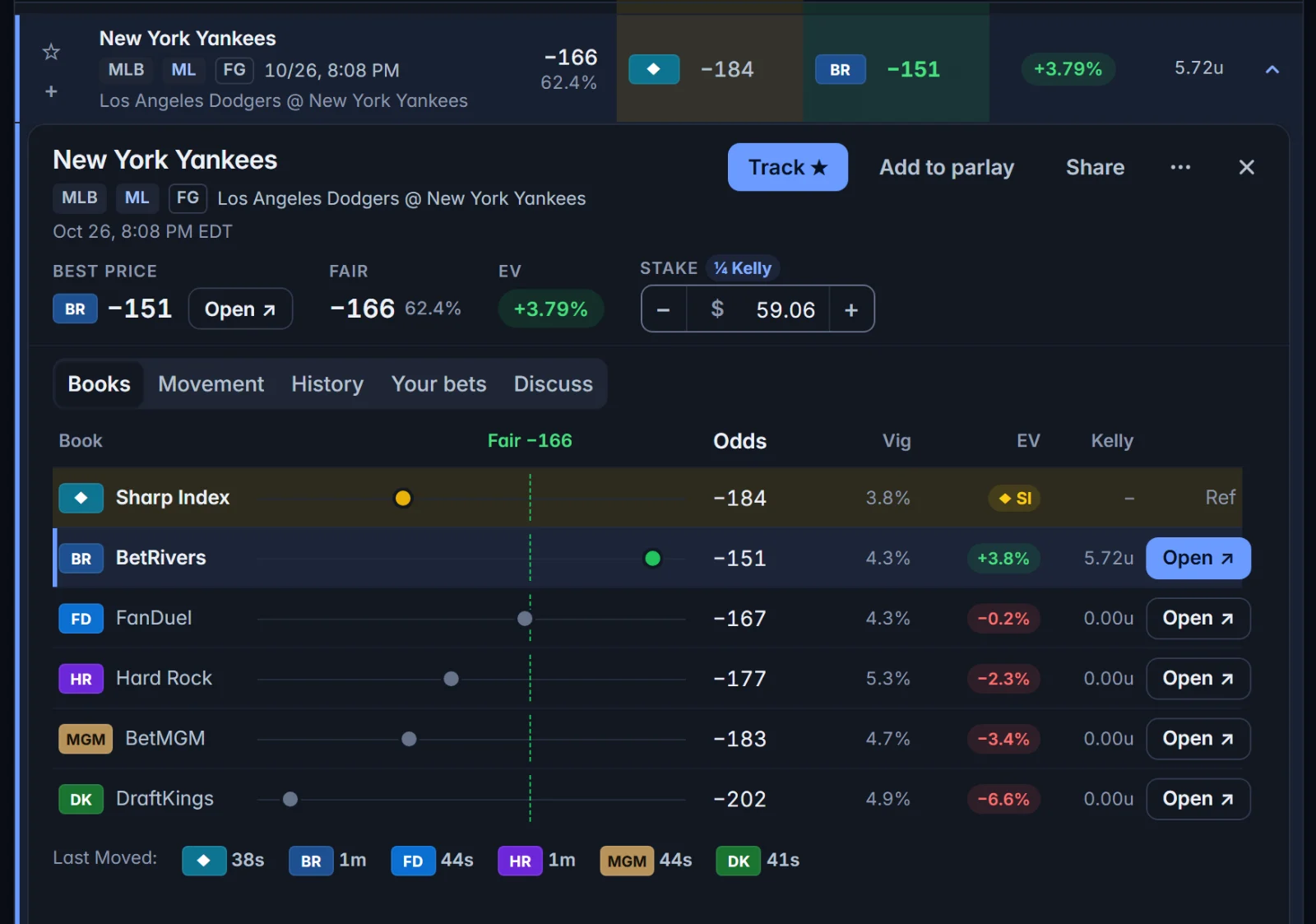
Every bet on the board shows the fair odds next to the Sharp Index price, and the expanded bet lists every book's price, the Sharp Index's included, with its own vig, EV and Kelly stake against that fair line. To compare methods on a specific market, the devig calculator on this page runs all four side by side.
Key takeaways
- Overround = Σ implied − 1; hold = 1 − 1 ÷ Σ implied. −110 / −110 is 4.76% / 4.55%.
- Devigging is an assumption about where the margin sits. Multiplicative spreads it proportionally; additive equally; power and Shin take more off the longshot.
- On even markets all methods agree. On lopsided ones the underdog's fair probability can differ by a point or two, enough to flip a bet from +EV to −EV.
- Power is the better default for most lopsided markets, backed by research and by how books price, but it's not universal. Use the lowest-vig sharp line and check the worst case on borderline bets.
Related guides and calculators
- Implied probability in betting: the conversions every devig starts from.
- Value betting: how to find +EV bets: what to do with a fair line once you have it.
- Profit boost strategy: valuing a boost against the fair price.
- Arbitrage betting: when prices across books add up to less than 100%.
- Free tools: no-vig fair odds calculator, vig and hold calculator, betting EV calculator.
Responsible gambling
A fair line is an estimate, not a certainty, and no devig method guarantees a profit. Every bet can lose, and books may limit accounts that win. Only bet what you can afford to lose. You must be 21+ (or the legal age where you live) to bet. If gambling stops being fun, call or text 1-800-GAMBLER for free, confidential help.
Examples are illustrative, not live prices or betting advice. Every number here can be reproduced with scripts/article_devig.py.
Frequently asked questions
What does devig mean in sports betting?
Devigging removes the sportsbook's margin from a market's prices so the implied probabilities add up to exactly 100%. The result is an estimate of each outcome's fair probability and fair (no-vig) odds.
What is vig in sports betting?
Vig (also called juice or margin) is the sportsbook's built-in cut. It shows up as implied probabilities that add up to more than 100%: at −110 / −110 each side implies 52.38%, a total of 104.76%, so the vig (overround) is 4.76% and the book's hold is 4.55%.
How do you devig odds?
Convert every outcome's price at one book to an implied probability (1 ÷ decimal odds), then rescale them to sum to 100%. The simplest way divides each by the total; the power method raises each to a power k chosen so they sum to 1, which takes more margin off the longshot.
What is the best devig method?
There's no universally best method. On close-to-even markets they all agree. On lopsided markets, methods that take more of the margin off the longshot, such as power and Shin, have generally matched results better than proportional scaling in published studies, so the power method is a sound default, but it's an assumption about where the book puts its margin, not a law.
What is the favourite–longshot bias?
It's the long-documented tendency for longshots to win less often than their odds imply and favourites slightly more often. It's strongest in horse racing and varies by sport and era. It's the main argument for devig methods, such as power and Shin, that remove more margin from the longshot.
Why does the devig method change my EV?
Your EV depends on the fair probability, and on lopsided markets the methods disagree by a percentage point or more on the underdog. That can turn an underdog bet from +3% to −4% EV depending on the method, so the method matters most on longshots.
Free calculators for this topic: Kelly Criterion Calculator: Optimal Bet Size for Sports, Odds Converter and Implied Probability Calculator, Betting EV Calculator: Expected Value of Any Bet, No-Vig Calculator: Fair Odds by the Power Method, Vig Calculator: Juice, Hold and Overround of Any Bet.
OddScouter is an information tool, not a sportsbook, and nothing here is betting or financial advice. Positive expected value is not a promise of profit. You must be 21 or older. Gambling problem? Call 1-800-GAMBLER. Responsible gambling resources.