Sports Betting Bankroll Management: Flat vs Kelly
Sports betting bankroll management: how big a unit should be, and flat betting vs full, half and quarter Kelly, simulated across 10,000 bettors and 1,000 bets.
Sports betting bankroll management means betting only money set aside for the purpose, and staking each bet as a small, rule-based share of it. The practical answer for most bettors: make one unit 1–2% of your bankroll, or stake quarter to half Kelly sized off a fair line. We simulated 10,000 bettors making 1,000 bets each to compare flat betting with full, half and quarter Kelly. Full Kelly grows fastest on average but suffers brutal drawdowns, and it does worst when edges are overestimated.
Below: how to set up a bankroll and choose a unit size, the four staking strategies, how the simulation works, the full results, and what they mean for how you size your own bets.
How to set up a betting bankroll
Every strategy here is a percentage of a bankroll, so the bankroll itself has to be well defined:
- It's money set aside for betting only, money you could lose entirely without affecting rent, bills or savings.
- Count only what you can actually bet with. Funds spread across six sportsbook accounts are all bankroll; money you'd need to withdraw from savings isn't.
- Don't top it up after losses. Refilling the bankroll after a downswing is the same as betting bigger than your plan, and it quietly turns quarter Kelly into something much more aggressive.
- Decide in advance how often you re-measure it, for example every Monday or the first of each month, and size stakes from that figure until the next check.
If a $1,000 bankroll means $10 units feel too small to bother with, that's useful information. The answer is patience or a bigger dedicated bankroll, not bigger units.
How big should a betting unit be?
A unit is your standard stake, written as a share of bankroll so results compare across bettors: on OddScouter and in these guides, 1u = 1% of your bankroll (a $2,000 bankroll has 1u = $20).
- Flat betting: most disciplined bettors stake 1–2u on a typical bet. The simulation below uses 1u.
- Kelly betting: the stake varies with the edge and the odds. A +4.4% bet at +140 is 3.14u at full Kelly, 1.57u at half and 0.79u at quarter Kelly (worked through in the Kelly criterion guide). The free Kelly criterion calculator gives any bet's stake in units.
Flat betting vs Kelly: the four strategies
- Flat 1 unit: stake the same dollar amount on every bet. Here, $10 on a $1,000 starting bankroll (1%), never resized.
- Full Kelly: stake f* = EV ÷ (decimal odds − 1) of your current bankroll on each bet. The Kelly criterion guide covers the formula and its history.
- Half Kelly: 50% of the full Kelly stake.
- Quarter Kelly: 25% of the full Kelly stake.
Flat betting ignores the size of each edge and doesn't compound. Kelly bets more on bigger edges and on favourites, and stakes rise as the bankroll grows and fall as it shrinks.
How the simulation works
All numbers below are simulated, not real results. Every bettor uses the same rules:
- 10,000 bettors × 1,000 bets, each starting with $1,000.
- Prices: 40% favourites between −105 and −200, 60% underdogs between +100 and +300, the kind of mix a +EV board produces.
- Edges: each bet's true EV is drawn at random between +2% and +4% (average +3%), a realistic edge for good value bets.
- Same luck for every strategy: within each simulated bettor, all four strategies see the identical sequence of bets and results, so differences come from staking alone.
- A second scenario with overestimated edges: the bettor believes each bet is +2–4%, but the true edge is 2 points lower (0% to +2%, average +1%). Kelly stakes are sized off the believed edge. This is the scenario that matters in practice, because no one's fair line is perfect.
- Ruin means ever falling to 5% of the starting bankroll ($50), the same threshold OddScouter's Variance tab uses.
The script is open: scripts/article_variance.py (pure Python, seeded, reproducible). For your own bets, OddScouter's Variance tab (see below) simulates your real bet history.
Results when edges are estimated correctly
| Strategy | Median final | Average final | 10th–90th percentile | Finished below $1,000 | Ever fell to $500 | Had a 50% drop from a peak | Median worst drawdown |
|---|---|---|---|---|---|---|---|
| Flat 1u ($10) | $1,298 | $1,303 | $805 – $1,804 | 22.1% | 5.4% | 8.4% | 26% |
| Quarter Kelly | $1,209 | $1,246 | $900 – $1,645 | 20.7% | 0.01% | 0.02% | 18% |
| Half Kelly | $1,384 | $1,552 | $767 – $2,566 | 24.4% | 4.2% | 10.8% | 34% |
| Full Kelly | $1,539 | $2,413 | $471 – $5,305 | 32.2% | 30.7% | 74.1% | 59% |
Simulated: 10,000 bettors × 1,000 bets, true edge +2% to +4%, seed 7.
The median bettor
Full Kelly's median bettor finishes highest ($1,539), then half Kelly ($1,384), flat ($1,298) and quarter Kelly ($1,209). Flat beats quarter Kelly here only because it bets more: the average flat stake was $10, the average quarter-Kelly stake $7.90 and half Kelly's $17.74. Every strategy earned about the same 3% return on money staked. Staking doesn't change your edge, only how much money you put through it and how hard the swings hit.
Average versus typical: Kelly's long right tail
Full Kelly's average final bankroll ($2,413) is far above its median ($1,539) because a minority of lucky runs compound into huge numbers: the 90th-percentile full-Kelly bettor ended with $5,305. That's the growth Kelly promises, but it's concentrated in the lucky tail. The typical full-Kelly bettor ends with a much more modest result than the average suggests.
The unlucky bettor
The 10th-percentile path shows what a bad run looks like with the same real edge:
At the 10th percentile, full Kelly ends at $471, less than half the starting bankroll despite +3% EV on every bet, while quarter Kelly ends at $900. One run in a hundred ended at $174 with full Kelly, against $702 with quarter Kelly.
The width of each band is the story. Full Kelly's 10th–90th percentile range spans more than $4,800; quarter Kelly's spans about $750.
Where everyone finishes
Drawdowns: what full Kelly feels like
Even with perfectly known edges, 74% of full-Kelly bettors saw their bankroll fall 50% from a peak at some point during 1,000 bets, and the median bettor's worst drawdown was 59%. Nearly one in three (30.7%) dropped below half of their starting bankroll.
Theory says the same thing. In the long run a full-Kelly bettor has a 50% chance of halving at some point (our 30.7% is lower because 1,000 bets is a finite horizon). Few people can keep betting confidently through a 59% drawdown, and most who try start second-guessing their numbers at exactly the wrong time.
Half Kelly cut the chance of falling to $500 to 4.2%; quarter Kelly to one bettor in 10,000. No Kelly bettor in either scenario hit the $50 ruin line except a handful at full Kelly (0.02% here, 0.27% with overestimated edges). Flat betting had its own small ruin risk (0.16%) because a fixed $10 stake doesn't shrink as the bankroll does.
When edges are overestimated
Now the realistic case: the bettor believes each bet is +2–4% EV, but the truth is 2 points lower (average +1%).
| Strategy | Median final | Finished below $1,000 | Ever fell to $500 | Had a 50% drop from a peak | Median worst drawdown |
|---|---|---|---|---|---|
| Flat 1u ($10) | $1,094 | 40.3% | 13.2% | 17.9% | 32% |
| Quarter Kelly | $1,054 | 41.5% | 0.25% | 0.4% | 22% |
| Half Kelly | $1,051 | 45.9% | 12.0% | 23.6% | 40% |
| Full Kelly | $886 | 55.0% | 49.8% | 86.7% | 67% |
Simulated: 10,000 bettors × 1,000 bets, believed edge +2–4%, true edge 0–2%, seed 8.
The ranking flips. Full Kelly's median bettor now loses money ($886) even though every single bet is still +EV on average. That's overbetting: staking as if the edge were three times larger than it is. Half of all full-Kelly bettors fell to $500 at some point. Half Kelly's median growth advantage over quarter Kelly disappears (both about $1,050), while half Kelly takes far bigger swings. Quarter Kelly still grows, with a median worst drawdown of 22%.
This is why most professional bettors size at a fraction of Kelly. You never know exactly how good your fair line is, and fractional Kelly loses little if you're right and protects you if you're wrong.
Flat betting: simple, steady, and less silly than it looks
Flat units have real advantages:
- Simplicity. One number to remember, easy to track in units, easy to compare with other bettors.
- Robustness. Flat stakes don't grow when your edge estimate is inflated, so they aren't hurt by bad estimates the way full Kelly is. With correct edges a 1% flat unit finished between quarter and half Kelly; with overestimated edges it finished slightly ahead of both. In both scenarios its chance of halving was similar to half Kelly's.
- Linear, not compounding. That cuts both ways: flat betting won't grow explosively, and it won't shrink your stakes after losses either, which is how it picked up a small ruin risk.
The weaknesses: flat staking bets as much on a +1% longshot as on a +4% favourite, and the right unit depends on your bankroll, so it needs re-basing as the bankroll changes. A common middle ground is flat units re-sized periodically: for example, set one unit to 1% of your bankroll at the start of each month.
Which bankroll strategy should you use?
- Quarter Kelly if your edges come from a devigged sharp line on mixed markets: strong growth, small drawdowns, and the most forgiving when your edges are overstated.
- Half Kelly if you're confident in your fair prices (main markets, sharp reference, a long CLV record) and can stomach 30–40% drawdowns.
- Flat 1% units if you value simplicity or bet many correlated or simultaneous positions. Keep the unit small (1–2% of bankroll) and re-base it now and then.
- Full Kelly: only with genuinely exact probabilities, which sports bettors never have. Avoid it.
Whatever you choose, bet only edges you trust. The +2% threshold and a solid devig matter more than the staking plan. Remember the simulation's assumptions too: it has no book limits, no voids, no simultaneous or correlated bets, and no taxes. In real life every one of those argues for staking smaller, not bigger. Even arbitrage, which looks riskless, carries void and limit risks that call for sensible sizing, and parlays need much smaller stakes than straight bets.
Run the same simulation on your own bets
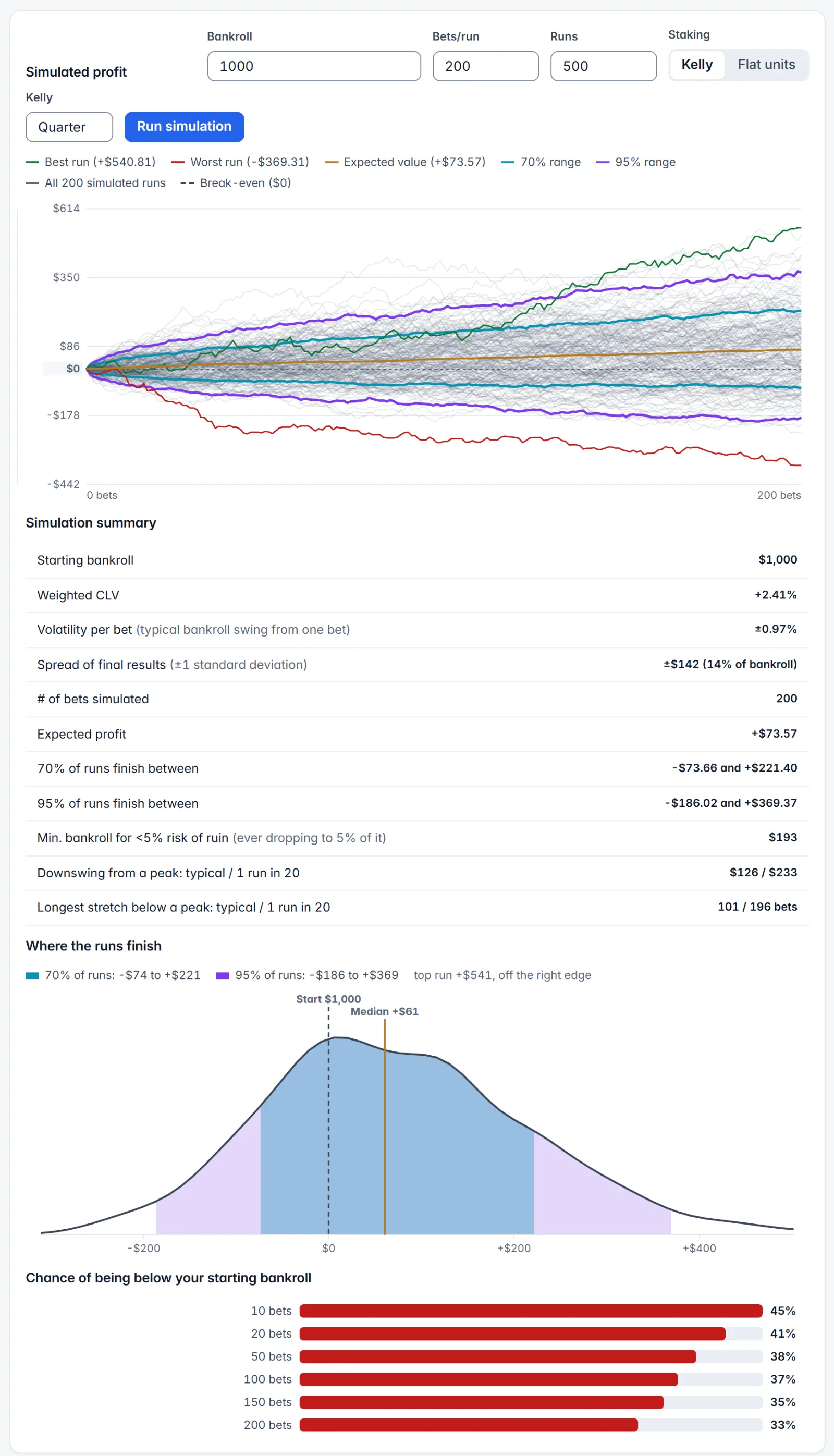
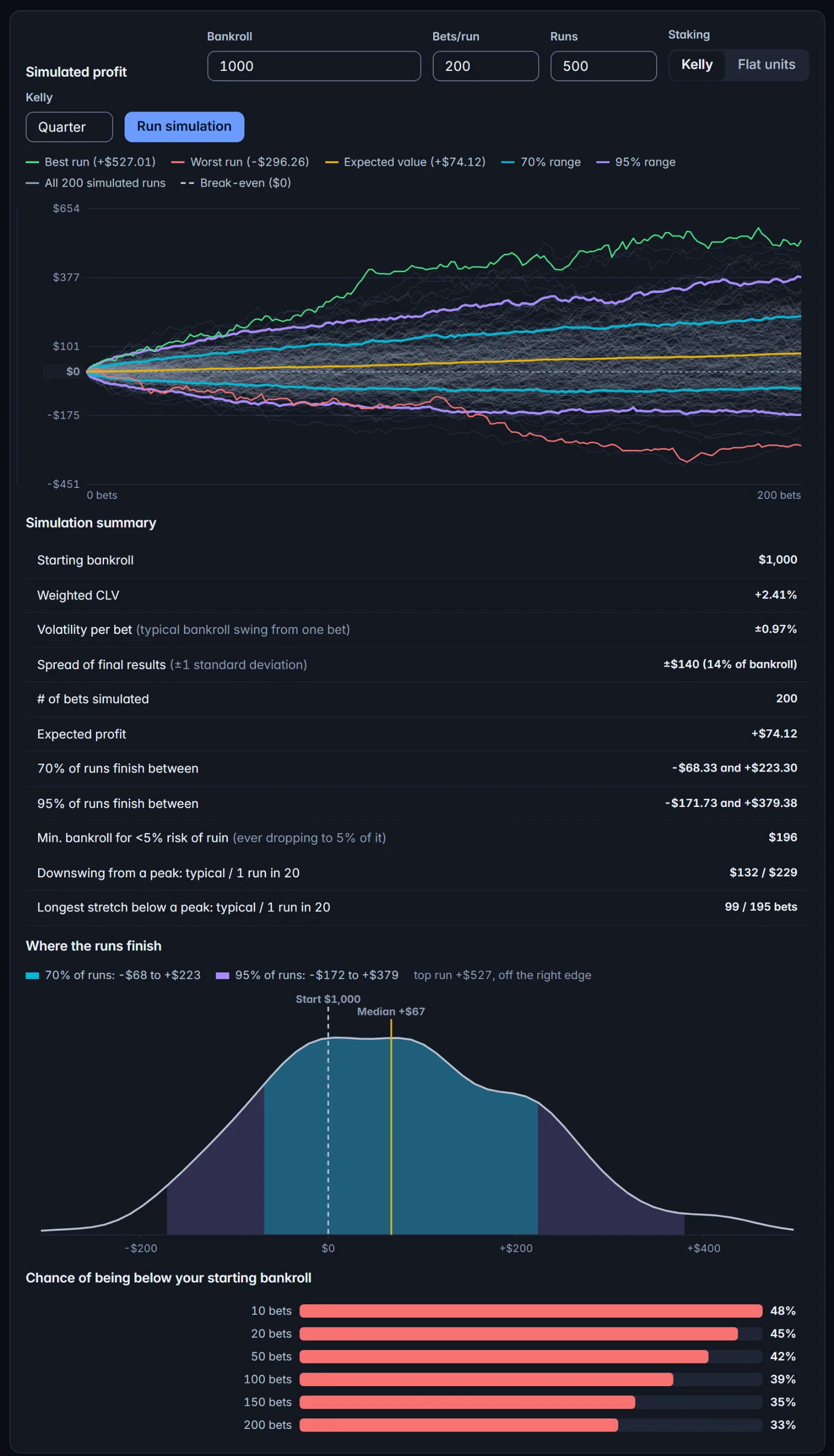
OddScouter's Variance tab runs this kind of simulation on your betting, not a generic assumption:
- Simulation draws bets from your own settled, tracked bets (resampled with replacement, each graded against its closing fair probability), so the mix of odds and edges is the mix you actually bet. Choose a bankroll, bets per run and number of runs, then compare Kelly at quarter, half or full against Flat units (OddScouter's flat-unit mode uses the Kelly edge to decide how many fixed-dollar units to bet, so it differs slightly from the pure 1-unit flat staking above).
- The simulation shows the expected profit, the 70% and 95% ranges, best and worst runs, a final-profit distribution, the chance of being below your starting bankroll at different points, and the minimum bankroll for under 5% risk of ruin.
- Downswing shows a typical run's drawdown from peak, and how deep and how long downswings typically last versus one run in 20.
- Analysis compares your actual profit with what your bets' edges predicted, as a z-score of how lucky or unlucky you've been, alongside your odds and CLV distributions.
Key takeaways
- Set a dedicated bankroll, make 1u = 1% of it, and re-measure on a schedule.
- Staking doesn't change your edge; it changes how much you bet and how big the swings are.
- Full Kelly grew the median bankroll most when edges were exactly right, but 74% of those bettors saw a 50% drawdown, and with edges overstated by 2 points the median full-Kelly bettor lost money.
- Quarter Kelly kept most of the growth with small drawdowns in both scenarios. Half Kelly is the aggressive end of reasonable.
- Flat 1% units are a perfectly good, simple choice. Keep them small.
Related guides and calculators
- The Kelly criterion in sports betting: the formula behind three of the four strategies.
- Value betting: how to find +EV bets: where the edges in this simulation come from.
- Implied probability and results versus process: why short-run results tell you so little.
- Parlay EV: parlay drawdowns and why their stakes should be small.
- Free tools: Kelly criterion calculator, betting EV calculator.
Responsible gambling
These are simulations with assumed edges, not predictions of what you will earn. Real betting includes limits, voided bets, taxes and edges that may be smaller than you think, and every strategy above lost money for a meaningful share of simulated bettors. Only bet what you can afford to lose and set limits before you start. You must be 21+ (or the legal age where you live) to bet. If gambling is causing harm, call or text 1-800-GAMBLER for free, confidential help.
Frequently asked questions
What is bankroll management in sports betting?
Bankroll management means setting aside a fixed amount of money for betting only, and sizing every bet as a small, rule-based share of it, so that normal losing streaks can't wipe you out. The two common rules are flat units (the same stake every bet) and fractional Kelly (a stake that grows with your edge).
What percentage of my bankroll should I bet?
Most disciplined bettors risk about 1–2% of their bankroll on a typical bet, often written as 1–2 units. Kelly-based staking varies the amount with the edge; at quarter Kelly a +4.4% bet at +140 is about 0.79u, under 1% of bankroll.
Is flat betting or Kelly betting better?
Full Kelly grows a bankroll fastest on average but brings deep drawdowns. In our simulation of 10,000 bettors, 31% of full-Kelly bettors fell to half their bankroll within 1,000 bets. Quarter or half Kelly, or a small flat unit, gives most of the growth with far less risk.
What is the best bankroll strategy for sports betting?
For most bettors, quarter to half Kelly sized off a devigged sharp line, or a flat unit of about 1% of bankroll. Quarter Kelly held up best when edges were overestimated, which is the realistic case. Full Kelly only makes sense if your probabilities are exact.
How big should a betting unit be?
Many sharp bettors use 1–2% of their bankroll as one unit. In our simulation a $10 unit on a $1,000 bankroll (1%) at +2–4% EV left 5.4% of bettors at half their bankroll at some point in 1,000 bets. Bigger units scale that risk up quickly.
What happens if I overestimate my edge?
Kelly stakes grow with your estimated edge, so overestimating it means overbetting. When we made the true edge 2 points lower than believed, the median full-Kelly bettor finished below their starting bankroll after 1,000 bets, while quarter Kelly still grew.
Free calculators for this topic: Kelly Criterion Calculator: Optimal Bet Size for Sports.
OddScouter is an information tool, not a sportsbook, and nothing here is betting or financial advice. Positive expected value is not a promise of profit. You must be 21 or older. Gambling problem? Call 1-800-GAMBLER. Responsible gambling resources.