Parlay EV: Are Parlays Worth It? The Math Explained
Parlay expected value explained: how EV and vig compound across legs, why most parlays lose, what correlation does to same game parlays, and when one pays.
Parlay EV compounds. For independent legs, a parlay's expected value is the product of each leg's (1 + EV) minus 1, so a parlay of +EV legs grows its edge faster than adding the legs together, and a parlay of −EV legs loses its value faster. A parlay of three +3% legs is about +9.3% EV; three ordinary −110 legs on coin flips are about −13%.
So are parlays worth it? Usually not, because most are built from −EV legs. The same multiplication that makes parlays a sportsbook's favourite product can make them a sharp bettor's tool, but only when each leg is +EV against a fair price. Below is the math, worked through on NFL, MLB and NHL legs, plus the parts most parlay articles skip: correlation, variance and how little you should actually stake.
How to calculate parlay EV
Start with one leg. If a bet pays decimal odds d and its true (fair) probability is p, the expected value of a $1 stake is:
EV = p × d − 1
Rearranged, that gives a handy identity: p × d = 1 + EV. A +3% bet has p × d = 1.03, a fair bet has p × d = 1, and a −4.5% bet has p × d = 0.955. (If you need a refresher on turning odds into probabilities, see implied probability.)
A parlay pays the product of its legs' decimal odds, D = d₁ × d₂ × … × dₙ, and it only wins if every leg wins. If the legs are independent, the chance of that is the product of their probabilities, P = p₁ × p₂ × … × pₙ. So:
EV_parlay = P × D − 1 = (p₁d₁)(p₂d₂)…(pₙdₙ) − 1
Substitute p × d = 1 + EV for each leg:
EV_parlay = (1 + EV₁)(1 + EV₂)…(1 + EVₙ) − 1
That's exact, not an approximation. It needs two conditions to hold: the fair probabilities have to be right (which is why they should come from a sharp, de-vigged line, not a guess; see how to devig odds), and the legs have to be independent. Different games, different leagues, different nights: close enough to independent. Same game: not independent at all. More on that below.
Worked example: a three-leg +EV parlay
Here are three illustrative legs on a Sunday-into-Monday slate, each priced at a recreational book and compared with a fair probability from a sharp book's de-vigged line:
| Leg | Price | Decimal | Fair probability | Fair odds | Leg EV |
|---|---|---|---|---|---|
| NFL: Eagles −2.5 | −105 | 1.952 | 52.8% | −112 | +3.09% |
| MLB: Dodgers–Padres Under 7.5 | +100 | 2.000 | 51.6% | −107 | +3.20% |
| NHL: Oilers moneyline | +125 | 2.250 | 46.0% | +117 | +3.50% |
Each leg is a modest edge of about 3%: exactly the kind of bet a value betting process turns up every day.
Parlay them:
- Parlay decimal odds: 1.952 × 2.000 × 2.250 = 8.786, or +779.
- Fair probability: 0.528 × 0.516 × 0.460 = 12.53%, or fair odds of +698.
- EV: 0.1253 × 8.786 − 1 = +10.11%.
- Check with the product form: 1.0309 × 1.0320 × 1.0350 − 1 = +10.11%. Same answer.
Adding the three leg EVs together gives +9.79%. The parlay beats that, because the edges multiply rather than add: each leg's edge is applied to a payout that the previous legs have already inflated. With more legs the gap widens: six legs at +3% each is +19.4% EV, against 18% if you added them.
The calculator below is prefilled with those three legs. Change one fair probability by a point or two and watch how sensitive the parlay is to every leg's estimate.
Parlay EV calculator
Each leg's odds and the fair chance it wins (assumes independent legs).
This calculator needs JavaScript. Enable it to use the form below; the explanation above works without it.
Enter your numbers to see results.
What +10% EV on a parlay actually means
Be careful comparing percentages. A $100 parlay at +10.11% has an expected profit of $10.11. Three separate $100 straight bets on the same legs have an expected profit of $9.79, but on $300 of total stakes. Per dollar risked, the parlay is roughly three times as efficient, which is the real attraction when a book limits how much you can bet. What you give up is the probability of being paid: the parlay loses 87.5% of the time.
Why most parlays lose: the vig compounds too
Run the same formula on an ordinary −110 line, where both sides are priced −110 and the outcome is a true coin flip. Each leg has EV = 0.5 × 1.909 − 1 = −4.55%. Now parlay them:
| Legs | Parlay pays | Fair odds | Parlay EV |
|---|---|---|---|
| 1 | −110 | +100 | −4.55% |
| 2 | +264 | +300 | −8.88% |
| 3 | +596 | +700 | −13.03% |
| 4 | +1228 | +1500 | −16.98% |
| 6 | +4741 | +6300 | −24.36% |
| 10 | +64208 | +102300 | −37.20% |
That's the vig compounding: 0.955ⁿ − 1. A four-leg parlay of standard lines gives up about 17% of every dollar staked, and a ten-leg lottery ticket hands the book over a third. The payouts look huge because they are huge. They're not as huge as the risk you're taking.
The chart is the whole article in one picture. Above zero, more legs means more EV percentage. At zero, a parlay of fair-priced legs is still a fair bet. Below zero, every extra leg digs the hole deeper.
One bad leg drags the whole parlay
Because the legs multiply, a single −EV leg costs you its full drag on everything else. Two +4% legs and one −110 coin flip: 1.04 × 1.04 × 0.955 − 1 = +3.24%, down from +8.16% for the two good legs alone. Three +3% legs plus two −110 "fun" legs: −0.44%. Those two extra legs turned a solid +EV bet into a losing one. If you're building parlays for value, every leg has to earn its spot.
Same game parlays and correlation
The independence assumption breaks down when legs come from the same game. A quarterback's passing yards Over and his top receiver's receiving yards Over tend to win together. A big NFL favourite covering and the game going Over tend to move together if the favourite's offence is the reason. A team's moneyline and its goalie's saves Under are linked.
For two yes/no legs, correlation changes the joint probability like this (φ is the correlation between the two outcomes):
P(A and B) = P(A)·P(B) + φ × √(P(A)(1 − P(A)) × P(B)(1 − P(B)))
Take two legs that are each a true 50%. Independent, they hit together 25% of the time (fair +300). With a modest positive correlation of φ = 0.2, they hit together 30% of the time (fair +233). That's a big difference, and it cuts both ways:
- If a book priced that combination at +300 by naively multiplying, it would be a +20% EV bet.
- Books know this. Their same game parlay engines adjust for correlation and typically add margin on top. Priced at +220, the same combination is −4%, even though the naive independent calculation says the "fair" price is +300 and +220 looks like a terrible −20% bet.
So the multiply-the-probabilities method can't tell you the EV of a same game parlay, in either direction. Correlation is real, books price it, and how well they price it varies by book, market and sport. Treat any claim that "SGPs are +EV" or "SGPs are always −EV" with suspicion; you need a model of the joint outcome, not a product of two marginal probabilities.
Parlay risk: long losing streaks
A parlay's edge comes with a lot more swing. For a $1 bet that wins with probability p at decimal odds d, the standard deviation of the result is d × √(p(1 − p)):
- Eagles −2.5 as a straight bet: about $0.98 per $1 staked.
- The three-leg parlay: about $2.91 per $1 staked, three times as volatile.
Over 200 bets of the same size, simulated 20,000 times, the results look like this:
| Straight bet (Eagles −2.5) | 3-leg parlay (+779) | |
|---|---|---|
| EV per $100 bet | $3.09 | $10.11 |
| Typical (median) longest losing streak | 6 | 26 |
| Typical (median) worst drawdown | 12.7 bets' stakes | 35.3 bets' stakes |
| Chance of being behind after 200 bets | about 33% | about 30% |
The parlay's higher EV keeps its chance of being behind after 200 bets roughly level with the straight bet's, but the path is brutal. Losing runs of 20 to 30 parlays in a row are normal, not bad luck. If you're betting parlays at the same dollar size as straights, your bankroll needs to survive drawdowns three times as deep. That's where bankroll management comes in. OddScouter's Variance tab shows the fan of outcomes for longshot-style odds for your own tracked bets.
How much to bet on a parlay: Kelly stakes are tiny
The Kelly criterion sizes a bet at f = (b·p − (1 − p)) / b, where b = d − 1. That simplifies to f = EV ÷ (d − 1): edge divided by net odds. Long odds mean a big divisor, so parlays receive small stakes even when their EV is large. (You can size one with the Kelly criterion calculator: enter the parlay's combined odds and fair probability. The odds converter turns the combined decimal odds into American.)
| Bet | EV | Full Kelly stake |
|---|---|---|
| Eagles −2.5 (−105) | +3.09% | 3.24u |
| Dodgers–Padres Under 7.5 (+100) | +3.20% | 3.20u |
| Oilers ML (+125) | +3.50% | 2.80u |
| The three-leg parlay (+779) | +10.11% | 1.30u |
The parlay has three times the EV percentage of any leg but less than half the Kelly stake. On quarter Kelly, which is what most experienced bettors actually use, that's about 0.3u (1u = 1% of bankroll). On a $5,000 bankroll, where 1u is $50, about $16.
There's a second, less obvious Kelly lesson. Measured by expected bankroll growth, which is what Kelly maximises, the three legs bet as full-Kelly straights grow a bankroll about 0.150% per round. The parlay alone grows it 0.064%. If you can place your full stake on each leg, straights usually do more for long-run growth than the parlay of the same legs. The parlay earns its place when limits stop you betting the straights at size, or when a boost or promo tilts the price (see profit boost strategy).
When is a parlay worth it?
A parlay is worth considering when:
- Every leg is +EV against a sharp fair price. Not "I like this team", but a price better than the de-vigged line from a sharp book. This is the non-negotiable part. (Value betting explains how to find those prices; how to devig odds explains how the fair line is calculated.)
- The legs are independent (different games), or you have a genuine model of their correlation.
- Limits bind. If a book will only take $50 per straight but a +EV parlay concentrates three edges into one $50 ticket, the parlay earns more expected profit through the same small window.
- A promotion improves the price. Parlay profit boosts and parlay insurance can turn a fair or slightly −EV parlay into a +EV one, because a boost on parlay winnings is applied to a big number. The profit boost guide works through one.
- You size it like a longshot. Kelly, fractional Kelly or a small flat unit: not the size of your straight bets.
And when it isn't: the legs are standard −110 lines you like; any leg is −EV; the "fair" probability is a guess; or it's a same game parlay you've priced by multiplying.
How OddScouter's parlay builder prices a parlay
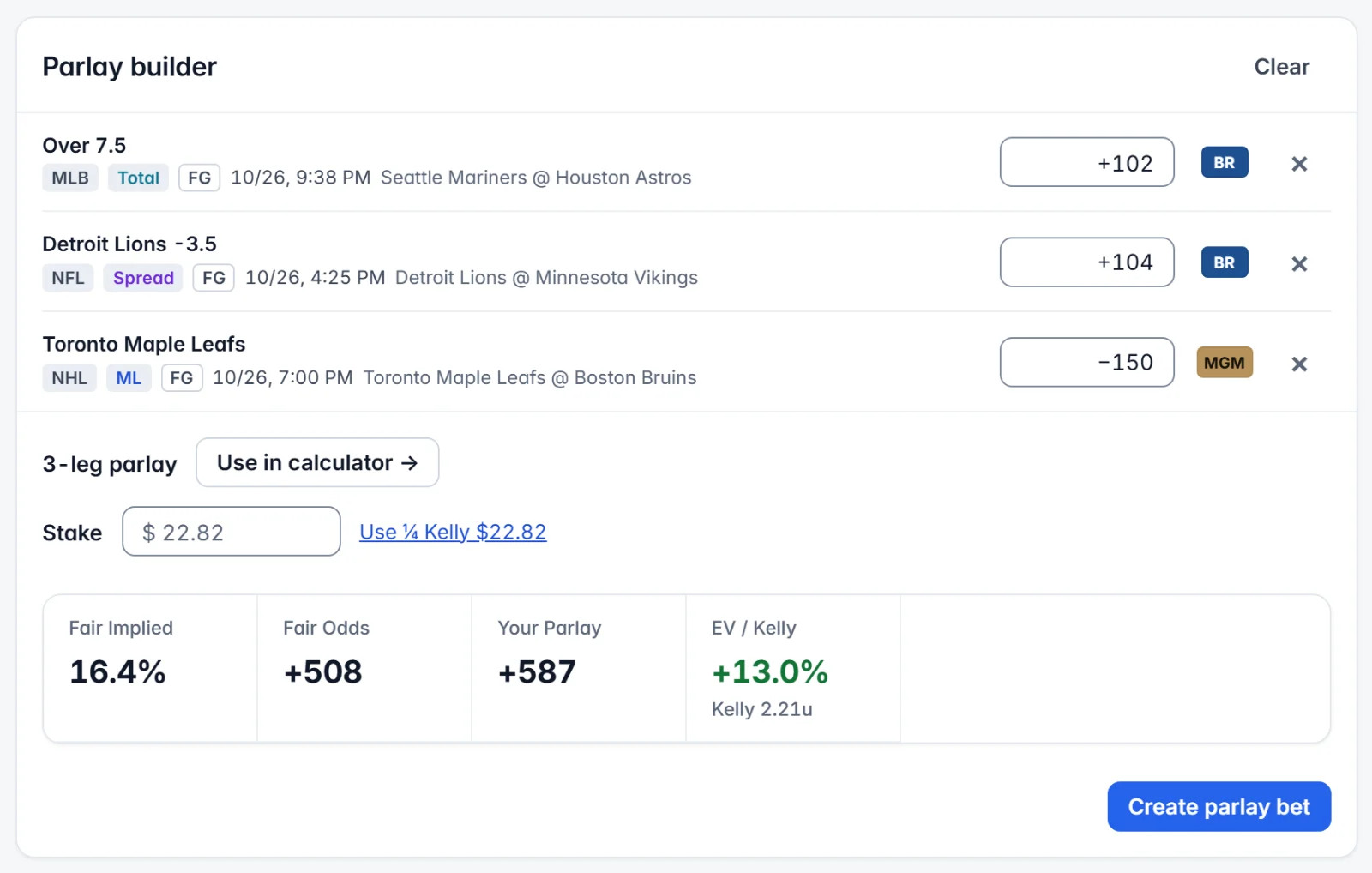
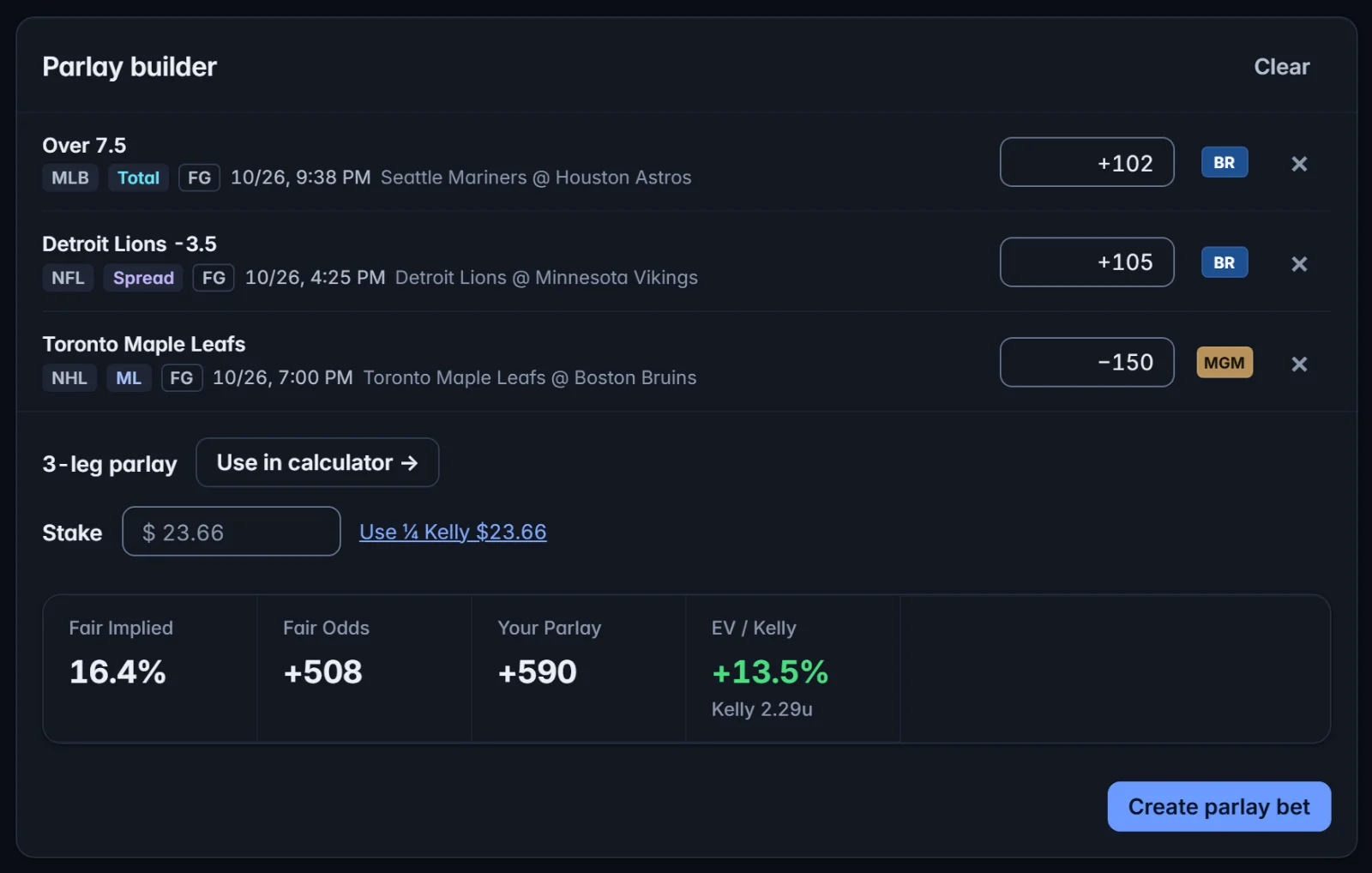
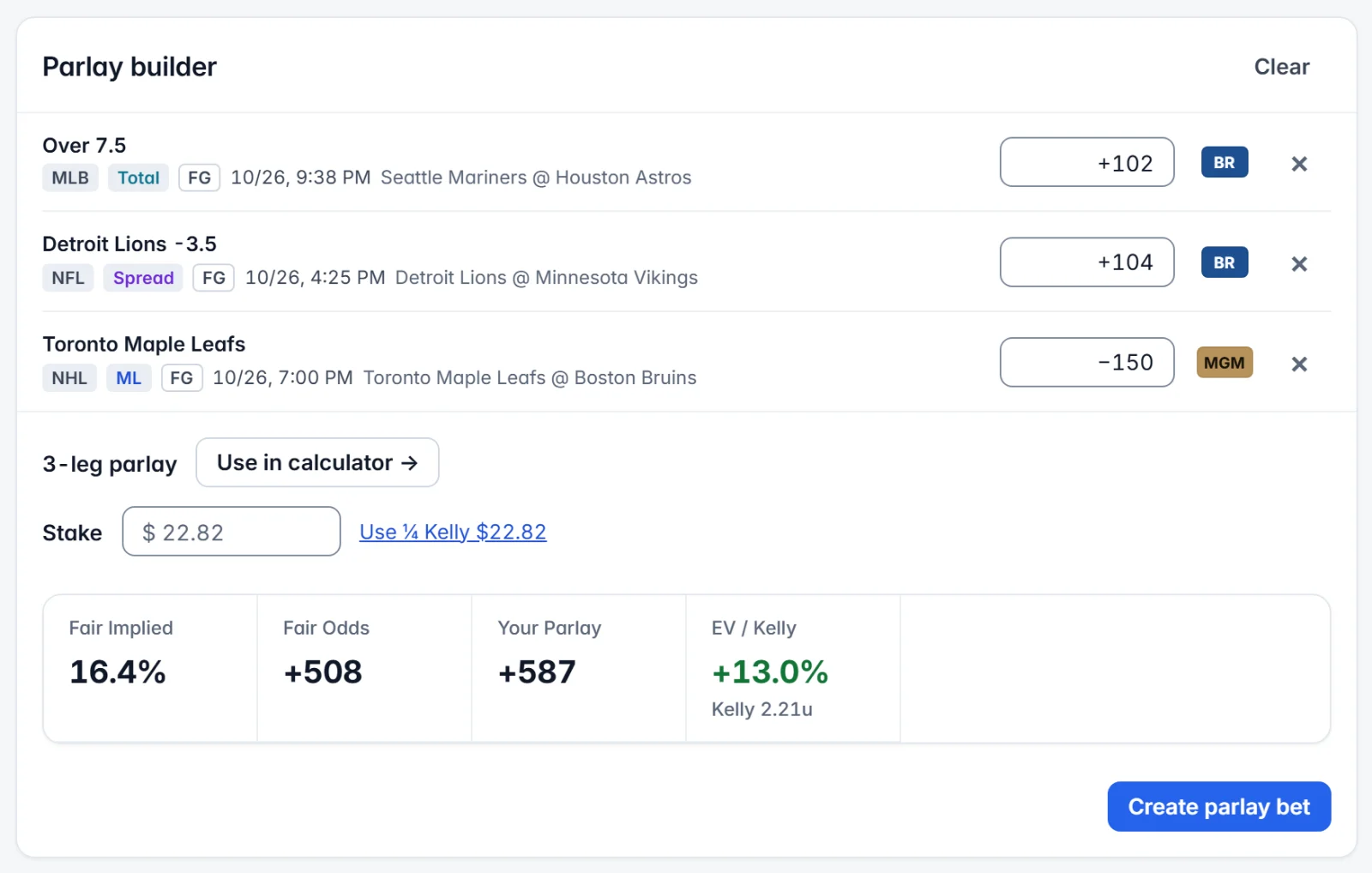
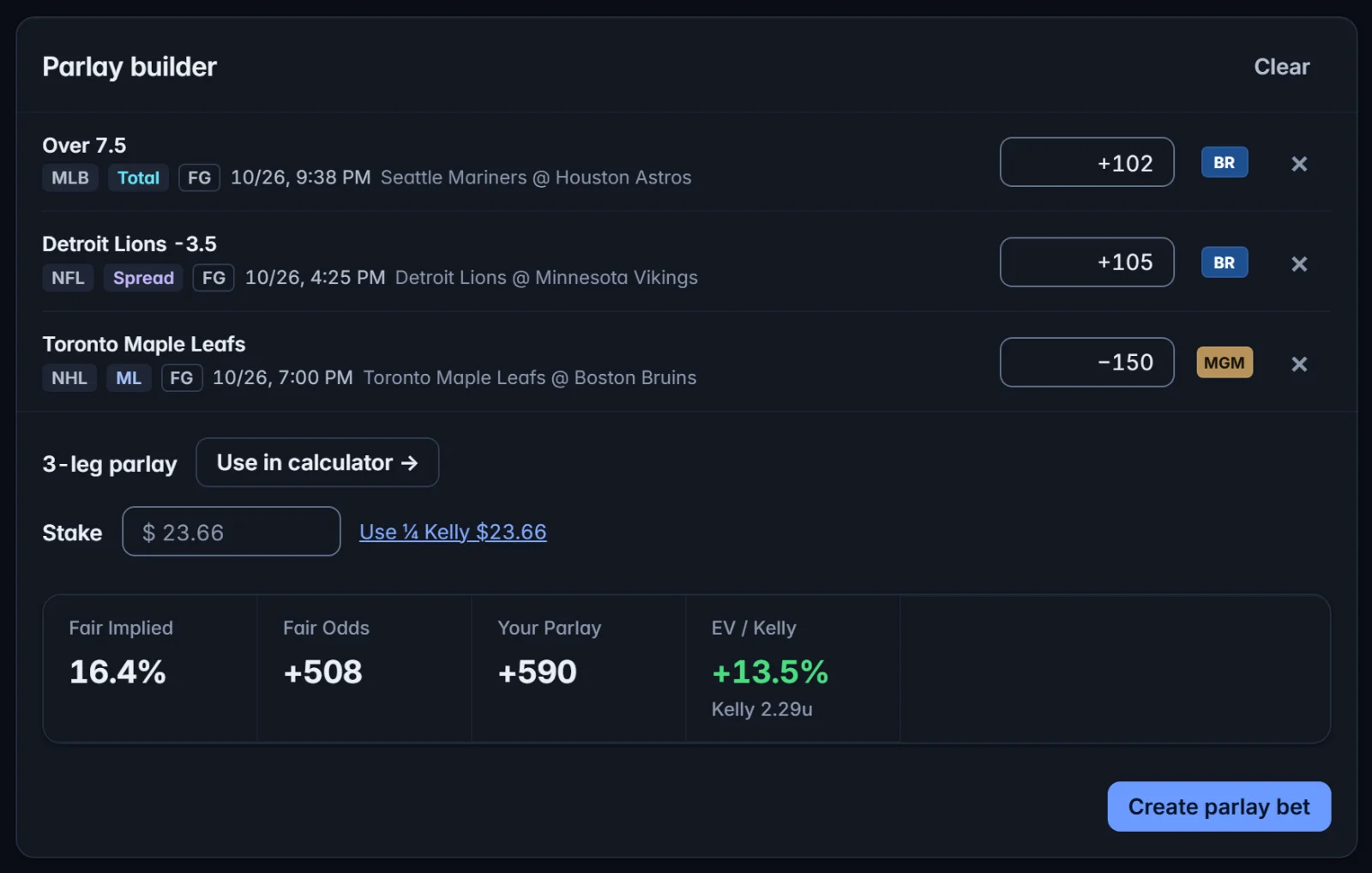
Send bets to the builder with Add to parlay (the + under a bet's star on the +EV board, or the button in its expanded view). Each leg keeps the price and book it had when you added it, and you can type a different price if your book offers one; adding a leg doesn't track the bet. Open the Parlay builder tab and it shows:
- Fair implied and Fair odds: the product of each leg's de-vigged fair probability from the sharp book.
- Your parlay: the product of the leg prices listed in the builder (each leg's best price when you added it, or the price you typed).
- EV / Kelly: the parlay's EV against the fair probability and its Kelly stake in units.
- A stake field with a one-click Kelly suggestion (¼ Kelly by default).
- Warnings when two legs share a game or a market, or a leg has started.
- Where a book supports it, a link that opens the parlay on that book's betslip with the parlay's EV at its current prices; Use in calculator, which sends the parlay's fair probability to the price calculator; and Create parlay bet, which turns the legs into one tracked parlay bet for your P&L.
Key takeaways
- Parlay EV = Π(1 + EVᵢ) − 1 for independent legs. Edges compound; so does vig.
- Three −110 coin flips: −13% EV. Three +3% legs: +9.3%. Same structure, opposite sign.
- Same game legs are correlated; books price that and usually charge more for it. Multiplying fair probabilities doesn't price an SGP.
- Parlays are about three times as volatile per dollar as a single −110-type bet at three legs; expect long losing runs.
- Kelly stakes for parlays are small (EV ÷ net odds), and straights often grow a bankroll faster when you can bet them at size.
Related guides and calculators
- Value betting: how to find +EV bets: the source of every +EV leg.
- Implied probability in betting: why probabilities multiply across legs.
- Profit boost strategy: how a parlay boost changes the EV.
- Sports betting bankroll management and the Kelly criterion: sizing high-variance bets.
- Free tools: Kelly criterion calculator, betting EV calculator, odds converter.
Responsible gambling
Parlays are high-variance bets that lose most of the time, even when they're +EV, and no strategy guarantees a profit. Only bet what you can afford to lose and set limits before you start. You must be 21+ (or the legal age where you live) to bet. If gambling stops being fun, call or text 1-800-GAMBLER for free, confidential help.
Examples are illustrative, not live prices or betting advice. Every number here can be reproduced with scripts/article_parlay_ev.py.
Frequently asked questions
How do you calculate the EV of a parlay?
For independent legs, multiply each leg's (1 + EV) together and subtract 1. Equivalently, the product of the legs' fair probabilities is the parlay's fair probability p, the product of their decimal odds is the parlay's decimal odds D, and EV = p × D − 1.
Are parlays worth it?
Usually not. Most parlays are built from ordinary −EV legs, and the vig compounds: three −110 coin flips are about −13% EV and six are about −24%. A parlay is only worth it when every leg is +EV against a sharp fair price, the legs are independent, and you stake it small.
Are parlays ever +EV?
Yes, when every leg (or the legs on balance) is +EV against a sharp fair price and the legs are independent or the book underprices their correlation. A parlay of +EV legs is more +EV in percentage terms than any one of its legs, but most parlays are built from −EV legs, and then the vig compounds against you.
Why do sportsbooks love parlays?
Because the book's margin compounds. Three −110 legs on 50/50 outcomes pay +596 when the fair price is +700, a −13% EV bet, versus −4.5% for each leg on its own. Six legs is about −24%.
Do same game parlays have worse odds?
Usually the margin is higher. Books adjust same game parlay prices for correlation and tend to add extra hold on top, so multiplying the legs' fair probabilities as if they were independent tells you little about a same game parlay's true EV.
How much should I bet on a +EV parlay?
Less than you think. The Kelly stake is EV ÷ (decimal odds − 1), and parlay odds are long, so even a +10% parlay at +779 has a full-Kelly stake of about 1.3u (1u = 1% of bankroll), and most bettors use a quarter of that.
Free calculators for this topic: Kelly Criterion Calculator: Optimal Bet Size for Sports, Odds Converter and Implied Probability Calculator, Betting EV Calculator: Expected Value of Any Bet.
OddScouter is an information tool, not a sportsbook, and nothing here is betting or financial advice. Positive expected value is not a promise of profit. You must be 21 or older. Gambling problem? Call 1-800-GAMBLER. Responsible gambling resources.