Kelly Criterion Calculator: Optimal Bet Size for Sports
Free Kelly criterion calculator for sports betting: enter your odds and fair win probability and see full, half or quarter Kelly stakes in units, plus dollars.
A Kelly criterion calculator tells you how much of your bankroll to stake on a bet so that your money grows as fast as possible over the long run, given the odds you're taking and the bet's true win probability. Enter the American odds and your fair probability, choose full, half, quarter or a custom fraction of Kelly, and it returns the stake in units (1u = 1% of your bankroll, i.e. a 100u bankroll). Add what one unit is worth in dollars and it shows the dollar stake too. If the bet has no positive expected value, it returns zero.
Kelly calculator
The stake that maximises long-run growth, in units (1u = 1% of your bankroll).
This calculator needs JavaScript. Enable it to use the form below; the explanation above works without it.
Enter your numbers to see results.
The calculator is prefilled with an illustrative NHL example: the Bruins at +140 with a 44% fair win probability, sized at half Kelly. The "dollars per unit" box is set to $20, as for a $2,000 bankroll. Your inputs are saved in your browser only.
How to use the Kelly calculator
- Enter your odds in American format, for example
+140or-150. Use the price you can actually bet, not the market average. - Enter the fair probability of your side winning, in percent. This is the number everything depends on, so take it from a reliable source, usually a sharp book's devigged line (see the no-vig calculator).
- Optionally enter the dollars per unit. One unit is 1% of your bankroll (a $2,000 bankroll has 1u = $20). The money should be set aside for betting only, not your savings.
- Pick a Kelly fraction. Full Kelly is the theoretical maximum-growth stake; half and quarter Kelly are what most experienced bettors actually use. "Custom" lets you enter any percentage of full Kelly.
- Read the result: the stake in units (and in dollars if you gave a unit size), the full Kelly stake it came from, and the EV of the bet.
How the Kelly criterion works
The calculator uses the standard Kelly formula for a bet that either wins or loses:
Kelly fraction = (b × p − (1 − p)) / b
- b = decimal odds − 1 (your net profit per $1 if the bet wins)
- p = fair (true) win probability
- the result is clamped at 0, so a bet with no edge receives no stake
- fractional Kelly multiplies the result (½ Kelly = 0.5 × the full stake)
- the calculator shows the stake in units: the fraction × 100, so 0.04 is 4u (1u = 1% of bankroll)
American odds convert to decimal as +A → 1 + A/100 and −A → 1 + 100/A.
A useful way to read the formula: the numerator, b·p − (1 − p), is the bet's expected value per $1. So Kelly = EV ÷ b. Your stake grows with your edge and shrinks as the odds lengthen, because longshots lose more often and need more bankroll to ride out the losing runs.
Worked example 1: an NHL underdog
The Bruins are +140 at a recreational book, and the devigged sharp line gives them a 44% chance. Bankroll: 100u ($2,000, so 1u = $20).
- Decimal odds = 1 + 140/100 = 2.40, so b = 1.40
- EV = 0.44 × 1.40 − 0.56 = +0.056, or +5.6%
- Full Kelly = 0.056 / 1.40 = 4.0u = $80
- Half Kelly = 2.0u = $40, quarter Kelly = 1.0u = $20
Worked example 2: favourite vs longshot
Same 100u ($2,000) bankroll, two other bets (illustrative prices):
| Bet | Odds | Fair p | EV | Full Kelly | ½ Kelly | ¼ Kelly |
|---|---|---|---|---|---|---|
| NFL favourite | −150 | 62% | +3.33% | 5.00u ($100) | 2.50u ($50) | 1.25u ($25) |
| MLB player prop | +400 | 21% | +5.00% | 1.25u ($25) | 0.63u ($12.50) | 0.31u ($6.25) |
The prop has the bigger edge but receives a quarter of the stake. That isn't a bug: at +400 you lose 79% of the time, and Kelly sizes the bet so those streaks don't sink you.
Why most bettors use fractional Kelly
Full Kelly is "optimal" only when your probability is exactly right, and it never is. Two facts drive the preference for ¼ to ½ Kelly:
- Estimation error hits Kelly hard. In the Bruins example, if the true probability is 42% instead of 44%, the correct full-Kelly stake is 0.57u, not 4u. You'd be betting seven times too much. Overbetting by 2× the true Kelly stake wipes out long-run growth entirely, under the standard approximation.
- Full Kelly is a rough ride. Under the same approximation, a full-Kelly bettor has about a 50% chance of seeing the bankroll halve at some point. At half Kelly that falls to about 12.5%, while keeping roughly 75% of the growth rate. At quarter Kelly it's under 1%.
The Kelly criterion guide covers the derivation in depth, and flat units vs full, half and quarter Kelly shows simulated bankroll paths for each.
Common Kelly mistakes
- Using the sportsbook's implied probability as "fair". The bet's own price has no edge against itself. Your fair probability must come from somewhere else, typically a sharp market with the vig removed.
- Forgetting to devig. Raw implied probabilities include the bookmaker's margin, so they overstate every side. Plugging them in inflates your edge and your stake.
- Betting full Kelly on a noisy estimate. Thin player props and early lines carry more uncertainty than NFL sides at close. Use smaller fractions where your fair line is weaker.
- Sizing off a bankroll you don't have. Kelly assumes the bankroll is money you're willing to lose entirely. Recalculate after big swings, up or down.
- Stacking simultaneous bets at full stake. Kelly is derived for one bet at a time. When you have many bets open at once on the same slate, the combined exposure can exceed what Kelly intends; scale down.
- Ignoring limits and rules. A Kelly stake is pointless if the book caps you at $25, and player props can void when a player doesn't play. The math assumes the bet settles as written.
How OddScouter automates Kelly sizing
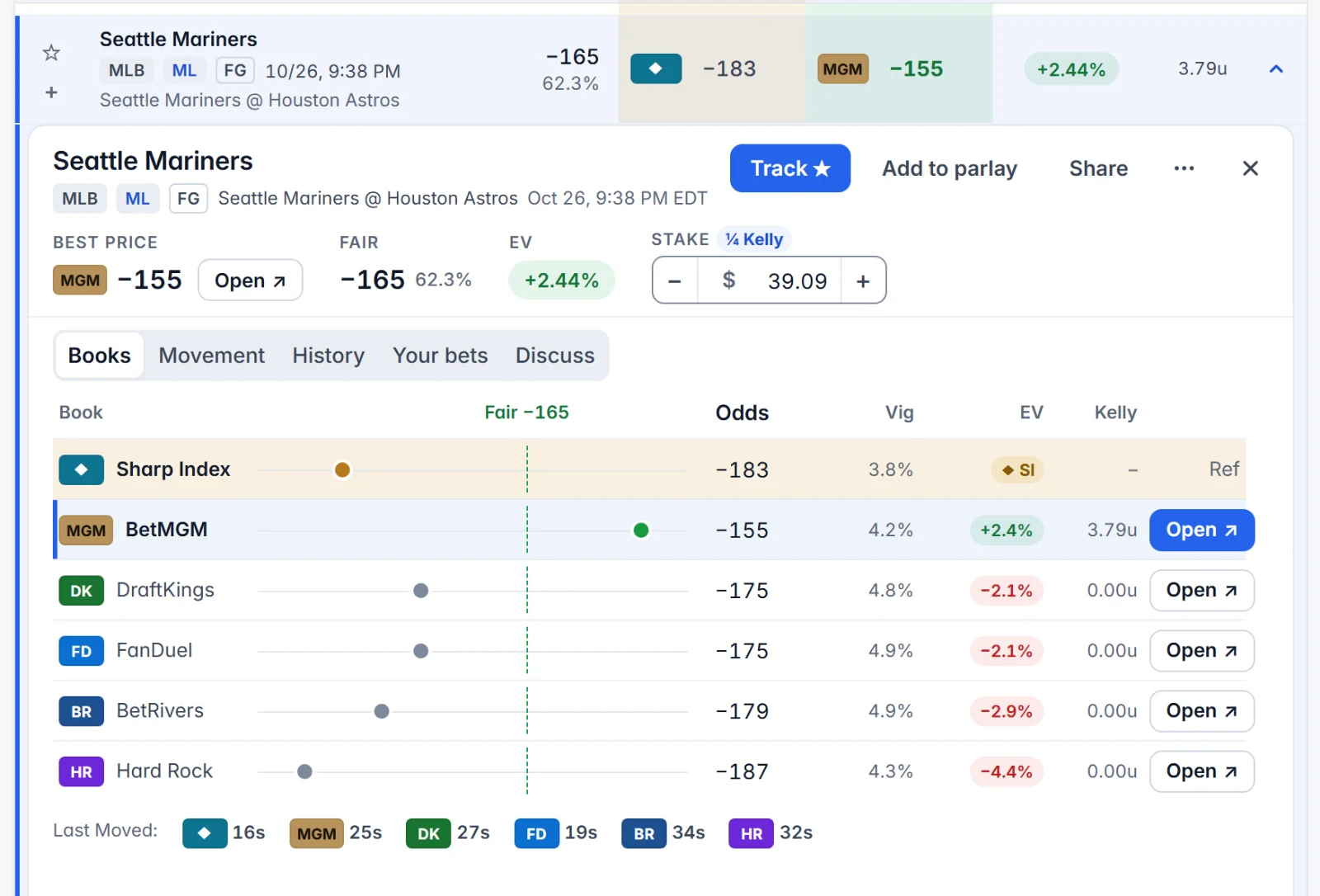
Doing this by hand for every price is slow. OddScouter devigs sharp markets for you and grades every sportsbook price against that fair line, so the inputs this calculator needs are already filled in:
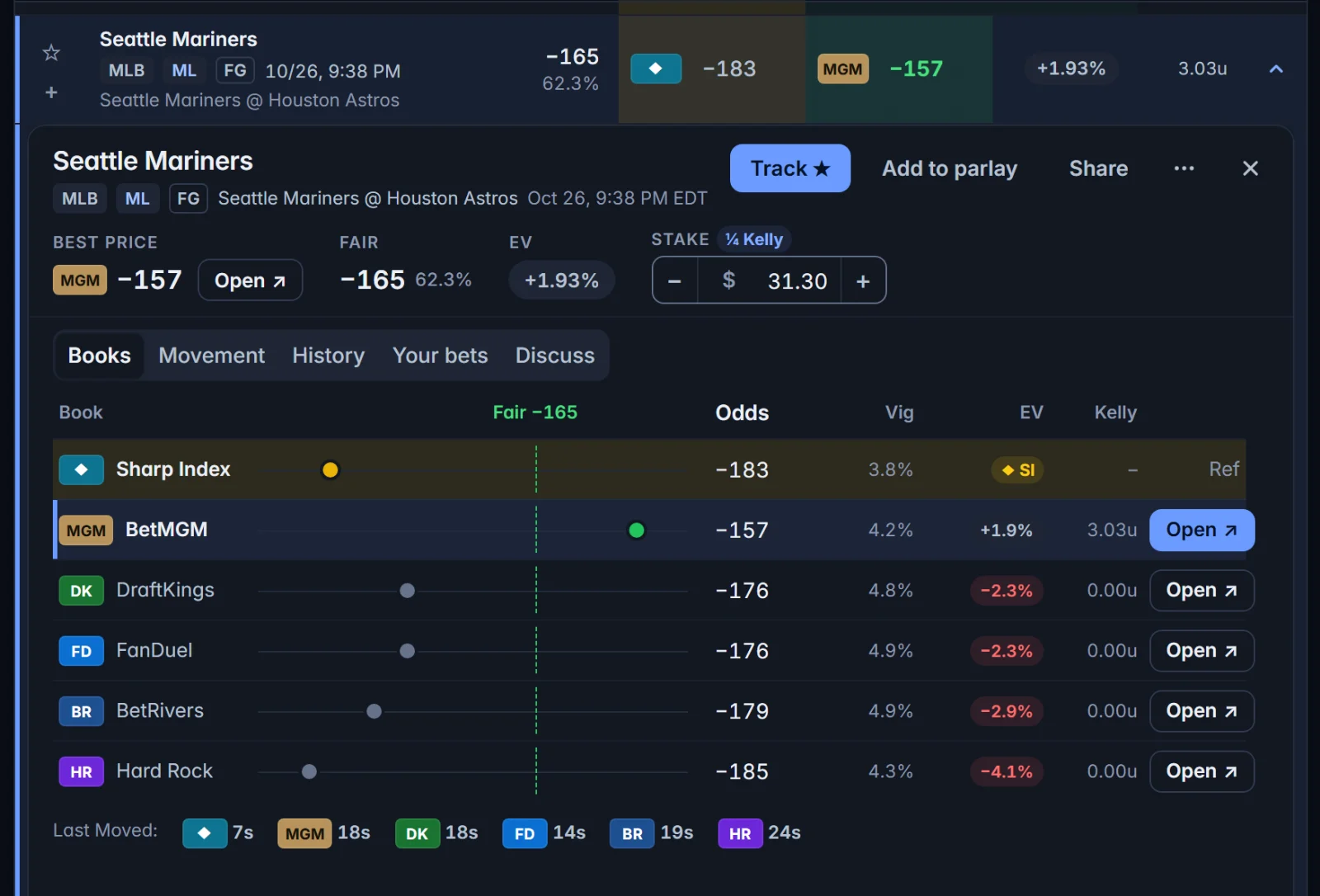
- The +EV board's Kelly column shows the full-Kelly stake in units of a 100-unit bankroll, so "3.14u" is the stake at 1u = 1% of bankroll, the same convention as this calculator.
- Expand a bet and its summary (Best price, Fair, EV, Stake) shows a suggested stake in dollars from your bankroll setting, at ¼ Kelly by default; clicking the ¼ Kelly label cycles it to ½ Kelly and full Kelly.
Learn the math behind this calculator
- The Kelly criterion in sports betting: the formula, its history, and why fractional Kelly.
- Sports betting bankroll management: flat units vs full, half and quarter Kelly, simulated.
- Value betting: how to find positive EV bets: where the edge you size comes from.
- Parlay EV: why Kelly stakes on parlays are so small.
Related free tools: betting EV calculator, no-vig fair odds calculator, odds converter.
Responsible gambling
The Kelly criterion helps you size bets sensibly; it does not make betting safe or profitable. Every bet can lose, estimates of edge are often wrong, and long losing streaks happen even to skilled bettors. Only bet money you can afford to lose. You must be 21+ (or the legal age where you live). If gambling stops being fun, call or text 1-800-GAMBLER for free, confidential help.
Frequently asked questions
What inputs does a Kelly criterion calculator need?
The odds you can bet, the bet's fair win probability, plus the fraction of Kelly you want (and, optionally, what one unit is worth in dollars). The stake as a fraction of bankroll = (b × p − (1 − p)) / b, where b is the decimal odds minus 1 and p is the true win probability. At +140 (b = 1.4) with a 44% fair probability, Kelly = (1.4 × 0.44 − 0.56) / 1.4 = 0.04 of your bankroll, which is 4u (1u = 1% of bankroll).
Should I bet full Kelly or fractional Kelly?
Most professional bettors use a quarter to half of the Kelly stake. Full Kelly maximises long-run growth only if your probability is exactly right; in practice your edge estimate has error, and full Kelly produces deep drawdowns. Half Kelly keeps about 75% of the growth with half the volatility.
What does it mean when the Kelly calculator says 0?
A Kelly stake of zero means the bet has no positive edge at that price. Your fair probability is at or below the break-even probability implied by the odds, so the expected value is zero or negative and Kelly says not to bet.
Why does Kelly bet more on favourites than on longshots with the same EV?
Kelly stake equals EV divided by b, the net odds. A +3.3% EV bet at −150 has b = 0.667, so Kelly is 5u; a +5% EV bet at +400 has b = 4, so Kelly is only 1.25u. Longshots lose more often, so the same edge supports a smaller stake.
Where does the fair probability for a Kelly calculation come from?
The most common source is a sharp sportsbook's price with the vig removed (devigged). Use a no-vig calculator on both sides of the sharp market, then enter the fair probability of your side here.
Does the Kelly calculator work for parlays?
Yes, if you enter the parlay's combined odds and its combined fair probability (the product of each independent leg's fair probability). Correlated legs break that multiplication, so treat same-game parlays with care.
Related tools: Betting EV Calculator: Expected Value of Any Bet, No-Vig Calculator: Fair Odds by the Power Method.
OddScouter is an information tool, not a sportsbook, and nothing here is betting or financial advice. Positive expected value is not a promise of profit. You must be 21 or older. Gambling problem? Call 1-800-GAMBLER. Responsible gambling resources.