Value Betting: How to Find Positive EV (+EV) Bets
Value betting explained: what +EV means, how to calculate a bet's expected value, where fair odds come from, line shopping, CLV and realistic results.
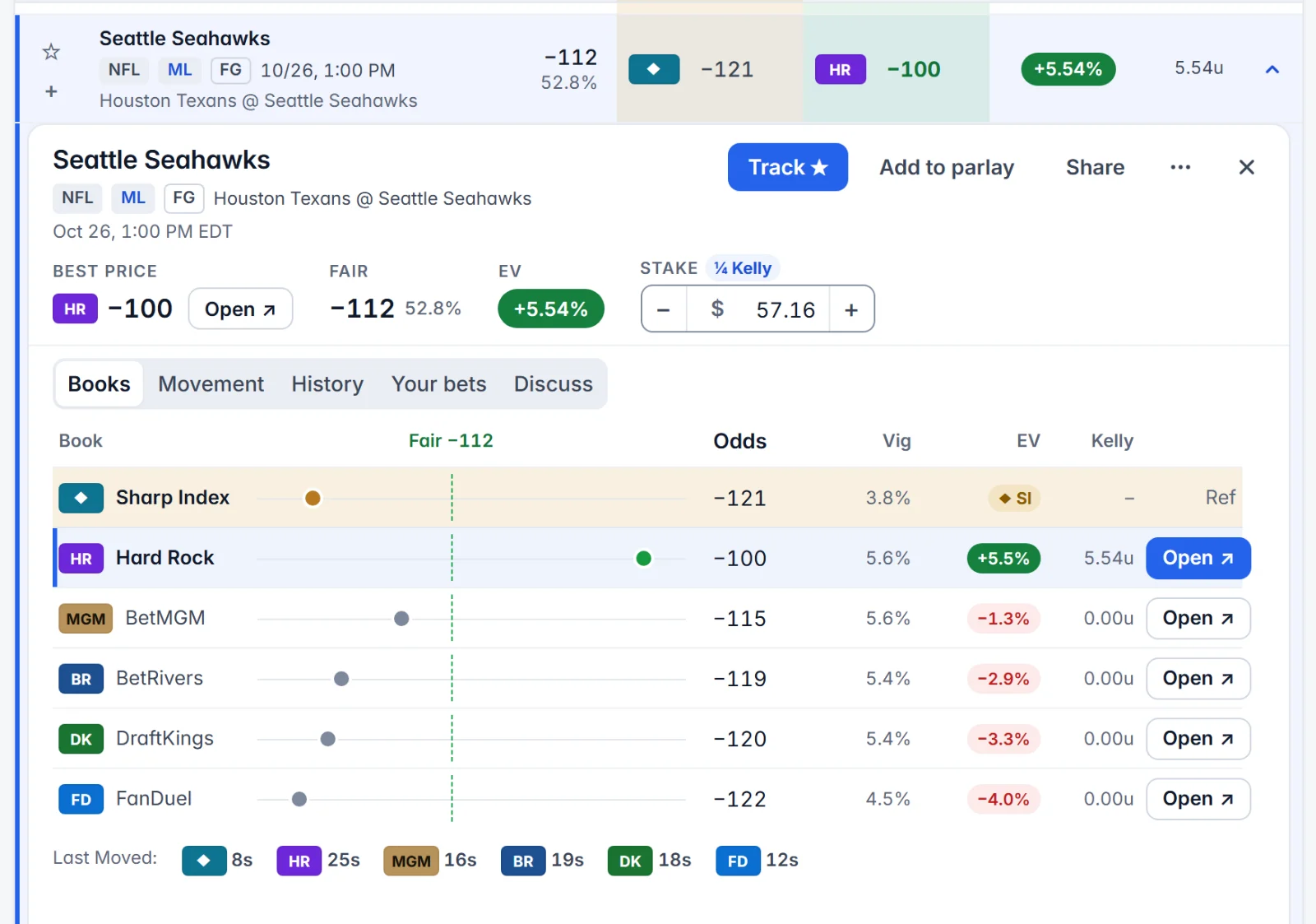
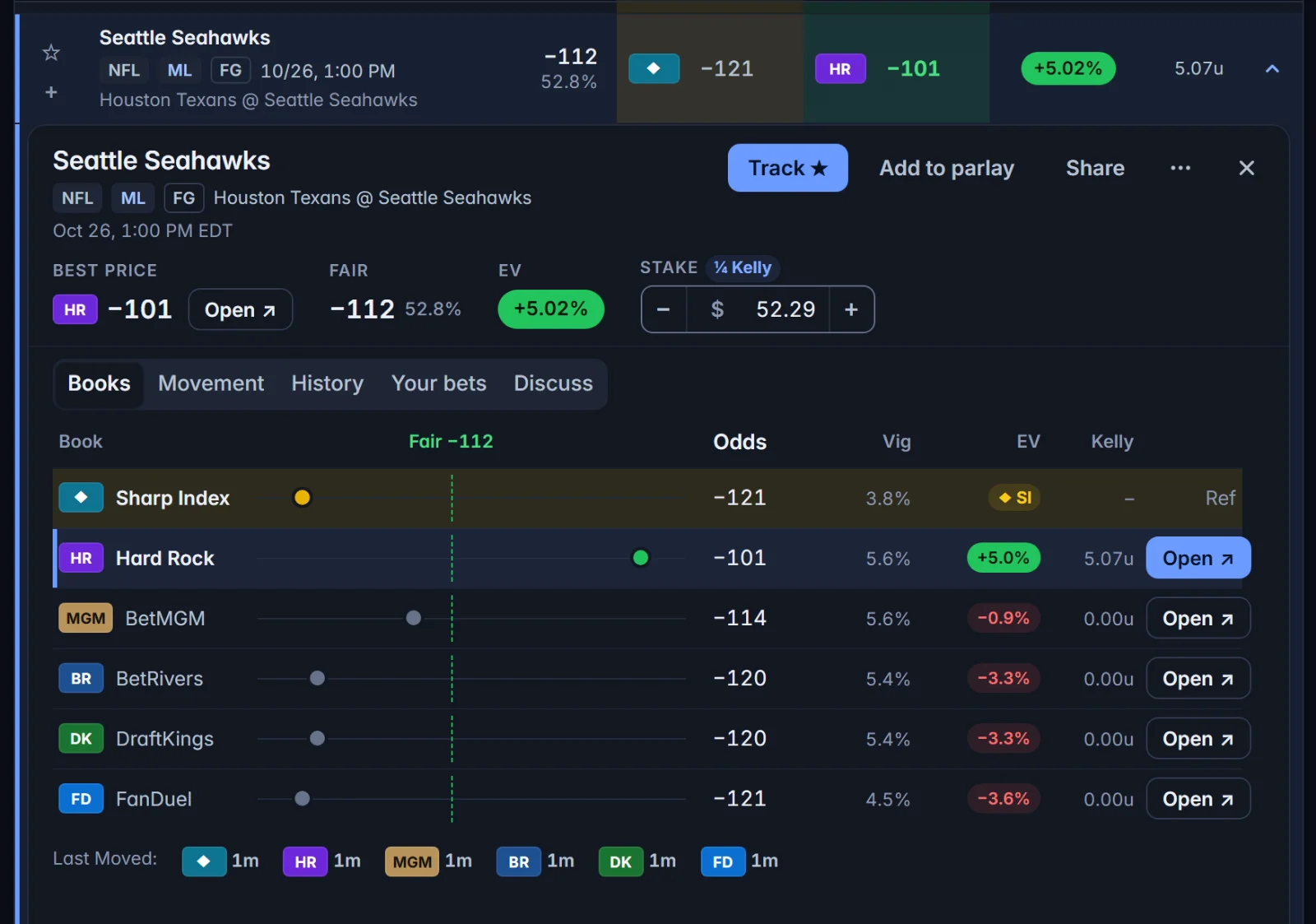
Value betting is betting only when the odds you're offered pay more than the outcome's true probability is worth. You estimate that probability from a sharp, low-vig market with the bookmaker's margin removed, compare it with the price at a recreational sportsbook, and bet when the gap is positive: positive expected value, or +EV. Each bet still wins or loses, but over hundreds of bets the edge shows up in your results.
In short:
- A bet is +EV when true probability × decimal odds is greater than 1.
- The "true probability" usually comes from a sharp book's line with the vig removed (devigged).
- Real edges are small, about 1–5%, so profit needs volume, sensible stakes and patience.
- Judge yourself by closing line value (CLV) early on, not by your win rate.
This is the starting point of the OddScouter Learn center. Each section below links to a deeper guide, and the full list of guides and free calculators is at the end.
What is +EV betting?
Expected value (EV) is the average profit a bet would return per dollar if you could place it thousands of times under identical conditions. It depends on two numbers only: the price you take and the true probability of winning.
EV per $1 = p × (decimal odds − 1) − (1 − p)
which simplifies to EV = p × decimal odds − 1, where p is the true (fair) win probability.
A coin flip shows the logic. Heads lands 50% of the time. If someone pays you even money (+100, decimal 2.00), EV = 0.5 × 2.00 − 1 = 0: no edge. If they pay +110 (decimal 2.10), EV = 0.5 × 2.10 − 1 = +5%. You will still lose about half your flips, but each $100 flip is worth $5 to you on average.
Sports bets work exactly the same way. The hard part is p. Nobody hands you the true probability of the Bills winning in Kansas City, so value betting is mostly the craft of estimating it well. If converting odds into probabilities is new to you, start with implied probability: how to convert betting odds.
How to calculate the EV of a bet: an NFL example
Say the Bills visit the Chiefs (illustrative prices). A sharp book deals the moneyline at:
| Side | Sharp price | Implied probability |
|---|---|---|
| Bills | +132 | 43.10% |
| Chiefs | −142 | 58.68% |
| Total | 101.78% |
The two implied probabilities add up to 101.78%. The extra 1.78% is the bookmaker's margin (the vig). Removing it, which is called devigging, leaves fair probabilities (how to devig odds compares the methods). The power method gives the Bills a fair probability of 42.15% (fair odds about +137); the simpler multiplicative method gives 42.35% (+136).
Now you shop the recreational books and find Bills +145 at one of them:
- Decimal odds: 1 + 145/100 = 2.45
- EV = 0.42149 × 2.45 − 1 ≈ +3.26%
- On a $100 bet: expected profit about $3.26
At other prices the same bet looks very different:
| Price on offer | EV vs a 42.15% fair probability |
|---|---|
| +145 | +3.26% |
| +140 | +1.16% |
| +135 | −0.95% |
| +130 | −3.06% |
Fifteen cents of price is the whole difference between a good bet and a bad one. Try your own numbers:
EV calculator
Expected value of a bet, given the true (fair) chance it wins.
This calculator needs JavaScript. Enable it to use the form below; the explanation above works without it.
Enter your numbers to see results.
The same calculator, with more worked examples, has its own page: the free betting EV calculator.
How to find value bets, step by step
There are two broad ways to estimate a true probability: build your own model, or borrow the market's. Most profitable value bettors borrow the market's, specifically from sharp books.
A sharp book (think of high-limit, low-margin operations and the brokers that give access to them) takes big bets from professional bettors and moves its line quickly when sharp money comes in. Its prices soak up a lot of information: injuries, weather, lineup news, and the opinions of people betting serious money. Recreational books (the big US apps) mostly make their money on margin and on bettors who don't shop, so their lines often lag the sharp market or are shaded toward popular sides.
The value betting recipe:
- Take the sharp book's full market, both sides of a two-way line (or all three of a three-way line).
- Remove the vig, which leaves fair probabilities. The free no-vig fair odds calculator does this in one step.
- Compare each recreational book's price for the same line with that fair probability.
- Bet when the EV clears a threshold you trust. Many bettors use +2% or more on main markets.
Devig calculator
Enter every outcome's price from one sportsbook to remove the vig four ways.
This calculator needs JavaScript. Enable it to use the form below; the explanation above works without it.
Enter your numbers to see results.
How much should you trust the sharp line?
A lot, but not blindly. Closing lines at sharp books are widely regarded as the best public estimate of a game's probability, and beating them is strongly associated with long-run profit. But a sharp line can still be wrong, a market can be thin (low-limit player props especially), and the devig method you use shifts fair prices slightly, more so on lopsided markets. Treat small edges (under 1–2%) as noise-sensitive, and bigger edges on thin markets with some suspicion.
Line shopping: the easiest edge in sports betting
Even if you never chase a +EV bet, comparing prices across books is the easiest money in sports betting. Take an NFL total, Over 48.5, where the fair probability of the Over is 50.8% (illustrative):
| Price | Implied probability | EV |
|---|---|---|
| −115 | 53.49% | −5.03% |
| −110 | 52.38% | −3.02% |
| −105 | 51.22% | −0.82% |
| +100 | 50.00% | +1.60% |
| +102 | 49.50% | +2.62% |
Same bet, same game, and a spread of more than seven percentage points of EV depending on where you click "place bet". A bettor who always takes −110 when +100 is available gives up about 4.6% of every dollar staked. Over a season that is far bigger than most people's edge from picking winners. The free vig calculator shows how much margin each book is charging on a market.
Line shopping is also what makes value betting possible at all: the +EV opportunity is almost always one book being slow or generous while the rest of the market has moved on. When the best prices across books move far enough apart, you can even back every side for a locked-in return, which is arbitrage betting.
Closing line value (CLV): how to know your bets are +EV
Results are a noisy way to judge betting skill (more on that below). Closing line value (CLV) is a much faster signal. It compares the price you took with the fair price at the moment the game starts, when the market has absorbed the most information.
Back to the Bills. Suppose by kickoff the sharp market has moved to Bills +128 / Chiefs −138. Devigged, that's a closing fair probability of 42.88% (about +133). Your +145 ticket, judged against the closing fair probability:
- CLV = 0.42878 × 2.45 − 1 ≈ +5.05%
You beat the close by about 5%. If you consistently take prices better than the closing fair line, you are very likely a winning bettor even through a stretch of losses, because the closing line is the best available estimate of each bet's true probability. Consistently negative CLV is a warning sign even if you're up money.
CLV has limits too. It is only as good as the closing market it's measured against, it says nothing about bets on markets that never have a sharp close, and positive CLV over 30 bets is still a small sample. But over a few hundred bets it tells you far sooner than your profit and loss whether your process works. Implied probability and results versus process shows how noisy short-run results are.
How OddScouter finds +EV bets
OddScouter runs the routine above continuously across FanDuel, DraftKings, BetMGM, BetRivers, Hard Rock and Underdog for NFL, NBA, MLB and NHL game lines and player props. It also grades the Kalshi and Polymarket prediction markets, whose availability varies by state, on full-game moneylines, spreads, totals and team totals in the same four leagues, using each exchange's price with its trading fee included.
- Sharp reference: the Sharp Index. The Sharp Index is the no-vig fair price from the world's sharpest market makers (Pinnacle, SBOBet and the Betdaq, Matchbook and Smarkets exchanges), combined into one line: the best price any of them offers on each side, with the margin removed. These are books that take large bets from professionals and move quickly on information. Game lines (moneylines, spreads, totals, team totals) are always graded against it. For player props the Props devig setting offers the Sharp Index, FanDuel, or "Lowest vig" (the default), which picks whichever of the two quotes the tighter market on that specific prop. A sharp quote carrying more than 10% vig is not used as a reference.
- Devigging. Every fair price on the board uses the power devig method, which takes more of the margin off longshots (and less off favourites) than the proportional method does. The devig guide explains why that matters on lopsided lines.
- EV and Kelly on every row. Each row shows the best recreational price, the fair odds, the EV of that price, and a full-Kelly stake in units (1u = 1% of bankroll). Filters for minimum EV, odds range, league, market and period cut the board down to what you actually bet.
- Line movement and stale lines. Expand a bet to see every book's price (with its own vig, EV and Kelly) and a movement chart. The Stale lines tab lists rec books still dealing a number the sharp book has already moved off.
- Tracking and CLV. Star a bet or log it with your stake, and the P&L tab records the price you locked. Once the game starts it grades your bet against the closing fair line, so you see your weighted average CLV and an "EV P/L" line (what your bets were worth) beside your actual profit.
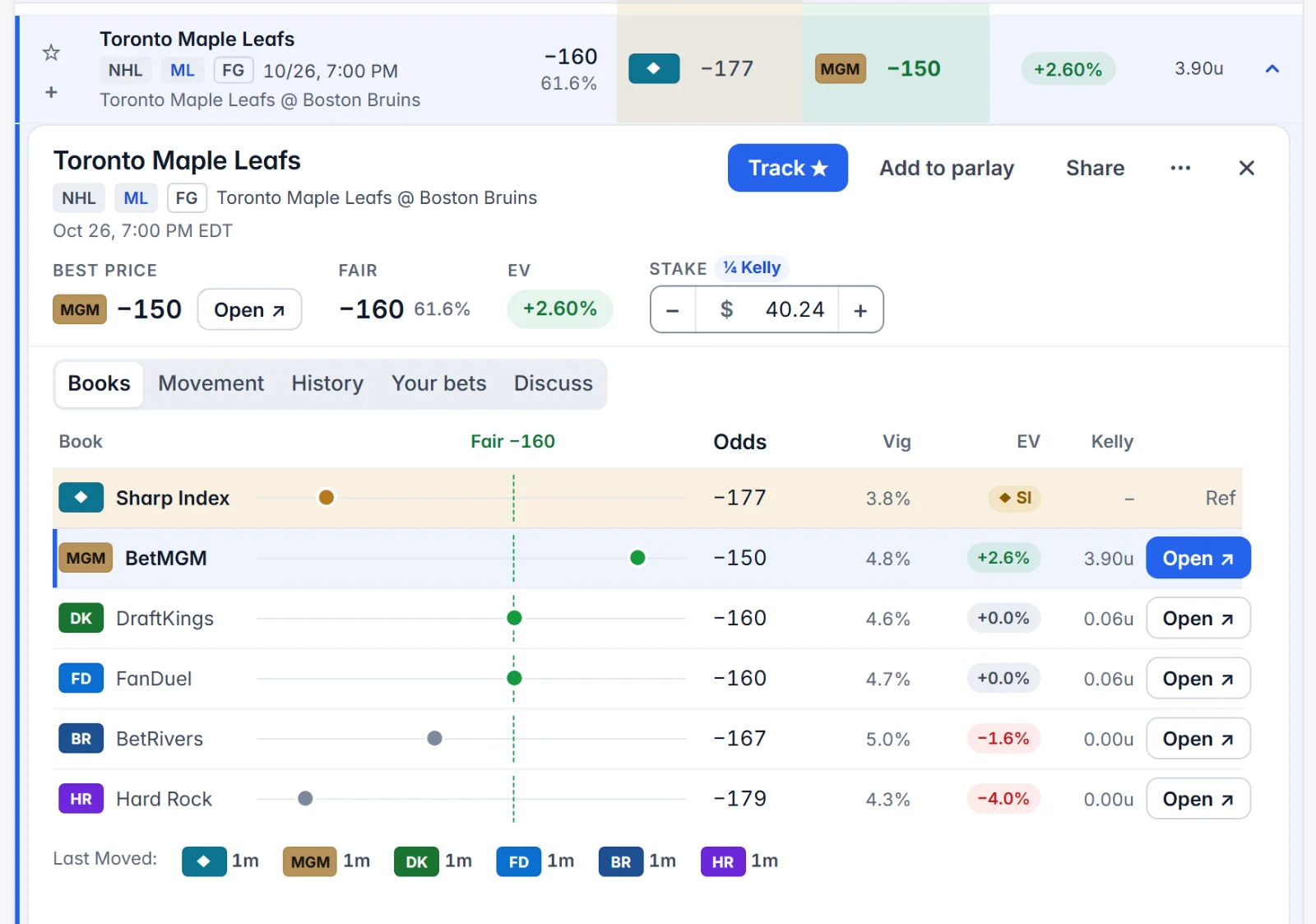
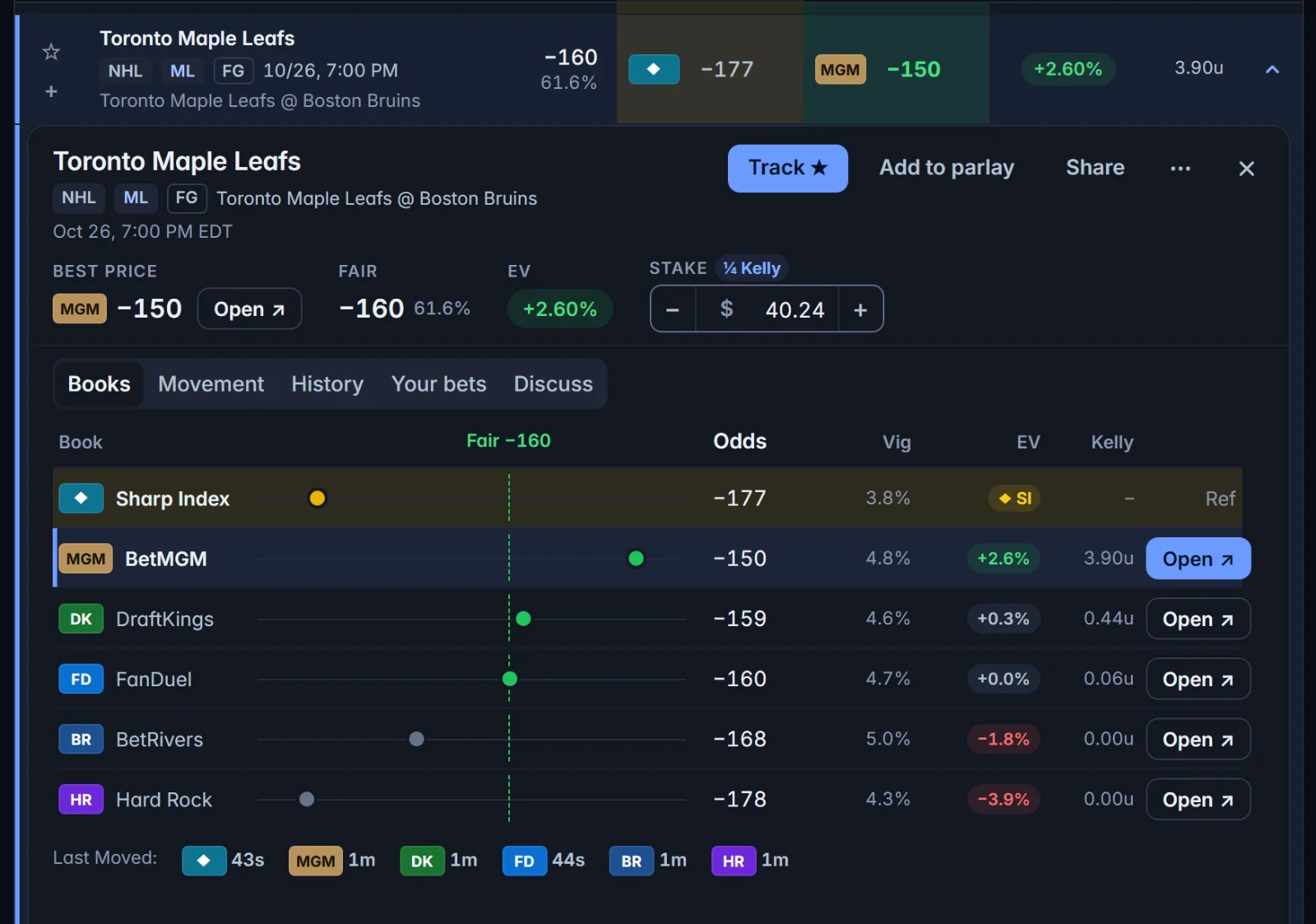
The board tells you where the edge is; it doesn't place bets, and it can't promise any single bet wins. You still choose what to bet, how much, and where.
Is value betting profitable? Realistic expectations
This is the part most "+EV betting" content skips.
Edges are small: 1–5% is normal
On main markets, a genuine edge of 2–4% is good. Player props and slower books can show larger numbers, but the bigger the edge, the more you should ask why the market hasn't corrected it (a stale feed, a different line, an injury the sharp book already priced). Edges above 10% are usually errors, either the book's (which may be voided, see below) or the comparison's.
Profit takes volume, and volume brings swings
At a 3% edge, a $100 bet is worth $3. A thousand of them are worth about $3,000, but the standard deviation of the result is roughly $3,200 (for bets near even money). So it's entirely possible to bet well for months and be down.
The chart shows the exact chance of being in profit after a given number of even-money bets at three edge sizes:
Read it carefully. A +3% bettor is ahead only about 62% of the time after 100 bets, 83% after 1,000, and 91% after 2,000. A +1% bettor is barely better than a coin flip for the first several hundred bets. That's why CLV, not profit, is the metric to watch early on, and why stake size matters so much. The Kelly criterion for sports betting and bankroll management: flat betting vs Kelly show how to size bets so a normal downswing doesn't knock you out.
Sportsbooks limit winning bettors
Recreational sportsbooks are allowed to limit or close accounts, and they do so with bettors who consistently beat their closing lines. Expect your maximum stakes to shrink at some books as your record builds. Practical responses: spread action across several books, don't hammer obvious errors, and treat your accounts as a resource that runs out.
Voids, rule differences and taxes
- Voids and palps. Books can void bets on "palpable errors" (obvious mispricings). An enormous edge is a red flag.
- Rule differences. A player prop may settle differently if the player doesn't play or leaves injured; some books count overtime in a market and others don't. Confirm the sharp market and your bet describe the same outcome under the same rules.
- Line differences. Over 4.5 shots on goal is not Over 3.5. Compare identical lines (OddScouter only grades a bet against the same line and period).
- Taxes. Gambling winnings are generally taxable. Keep records; the P&L tab helps.
Common value betting mistakes
- Using a recreational book as the "fair" line. A soft line with the vig removed is still a soft line.
- Ignoring the vig on the sharp side. Raw implied probabilities overstate both sides; always devig.
- Chasing huge EVs on thin props. Low-limit markets move on small bets and can be stale at the sharp end too.
- Judging yourself on 50 bets. Fifty bets tell you almost nothing. Track CLV.
- Overbetting. A real 3% edge with stakes that are too big can still go broke. See flat units vs Kelly.
- Parlaying +EV legs without thinking. Combining edges can help or hurt depending on the vig and correlation; parlay EV covers when it works. Profit boosts are a related source of value that's easy to misjudge.
A simple value betting routine
- Pick your sharp reference and devig method, and stick with them.
- Shop every book you have access to for the same line.
- Bet only above a minimum EV (start at +2% on main markets).
- Size each bet with a fraction of Kelly or a small flat unit (the Kelly criterion calculator gives the stake in units).
- Log every bet with the price you took.
- Review CLV monthly; review profit only over hundreds of bets.
The complete +EV toolkit: guides and free calculators
Every guide in the Learn center builds on this one. Read them in roughly this order:
- Implied probability: how to convert betting odds: turn any price into a win chance and a break-even rate.
- How to devig odds: vig, overround and hold, and the four devig methods compared.
- The Kelly criterion for sports betting: the formula, its history, and why most bettors use half or quarter Kelly.
- Sports betting bankroll management: flat units against full, half and quarter Kelly, simulated over 10,000 bettors.
- Parlay EV: are parlays worth it?: how edges and vig compound across legs.
- Arbitrage betting: the math of sure bets and the risks the formula hides.
- Profit boost strategy: which bets to boost, and how max-win caps change the answer.
Free calculators, no sign-in: the betting EV calculator, the no-vig fair odds calculator, the Kelly criterion calculator, the odds converter and implied probability calculator, and the vig and hold calculator.
Responsible gambling
Value betting improves your odds; it doesn't remove risk. Every bet can lose, long losing runs happen to good bettors, and no tool or method guarantees a profit. Only bet money you can afford to lose, set limits before you start, and take breaks. You must be 21+ (or the legal age where you live) to bet. If gambling stops being fun, call or text 1-800-GAMBLER for free, confidential help.
Examples are illustrative, not live prices or betting advice. The numbers can be reproduced with scripts/article_math.py.
Frequently asked questions
What is value betting?
Value betting is placing a bet only when the odds pay more than the outcome's true probability justifies. If a sportsbook offers +145 on a team whose fair price is +137, every dollar you stake is worth more than a dollar on average, so the bet has positive expected value (+EV).
What does +EV mean in sports betting?
+EV means positive expected value: the bet's average profit, over many identical bets, is above zero. EV per $1 = p × decimal odds − 1, where p is the true win probability. A true coin flip priced at +110 (decimal 2.10) has EV = 0.5 × 2.10 − 1 = +5%.
How do you find value bets?
Remove the vig from a sharp sportsbook's market, which leaves a fair probability, then look for a recreational book whose price pays more than that. If the sharp line makes the Bills a fair +137 (42.15%) and another book deals +145, that price is about +3.3% EV.
Is value betting profitable?
It can be, but slowly and with large swings. Realistic edges are about 1–5% of the amount staked. A bettor who stakes $100 a bet at a +3% average edge expects about $3,000 over 1,000 bets, with a standard deviation of roughly $3,200, so losing months are normal and no result is certain.
Do sportsbooks limit +EV bettors?
Often, yes. Betting at licensed sportsbooks is legal where sports betting is legal, and value betting is choosing good prices, but recreational books can and do limit accounts that consistently beat their lines. Plan for limits rather than hoping to avoid them.
What is closing line value (CLV)?
CLV measures how your price compares with the fair price at kickoff or puck drop. If you bet +145 and the sharp market closes at a fair +133, you beat the close by about 5%. Consistently positive CLV is the fastest evidence that your bets are genuinely +EV.
Free calculators for this topic: Kelly Criterion Calculator: Optimal Bet Size for Sports, Odds Converter and Implied Probability Calculator, Betting EV Calculator: Expected Value of Any Bet, No-Vig Calculator: Fair Odds by the Power Method, Vig Calculator: Juice, Hold and Overround of Any Bet.
OddScouter is an information tool, not a sportsbook, and nothing here is betting or financial advice. Positive expected value is not a promise of profit. You must be 21 or older. Gambling problem? Call 1-800-GAMBLER. Responsible gambling resources.